Product images are provided for reference and may not represent the exact model, configuration, or included
components.
Build a complete system in one click
Manufacturer-verified compatible cameras, recorders, mounts, accessories, and licenses for this product.
Build Your Complete System
Manufacturer-verified compatible cameras, recorders, mounts, accessories, and licenses for this product. Adjust quantities and add the entire bundle to your cart in one click.
ItemQtyStatusPrice
Mounts & Accessories recommended
Recorders, NVRs & Storage recommended
Licenses & Software where applicable
Services & Training optional
$0.00$0.00$0.00$0.00$0.00$0.00
No Bots, Just Experts
Questions about this product? Free pre-sales support from a senior specialist — product questions, compatibility checks, BOM quotes, price confirmation — typically answered within one business day. Need camera placement or system design work? Engineering time is $175 per hour (qty 1 = 1 hour). Hardware buyers get up to one hour ($175) credited back on their order.
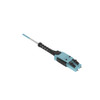
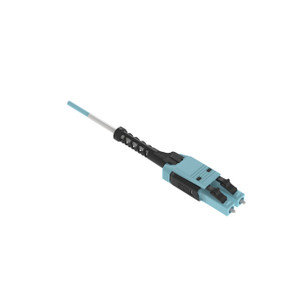
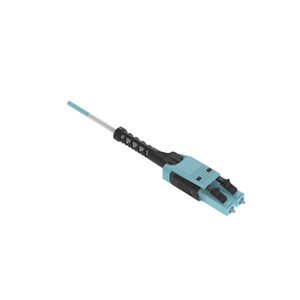
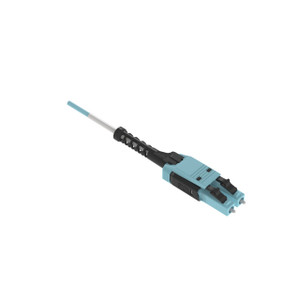
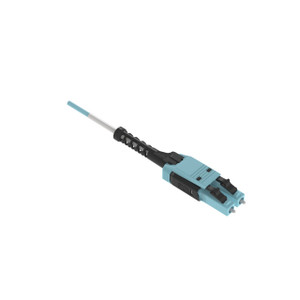
The Panduit FZ2RLU1U1ONM5.5 is a 5.5-meter OM4 duplex fiber patch cord built for data centers, enterprise switching closets, and any structured cabling environment where smoke toxicity and halogen content matter. It uses a 2.0mm LSZH (Low Smoke Zero Halogen) duplex jacket and LC Uniboot connectors with pull-boot design, and ships with optimized insertion loss — meaning you're not burning link budget on the patch cord before your signal even reaches the switch or transceiver. If you're specifying Panduit fiber optic systems for a project, this cord belongs in any OM4 backbone or horizontal run requiring plenum-equivalent safety in enclosed spaces.
OM4 multimode supports 100G Ethernet to 150 meters and 40G to 500 meters over laser-optimized 50/125µm glass. At 5.5 meters, the FZ2RLU1U1ONM5.5 is a patching length — trunk-to-switch, panel-to-panel, or appliance-to-patch-panel — where you want a cord long enough to route cleanly through a rack without stressing the bend radius, but short enough to keep link budgets tight and cable management tidy.
Key Features
OM4 Laser-Optimized Multimode Fiber: 50/125µm OM4 glass supports 100GbE up to 150m and 40GbE up to 500m — the right fiber tier for spine-leaf architectures and high-density switch interconnects running QSFP28 or QSFP+ transceivers. If your runs are under 100m, OM4 gives you overhead; if you're approaching 150m at 100G, every component including the patch cord matters.
LSZH Jacket — 2.0mm Duplex: Low Smoke Zero Halogen construction means that in a fire event, the jacket produces minimal toxic smoke and no halogen acid gases. This is the mandatory jacket type for enclosed public spaces, transit facilities, hospitals, and any jurisdiction where IEC 60332 or EN 50575 compliance is required. The 2.0mm outer diameter per strand keeps the cord flexible and manageable in tight patch panels without compromising bend performance.
LC Uniboot Connector with Pull-Boot: Uniboot packages both TX and RX fibers into a single connector body — half the connector footprint of a standard duplex LC pair. In high-density fiber optic patch panels with 48 or 96 ports per 1U, that density difference is real and measurable. The pull-boot design lets you disconnect the cord cleanly even when it's surrounded by adjacent cables — no fishing around with a pen cap or a flat-head.
Optimized Insertion Loss: Panduit specifies optimized insertion loss on this cord, meaning the connector end-faces are polished and inspected to a tighter loss budget than standard performance. Lower insertion loss means more usable link budget for your optical path — relevant when you're daisy-chaining through multiple patch points between a line card and an end device.
5.5-Meter Length — Rack-Friendly: 5.5m is long enough to route from a top-of-rack switch down to a mid-rack patch panel with a proper service loop, but short enough to avoid the cable management problems that come with excess slack. For adjacent-rack interconnects with a short overhead tray run, this length typically fits without cutting or bundling excess.
A-to-B Polarity (PI Optical): The cord ships with PI (straight-through) polarity — TX on one end maps to the same fiber position on the other. Confirm your overall link polarity scheme (TIA-568 Method A, B, or C) before ordering; PI patch cords are the correct choice for Method B deployments and for direct device-to-device connections without a trunk polarity flip.
Integration & Compatibility
This cord terminates in standard LC duplex footprint connectors on both ends (in a Uniboot body), so it mates with any LC-compatible SFP+, SFP28, or QSFP breakout transceiver, patch panel port, or fiber coupler. OM4 is backward compatible with OM3 infrastructure — you can mix OM4 patch cords into an OM3 system, though the link budget will be governed by the lower-performing OM3 segments. Do not mix OM4 with OM1 or OM2 fiber; the 50µm vs. 62.5µm core mismatch creates significant insertion loss and will cause link failures at higher data rates.
For enterprise network switch deployments, pair with OM4-rated SFP+ (10G), SFP28 (25G), or QSFP28 (100G) transceivers. Verify transceiver reach specifications against your actual fiber path length including all patch and splice points — 5.5m of patch cord is negligible in the budget, but the system calculation still applies. For structured cabling projects using fiber patch panels, the LC Uniboot form factor integrates directly with high-density panel ports designed for Uniboot or standard LC connectors.
Frequently Asked Questions
Q: What data rates does the FZ2RLU1U1ONM5.5 support?
A: As an OM4 multimode fiber cord, it supports 10GbE, 25GbE, 40GbE, and 100GbE at the patching distances involved (5.5m). OM4 is rated for 100GbE to 150m and 40GbE to 500m over laser-optimized 50/125µm fiber.
Q: What does LSZH mean and when is it required?
A: LSZH stands for Low Smoke Zero Halogen. In a fire event, LSZH-jacketed cables produce significantly less toxic smoke and no halogen acid gases compared to PVC. It is typically required by code in enclosed public spaces, transit systems, hospitals, data centers with limited ventilation, and jurisdictions following IEC 60332 or EN 50575 fire safety standards.
Q: What is the polarity of this patch cord?
A: The FZ2RLU1U1ONM5.5 ships with PI (straight-through) optical polarity — A-to-B. This is correct for TIA-568 Method B cabling systems and for direct device-to-device connections. Confirm your overall link polarity method before ordering.
Q: Can I use this cord with OM3 fiber infrastructure?
A: Yes, OM4 is backward compatible with OM3. However, the link will operate at OM3 performance levels — the link budget is set by the lowest-performing fiber in the path. Do not mix with OM1 or OM2 (62.5µm core); the core size mismatch causes unacceptable insertion loss.
Q: Does the LC Uniboot connector fit standard LC patch panel ports?
A: Yes. The LC Uniboot connector mates with any standard LC-compatible port — patch panels, transceivers, or couplers. The Uniboot body simply packages both TX and RX fibers into one housing rather than two separate connectors, reducing port footprint by approximately 50% in high-density panels.
Senior Specialist · Typically replies within 1 business day
Message sent!
A representative will reply to your email within one business day.
Build a complete system in one click
Manufacturer-verified compatible cameras, recorders, mounts, accessories, and licenses for this product.
Build Your Complete System
Manufacturer-verified compatible cameras, recorders, mounts, accessories, and licenses for this product. Adjust quantities and add the entire bundle to your cart in one click.