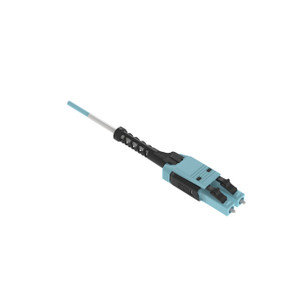
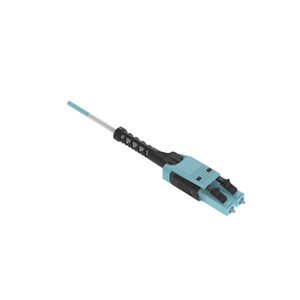
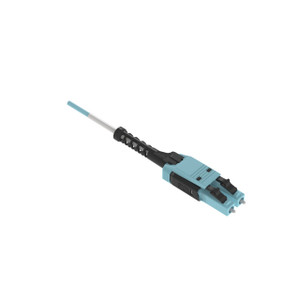
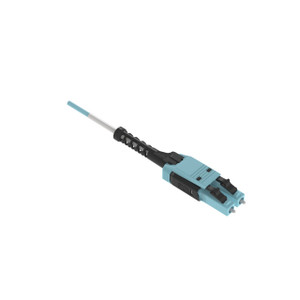
Panduit FZ2RLU1U1ONM4.5 OM4 LC Uniboot Duplex Fiber Patch Cord
Overview
The Panduit FZ2RLU1U1ONM4.5 is a 4.5-meter OM4 duplex fiber patch cord built around a 2.0mm LSZH-jacketed cable and LC Uniboot pull-boot connectors on both ends. It is designed for high-density structured cabling environments where polarity management, cable tray cleanliness, and fire/smoke code compliance are operational requirements — not afterthoughts. If you are running fiber in a data center, IDF closet, or any enclosed space subject to low-smoke zero-halogen codes, this is the cable tier to specify.
The Uniboot connector format is the key differentiator here. Rather than managing two separate LC simplex connectors per fiber pair, each end of the FZ2RLU1U1ONM4.5 presents a single, compact LC Uniboot housing that carries both fibers. That means roughly half the connector footprint per port compared to standard duplex LC — a real difference when you are patching 48 or 96 ports in a single panel.
Key Features
- OM4 Multimode Fiber: OM4 supports 40GbE and 100GbE at distances well beyond what OM3 can reliably handle. At 4.5 meters, this cord is purpose-built for switch-to-patch-panel or server-to-ToR connections where every dB of headroom matters at 40G and above.
- LC Uniboot Pull-Boot Connectors: The pull-boot design allows field polarity reversal without tools — you can flip A-to-B polarity on the connector itself rather than relabeling or re-routing cables. In a dense patch environment, this eliminates a significant source of installation errors and truck rolls.
- Optimized Insertion Loss: Panduit specifies optimized insertion loss on this cord, meaning each connector end is factory-tested and tuned to minimize signal attenuation. In a multi-hop fiber path, every connector loss compounds — starting with low-IL jumpers preserves link budget for longer reach and more cascaded connections.
- 2.0mm Cable Diameter: The 2.0mm outer diameter is a deliberate compromise between bend radius and flexibility. It routes cleanly through high-density trays and vertical managers without the stiffness of 3mm jacketed cables, while still providing more protection than 1.6mm slim-line cords in environments with moderate physical traffic.
- LSZH Jacket: Low-smoke zero-halogen jacketing is mandatory in plenum, riser, and enclosed-space deployments under IEC and EN fire codes. LSZH reduces toxic gas emission during combustion — the relevant factor for occupied data centers and healthcare facilities where evacuation time matters. This is not a premium for premium's sake: in LSZH-required environments, substituting PVC voids compliance.
- 4.5-Meter Pre-Terminated Length: Factory-terminated patch cords eliminate the field labor and test risk of field-polished connectors. At 4.5m, this length covers most intra-rack and short inter-rack runs without excess slack cluttering the cable tray.
- A-B Polarity: Ships in standard A-B (straight-through) polarity, compatible with the most common structured cabling polarity scheme. Combined with the Uniboot's field-reversibility, you are covered for both Method A and Method B deployments without stocking two SKUs.
Integration & Compatibility
The FZ2RLU1U1ONM4.5 terminates in standard LC Uniboot connectors, which seat in any LC-port SFP+, QSFP+ breakout, or LC-coupled fiber panel. It is compatible with Panduit fiber optic systems including OptiJack panels, FiberRunner cable management, and Panduit's high-density fiber enclosures. The OM4 glass is forward-compatible with OM5 equipment (OM5 transceivers will run at reduced distance on OM4 fiber — confirm link budgets for 400G applications). For structured cabling planning, review the fiber optic cable category for complementary trunks, enclosures, and adapter panels. If you are building out a high-density fiber backbone, pair this patch cord with compatible fiber patch panels and cable management solutions to maintain bend radius and organize inter-rack runs cleanly. For PoE network planning alongside your fiber infrastructure, the PoE switch category covers the copper-side infrastructure that commonly runs parallel to these fiber links in IP security deployments.
Frequently Asked Questions
Q: What fiber type is the FZ2RLU1U1ONM4.5 — OM3 or OM4?
A: It is OM4 multimode fiber. OM4 supports higher bandwidth and longer reach than OM3, making it suitable for 40GbE and 100GbE applications within data center and high-density IDF environments.
Q: Can I reverse polarity on the LC Uniboot connectors without replacing the cable?
A: Yes. The LC Uniboot pull-boot design allows field polarity reversal on the connector itself — no tools required. This lets you switch between A-B and B-A polarity at the point of installation without stocking separate SKUs or re-routing cables.
Q: Is the LSZH jacket required for my installation, or is PVC acceptable?
A: LSZH is required in enclosed spaces, plenum, riser, and certain healthcare or public-occupancy environments under IEC/EN fire and building codes. If your installation is in an open data center floor with adequate ventilation and no LSZH mandate, PVC is typically acceptable. Verify your local fire and building codes before specifying jacket type.
Q: What connector format does the FZ2RLU1U1ONM4.5 use, and what equipment does it fit?
A: It uses LC Uniboot connectors — a single housing per end that carries both fibers. These seat in any standard LC-port transceiver (SFP+, QSFP+ with LC breakout) or LC-coupled fiber patch panel. The connector is physically identical to a standard duplex LC in terms of port compatibility.
Q: What does 'optimized insertion loss' mean in practice for this patch cord?
A: It means each connector end is factory-tested and finished to minimize signal attenuation at the connection point. In a multi-hop fiber link, connector loss accumulates — starting with low insertion loss jumpers preserves link budget, which is especially relevant in longer backbone runs or cascaded patch environments.
Q: Is the 4.5-meter length appropriate for inter-rack connections?
A: 4.5 meters covers most intra-rack runs and short inter-rack connections in standard 600mm or 800mm aisle configurations. For longer inter-rack or row-to-row runs, evaluate pre-terminated trunk cables or longer individual patch cords from the same Panduit fiber family.
The detail I keep coming back to on the FZ2RLU1U1ONM4.5 is the Uniboot connector combined with LSZH jacketing in a single SKU. Most integrators are used to specifying these two features separately — Uniboot for density, LSZH for code compliance — and then discovering their preferred vendor doesn't stock both together at 4.5m. Panduit combines them here, which matters when you are outfitting a healthcare data closet or a transit authority comms room where both the density requirement and the smoke-toxicity code are non-negotiable.
Technical Highlights:
- OM4 Glass at 4.5m: OM4 supports 40GbE to 150m and 100GbE to 100m — at 4.5m you are well within the performance envelope for any current-generation SFP+ or QSFP28 transceiver, with significant headroom for link budget accumulation across multiple connection points.
- LC Uniboot Pull-Boot Polarity Reversal: Field-reversible polarity without tools means one SKU handles Method A and Method B structured cabling schemes. That is a real reduction in stocking complexity on large projects with mixed polarity requirements.
- 2.0mm LSZH Jacket: The 2.0mm diameter threads through high-density trays and vertical managers more cleanly than 3mm cords, while the LSZH formulation satisfies IEC 60332, IEC 60754, and IEC 61034 emission requirements — the three tests that actually matter for occupied-building certifications.
Deployment Considerations:
- Verify transceiver polarity requirements before bulk-ordering: LC Uniboot pull-boot reversal is fast in the field, but it adds a step per port if your panel uses a non-standard polarity scheme. Map polarity across your link before procurement.
- The 4.5m length is fixed — factory-terminated patch cords cannot be field-shortened. If your rack spacing varies significantly (sub-2m intra-rack vs. 4m+ inter-rack), you will need to stock a second length to avoid excess slack management in tight cable trays.
This cord is well-positioned for high-density IDF builds in healthcare, higher education, and enterprise campuses where LSZH is a hard specification requirement and patch panel real estate is at a premium. If you are populating 48-port fiber panels across multiple IDFs, the Uniboot format alone justifies the specification over standard duplex LC.