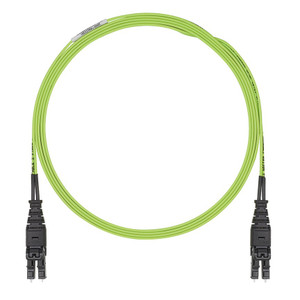
Panduit FZ2ERQ1SNSNM038 QuickNet OM4 2-Fiber LC/SC Duplex Fiber Assembly - 38m OFNR
Pre-terminated fiber assemblies eliminate field termination risk and cut deployment time by 70% compared to on-site splicing. The Panduit FZ2ERQ1SNSNM038 delivers factory-terminated OM4 multimode fiber in a 38-meter LC-to-SC duplex configuration, purpose-built for data center core-to-distribution uplinks, equipment migration scenarios requiring backwards compatibility between legacy SC infrastructure and modern LC switches, and telecommunications horizontal trunking where OFNR riser rating and guaranteed performance matter. Push-pull connector boots and 1.6mm cable diameter enable high-density patching in congested rack environments while maintaining full TIA-568.3-D and ISO/IEC 11801 compliance for 10GBASE-SR, 40GBASE-SR4, and 100GBASE-SR10 applications.
Key Features
- OM4 50/125µm multimode fiber — 550m reach at 10Gb/s (850nm), 150m at 40Gb/s, 100m at 100Gb/s, with 4700 MHz·km effective modal bandwidth for future-proof infrastructure
- LC-to-SC duplex hybrid configuration — connects modern LC-equipped switches and transceivers to legacy SC patch panels and trunk cables without adapters or conversion kits
- Factory-terminated and tested — each assembly serialized with test data, insertion loss <0.35 dB typical, return loss >26 dB, eliminates field termination inconsistency and labor cost
- OFNR riser-rated jacket — meets NEC Article 770 for vertical riser pathways, approved for use between floors in non-plenum spaces without additional conduit
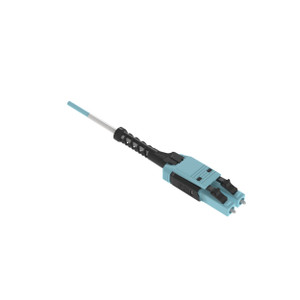
- Push-pull connector boots — latch-free disconnection in tight spaces, reduces accidental disconnects, color-coded aqua for instant OM4 identification in mixed-fiber environments
- 1.6mm diameter cable — tight-buffered construction with aramid yarn strength members, supports minimum 20x bend radius (32mm) for dense patch panel routing without performance degradation
- 38-meter optimized length — ideal for floor-to-floor vertical runs (typical 3-4 floor span), row-to-row horizontal trunking in warehouse or campus installations, or equipment room to entrance facility links
- TIA/ISO/ANSI compliance — conforms to TIA-568.3-D Category OM4 specifications, ISO/IEC 11801 Class OM4, and ANSI/TIA-942-B data center infrastructure requirements for Tier III/IV deployments
OM4 Fiber Performance and Connector Quality: The 50/125µm OM4 multimode fiber delivers 4700 MHz·km effective modal bandwidth at 850nm, supporting 10GBASE-SR Extended (10 Gigabit Ethernet) to 550 meters — more than double OM3's 300-meter limit — and enabling 40GBASE-SR4 to 150 meters and 100GBASE-SR10 to 100 meters. This bandwidth headroom future-proofs installations against next-generation 200G and 400G standards while maintaining backwards compatibility with 1G and 10G equipment. Factory-terminated LC and SC connectors use precision ceramic ferrules with Physical Contact (PC) polish, achieving typical insertion loss below 0.35 dB and return loss exceeding 26 dB across the 850nm and 1300nm windows. Each connector undergoes automated endface inspection and interferometric testing before leaving Panduit's controlled manufacturing environment, ensuring geometric compliance with IEC 61755-3-1 and eliminating the 30-50% field-termination failure rate common to on-site fusion splicing or mechanical splice installations. The tight-buffered cable construction encases each 50µm core and 125µm cladding in a 900µm protective buffer, surrounded by aramid yarn (Kevlar) strength members rated to 100N pull tension, preventing core damage during installation pulls through conduit or cable tray. The aqua-colored OFNR jacket meets UL 1666 riser flame test requirements and remains flexible across -20°C to +60°C operating range, critical for unheated telecom huts or rooftop entrance facilities in extreme climates.
Deployment Context and Hybrid LC/SC Applications: The LC-to-SC hybrid termination solves a common migration pain point: enterprise data centers upgrading from 1G to 10G infrastructure typically inherit SC-terminated trunk cables and patch panels installed in the early 2000s, while modern 10G switches, storage arrays, and server NICs universally ship with LC or MPO transceivers. This assembly eliminates the need for bulky SC-to-LC conversion cassettes or duplex adapters that add insertion loss, create failure points, and consume valuable rack space. Connect the LC end directly to SFP+ or QSFP+ transceiver modules in core switches, storage controllers, or fiber channel directors, and the SC end to existing 12-strand or 24-strand SC trunk cables running to distribution frames — preserving existing structured cabling investment while enabling 10G speeds. The 38-meter length bridges typical data center topologies: main distribution area (MDA) to horizontal distribution area (HDA) in adjacent rows (20-35m typical run), ground-floor equipment room to second-floor telecommunications room in low-rise buildings (30-40m vertical span including pathway routing overhead), or entrance facility to main cross-connect in campus headend installations. Push-pull connector boots prove critical in these high-density scenarios: standard LC boots require thumb-and-forefinger pinch access on both sides of the connector, impossible in fully populated 144-port LC patch panels with <6mm port spacing. Push-pull designs allow single-finger actuation from the front, enabling blind disconnection in rear-access racks or overhead cable management zones where visibility is limited. The 1.6mm cable diameter — versus 2.0mm or 3.0mm distribution-grade cables — permits tighter bend radii (32mm minimum vs. 50mm+) and denser bundling in vertical managers or horizontal wire guides without exceeding pathway fill ratios or inducing macrobend attenuation.
TIA-568.3-D and ISO/IEC 11801 compliance guarantees the assembly meets Category OM4 insertion loss budgets (≤3.5 dB per channel including connectors and splices over 550m), return loss minimums (≥26 dB), and geometric endface specifications required for equipment manufacturer warranty coverage — Cisco, Juniper, Arista, and Brocade all mandate standards-compliant fiber infrastructure as a condition of transceiver and switch support agreements. ANSI/TIA-942-B certification extends this compliance to data center-specific requirements: Tier III and Tier IV topologies require diverse path redundancy and concurrent maintainability, which depends on trunk cable identification, polarity management, and connector durability under 20+ mate/demate cycles. Panduit's QuickNet factory-termination process includes per-assembly serialization with traceable test data (insertion loss, return loss, length, endface geometry), allowing integrators to document as-built performance for DCIM systems and maintain chain-of-custody records for compliance audits. Pre-terminated assemblies also eliminate the silica dust exposure risk inherent to on-site cleaving and polishing operations, reducing jobsite PPE requirements and aligning with OSHA crystalline silica exposure limits for enclosed workspace installations. For integrators managing multi-site rollouts or rapid deployment schedules, factory-terminated assemblies collapse the critical path: no field termination training, no fusion splicer rental and calibration delays, no endface inspection equipment or cleaning supplies logistics — the assembly ships ready to plug in, test, and commission, compressing installation timelines from days to hours and reducing per-drop labor cost by 60-70% compared to field-terminated alternatives.