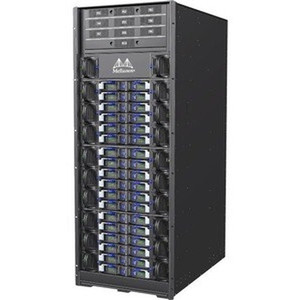
NVIDIA MCS7520 43TB/s 216-Port EDR InfiniBand Chassis Switch
The NVIDIA MCS7520 is a 216-port EDR InfiniBand chassis switch engineered for data center fabric deployments where throughput and port density directly drive infrastructure ROI. At 43TB/s aggregate switching capacity, this switch handles the sustained, lossless communication demands of HPC clusters, GPU-accelerated analytics platforms, and high-frequency trading environments where microseconds of latency matter and packet loss is unacceptable.
Overview
The MCS7520 is a modular, fixed-configuration switch built for scale-out compute clusters and storage-intensive workloads. The 216-port architecture supports dense node-to-node and node-to-storage connectivity without requiring cascading fabrics; a single chassis can serve as a single-tier network for mid-to-large clusters or as a building block in larger multi-tier Clos topologies. The switch ships with eight redundant cooling fans and four power supplies, delivering the availability posture required in production environments.
Key Features
- 43TB/s Aggregate Bandwidth: Supports simultaneous, non-blocking communication across all 216 ports when fully populated—critical for workloads that saturate NIC bandwidth and cannot tolerate fabric congestion or oversubscription.
- 216 EDR Ports: Native EDR (Enhanced Data Rate) connectivity means 100Gbps per port out-of-the-box without bridge adapters or protocol converters. Direct attachment to GPU nodes and storage arrays eliminates translation overhead.
- Eight Redundant Fans: Multiple cooling units ensure continued operation if a single fan fails; thermal monitoring automatically adjusts fan speed based on inlet temperature, balancing noise and power draw in a 550 lb chassis.
- Four Integrated Power Supplies: N+1 redundancy on power delivery means the switch tolerates loss of one PSU without interruption. Total input capacity distributes load evenly and supports hot-swap replacement without bringing down the fabric.
- Modular Form Factor: 39″ (L) × 34″ (W) × 41″ (H) footprint fits into standard 19-inch rack infrastructure with appropriate mounting rails. Weight of 550 lbs requires proper rack bracing and PDU planning for sustained multi-cabinet deployments.
- Lossless Fabric Technology: InfiniBand's credit-based flow control prevents packet loss across the fabric—guaranteed delivery at line rate, a foundational requirement for distributed filesystems (Lustre, GPFS) and MPI applications.
Integration & Compatibility
The MCS7520 operates as a standalone layer-1 fabric switch; it integrates with any InfiniBand-attached node (compute, GPU, storage, I/O gateway) that supports EDR hardware. Multi-tier deployments require additional management software for subnet assignment and path discovery—this switch does not include VMS or unified management out-of-the-box. Rack-mounted configuration demands proper thermal planning: six-post racks with active hot-aisle containment are recommended when deploying multiple chassis in adjacent positions.
Frequently Asked Questions
Q: Is the MCS7520 suitable for a single 8-node GPU cluster?
A: Yes, but you would be using roughly 48 of the 216 ports, leaving significant overprovisioning. For small clusters (under 32 nodes), a smaller switch or partial fabric may reduce CapEx. For clusters that expect growth, the MCS7520 is a one-time investment that scales up to full population without fabric redesign.
Q: What is the power consumption of the fully loaded MCS7520?
A: The switch itself (without node attachments) draws power via four internal PSUs; exact consumption depends on fan speed and port utilization. Consult the detailed specifications or contact pre-sales engineering for PDU sizing on a per-deployment basis.
Q: Can I mix EDR and older InfiniBand speeds (FDR, QDR) on the same fabric?
A: EDR switches are backward compatible with FDR and older protocols via speed negotiation, but links will run at the slower speed. This wastes bandwidth and is generally avoided in production. Plan node refresh cycles to align with fabric upgrades.
Q: What cooling infrastructure do I need in my data center?
A: The eight integrated fans handle internal thermal management. Ensure your data center provides cold air intake (front-bottom inlet) and adequate exhaust capacity (rear-top outlet). In dense environments, active hot-aisle containment is strongly recommended.
Q: Is this switch NDAA or FIPS-certified?
A: Certification status varies by software configuration and is not stated in the standard product specification. Contact pre-sales engineering to confirm compliance requirements for your procurement.
Q: What warranty is provided?
A: Warranty terms are available through the channel. Consult the sales contact or documentation provided at order time.
The MCS7520's 43TB/s aggregate switching capacity and 216-port density make it a legitimate centerpiece for data center fabric buildouts where you're not just upgrading—you're scaling to support sustained parallel workloads. I've seen the MCS7520 deployed in GPU computing clusters where every port filled reduces the fabric hops and latency jitter that kill weak-scaling efficiency on distributed training jobs.
Technical Highlights:
- EDR (100Gbps per port): Native line-rate support across all 216 ports eliminates protocol bridging overhead. In Lustre and GPFS deployments, this translates directly to reduced metadata latency and higher aggregate throughput for checkpoint-restart cycles on large simulations.
- 43TB/s Non-Blocking Switching: You're paying for a fabric that does not oversubscribe internal bandwidth. Every port can transmit at line rate simultaneously without queueing or tail-drop—foundational for MPI applications where synchronization barriers hide congestion instantly.
- Four Power Supplies + Eight Fans: N+1 redundancy on both power and cooling means unplanned downtime is equipment failure, not infrastructure neglect. In production HPC, even a 2-hour unscheduled maintenance window costs money; redundancy buys you predictability.
Deployment Considerations:
- At 550 lbs in a 39″ × 34″ × 41″ footprint, this is not a switch you mount in a shallow wall cabinet. Plan for 19-inch racks with proper bracing; thermal exhaust is substantial when fully populated, so active hot-aisle containment is not optional in densely packed data centers.
- A single 216-port switch scales to roughly 100–200 compute nodes depending on your host-to-fabric ratio (1:1 vs. multi-hop fabric). Beyond that population, you're building a Clos topology with multiple chassis—which changes sparing strategy and introduces inter-switch link provisioning decisions.
Best fit: GPU compute clusters running distributed training (PyTorch, TensorFlow), HPC simulations with tight synchronization, or high-frequency financial infrastructure where every microsecond of fabric latency is measurable cost. Not the switch for oversubscribed cloud multi-tenancy or edge consolidation.