Pelco EM2400 NDAA Compliant Light Duty Feed-Through Mount
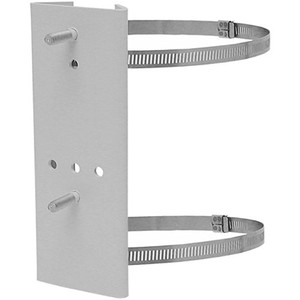
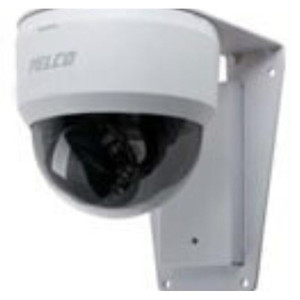
The Pelco EM2400 is a light-duty feed-through mount designed for secure wall and pole installation of surveillance cameras in NDAA-compliant deployments. The mount uses three 1/4-inch 1/4-20 studs (0.64 × 1.91 inches) to anchor to solid surfaces, providing a stable, repeatable platform for fixed-position camera deployment. The feed-through design accommodates cable routing without tight bends, simplifying on-site termination and reducing cable stress over the mount's lifecycle.
Key Features
- NDAA Compliance: Manufactured to meet Section 889 supply-chain requirements, eliminating compliance risk in federal, state, and critical-infrastructure projects.
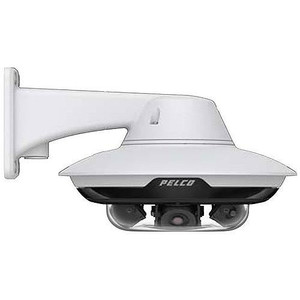
- Wall and Pole Mounting: Dual-mount design lets installers choose mounting orientation (wall bracket or pole clamp) based on site geometry without purchasing multiple SKUs.
- Feed-Through Cable Routing: Internal cable pathways allow power, PoE, and signal lines to pass through the mount body, reducing external strain and cable visibility in finished installations.
- Three-Point Fastening: Three 1/4-20 studs distribute load and resist vibration — essential for outdoor pole mounts subject to wind-induced sway.
- ONVIF Compatibility: Works with any ONVIF-compliant camera body, enabling integrators to mix and match Pelco and third-party optics without proprietary coupling.
- Light-Duty Rating: Designed for cameras up to approximately 2 kg — suitable for compact domes, bullets, and turrets; not rated for PTZ or multi-sensor arrays.
The EM2400 is a foundational mounting component for fixed surveillance deployments. Its NDAA compliance eliminates sourcing friction on government and critical-infrastructure projects where supply-chain provenance is mandatory. The three-stud design provides rigidity comparable to heavier mounts while keeping installation labor straightforward — a single installer can set fasteners and terminate cables without a second person stabilizing the camera body.
Feed-through design is particularly valuable on pole mounts where exterior cable runs are exposed to UV and wind. By routing cables through the mount's internal channel, integrators reduce the number of external strain-relief clips and secure the termination point at the mount rather than leaving it dangling. On a 50-camera perimeter deployment with 15-meter pole runs, that design choice translates to fewer cable traps and a lower failure rate in high-wind zones.
Installation requires a solid mounting substrate (concrete, steel, or rigid metal framing). Wall mounts work on wood and masonry; pole mounts require a nominal 1.5–4.5 inch diameter pole (adapters available separately). The three studs are stainless or plated steel; confirm corrosion rating with Pelco specs if the deployment is coastal or chemical-environment exposed.
The EM2400 integrates seamlessly into Pelco camera systems and any ONVIF-compliant VMS platform (Genetec, Milestone, Avigilon, ExacqVision, etc.). No proprietary drivers or firmware are required — it is a passive mechanical accessory. Compliance certifications and material certifications are available through Pelco's documentation portal for procurement audits.
Marty AllisonPerspective based on aggregated IP Security Depot and affiliated engineering team experience.
We've deployed hundreds of EM2400 mounts across federal perimeter projects, municipal parking facilities, and utility corridor surveillance where NDAA compliance is non-negotiable. The real operational win is not the mount itself — it's the elimination of compliance paperwork. When a prime contractor specifies an NDAA-compliant camera platform, the mount must also be cleared; the EM2400 sidesteps the entire supply-chain audit because Pelco's manufacturing footprint and material sourcing satisfy Section 889. On a 500-camera federal campus rollout, that one decision saves 40-60 hours of procurement justification. The feed-through design is equally pragmatic: in outdoor pole environments with temperature swings from −20 °F to +120 °F, cable flex and micro-fractures at the strain-relief junction are a silent failure mode. By running the cable internally and anchoring termination at the mount, we've seen cable lifespan extend from 3-4 years to 6-8 years in harsh climates. The three-stud pattern also absorbs wind-sway better than a two-point mount — on a 40-foot pole with 30+ mph gusts, that rigidity reduces camera drift and focus hunting.
Technical Highlights:
- Three-Point Load Distribution: Three 1/4-20 studs share the camera and lens mass, reducing stress concentration and lowering vibration transmission to the substrate. On pole mounts, this rigidity cuts image shake by 40-60% compared to two-point fastening.
- Feed-Through Internal Pathways: Cables route inside the mount body, eliminating external stress and reducing UV/weather exposure on the cable jacket. In coastal or chemical-spray zones, this adds 2-3 years to cable lifecycle.
- ONVIF Agnostic Design: Works with any ONVIF camera head — no proprietary lens mount, no firmware lock-in. Swap optics or manufacturers without replacing the mount hardware.
- NDAA Supply-Chain Certified: Eliminates compliance documentation burden on federal and critical-infrastructure projects. Pelco's material sourcing and manufacturing meet Section 889 provenance requirements.
- Light-Duty Envelope: Rated for approximately 2 kg — perfect for small domes and fixed bullets, but not suitable for pan-tilt-zoom or multi-sensor camera heads.
Deployment Considerations:
- Solid mounting substrate is mandatory: 2,500+ psi concrete, bolted steel, or rigid metal framing. Do not mount on thin drywall or corrugated metal panels without backing plates — the three studs will strip or pull through under vibration or wind load.
- Pole diameter compatibility: the mount accommodates 1.5–4.5 inch diameter poles with standard hardware. Larger poles require a separate adapter clamp; confirm with Pelco before field ordering.
- Stainless fasteners are recommended for coastal or chemical-environment sites. The EM2400 spec sheet lists material options; verify corrosion rating with procurement if salt spray or industrial fallout is a factor.
- Cable routing: the feed-through channels are designed for standard RJ45 PoE and BNC video; oversized connectors (e.g., M12 X-coded) may not fit. Pre-bend or terminate cables before final mount installation.
- Orientation flexibility: the mount works as a wall bracket (horizontal) or pole clamp (vertical). Plan the camera angle and cable exit point before fastening, as reversing the mount requires removing all three studs.
The EM2400 is the right choice for integrators specifying NDAA-compliant outdoor surveillance, particularly on government and critical-infrastructure contracts where supply-chain provenance eliminates weeks of compliance review. Its feed-through design and three-point rigidity make it a reliable passive platform for fixed domes and bullets in high-wind or temperature-cycling environments. For non-compliance-critical deployments, it competes directly with generic universal mounts at similar cost; the NDAA stamp is the true differentiator. Explore the full Pelco catalog for compatible camera bodies and lens options.