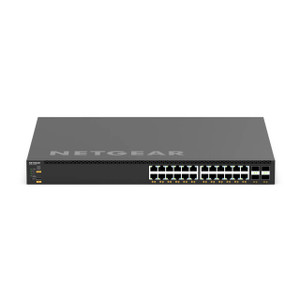
NETGEAR XSM4328CV-TAANES Managed Switch
Overview
The NETGEAR M4350-24X4V (model XSM4328CV-TAANES) is a 24-port 10G managed switch with four 40G uplink ports, built for enterprise edge deployments, AI compute clusters, and data center environments where you need predictable, low-latency connectivity across dozens of servers, storage nodes, or security appliances without the overhead of consumer-grade switching.
This is a factory-new unit sourced direct from the manufacturer or US direct manufacturer source, with full manufacturer warranty and no grey-market inventory — a critical baseline when integrating into compliance-sensitive networks (federal, healthcare, financial). The XSM4328CV-TAANES TAA designation confirms suitability for US government procurement workflows.
Key Features
- 24x 10 Gigabit Ethernet ports: Each port sustains wire-rate 10G throughput, so you're not bottlenecking 25G and 40G-capable servers or NVRs with undersized interconnect. This matters when you're running parallel backup streams, multi-camera ingest, or distributed AI inference across a cluster.
- Four 40G uplink ports: Aggregate traffic from the 24x 10G ports upstream to your core switch or data center fabric without congestion. A 40G uplink can absorb combined traffic from four 10G ports running at full capacity — the math scales smoothly for spine-and-leaf architectures.
- Layer 2 and Layer 3 switching: Managed switching means you can segment traffic with VLANs, apply quality-of-service (QoS) policies to prioritize security camera streams or critical AI model training, and use static or dynamic routing protocols for multi-site failover. Not a dumb switch — every port is addressable and controllable.
- Power budget and cooling: Built for 24/7 rack operation; verify your PDU capacity and cooling airflow before installation, as 10G switching at full density generates sustained heat. Confirm power specifications in your datacenter planning — typical managed switches at this tier draw 200–400W depending on optical module density.
- Web GUI, CLI, and SNMP management: Control via browser interface, command-line SSH, or standard SNMP monitoring tools (Nagios, Zabbix, Prometheus). No vendor lock-in to proprietary management platforms — integrates with open-source and enterprise monitoring stacks equally.
- Compact 1U rack footprint: Fits standard 19-inch relay racks and network cabinets without special adapters. Plan for front-to-back airflow and adequate patch panel real estate — 24 SFP+ ports plus 4x 40G QSFP+ consume cabling and connector space quickly.
Integration & Compatibility
The XSM4328CV-TAANES is platform-agnostic at Layer 2/3 — it carries IP traffic from any vendor: Axis IP cameras, Hikvision NVRs, Uniview edge AI boxes, x86 compute, ARM-based appliances, and cloud gateway hardware all coexist on the same fabric. VLAN tagging lets you isolate security cameras from production networks without physical port separation. SNMP traps and syslog forwarding integrate with enterprise security information and event management (SIEM) platforms for switch health alerting.
TAA certification means it complies with US Trade Agreements Act procurement rules — essential if you're selling into federal, state, or local government end-users, or integrating into prime contractor supply chains.
Frequently Asked Questions
Q: Is the XSM4328CV-TAANES suitable for a surveillance network with 50+ IP cameras?
A: Yes. A typical 5MP IP camera consumes 2–4 Mbps of sustained bandwidth at 30 fps. 50 cameras running 24/7 = 100–200 Mbps total, well within the 10G per-port capacity. Use VLANs to isolate camera traffic from production data, and apply QoS to ensure camera streams don't starve during backup windows.
Q: What is the warranty on the XSM4328CV-TAANES?
A: Full manufacturer warranty applies. Verify the warranty term (typically 1–5 years depending on support tier) at point of purchase. Factory-new units carry coverage from the ship date.
Q: Does the XSM4328CV-TAANES support redundant power supplies?
A: Confirm power supply architecture in the technical datasheet. Many managed switches in this class offer optional dual-PSU configurations for N+1 redundancy — critical for always-on surveillance and AI compute.
Q: Can I use standard Ethernet cabling with the 10G ports?
A: The XSM4328CV-TAANES uses SFP+ module form factor on the 24 main ports. You'll need SFP+ optical transceivers (LC connector, typically single-mode fiber for distance or OM3/OM4 multimode for short runs) and matching cabling. Copper RJ45-to-SFP+ DAC (direct-attach copper) cables work for under 3 meters; fiber is cleaner for structured cabling.
Q: Is the XSM4328CV-TAANES NDAA Section 889 compliant?
A: NETGEAR products qualify as TAA-compliant goods for federal procurement. Confirm NDAA Section 889 status (Huawei, ZTE, Kaspersky, and certain supply-chain restrictions) with your procurement office or reseller if you're subject to DFARS or government acquisition rules.
The XSM4328CV-TAANES is a no-nonsense enterprise switch for infrastructure environments where you need density without compromise. The 24x 10G port count plus four 40G uplinks gives you a solid spine-and-leaf foundation for medium-scale deployments — think: 50–200 camera cluster, distributed AI inference workload, or mixed-media enterprise edge with video, storage, and compute all converged on the same fabric.
Technical Highlights:
- 24x 10 Gigabit ports with 4x 40G uplinks: You get 240 Gbps of 10G throughput (24 ports × 10 Gbps) plus four 40 Gbps uplink channels. That's real oversubription math — not a problem if you're not running every port at saturation simultaneously. For surveillance, you're typically seeing 2–5% utilization per camera, so this architecture easily absorbs 100+ simultaneous streams without QoS grief.
- Layer 3 routing with VLAN support: Don't get stuck with flat broadcast domains. Carve isolated segments for security cameras (VLAN 100), storage (VLAN 200), production servers (VLAN 300), and guest/management (VLAN 400) without burning physical ports. Managed switches enforce policies at line rate — VLAN traversal adds zero latency.
- TAA certification for federal procurement: If you're building a system for a US government agency, state health department, or prime contractor, the TAA stamp removes a compliance checkbox. No special sourcing negotiation — it's baked into the model.
Deployment Considerations:
- SFP+ modules are not included — budget for 24 optical transceivers (typically $50–150 each depending on multimode fiber vs. single-mode, and distance). Copper DAC cables (direct-attach copper) are cheaper for short runs (under 3m), but thermal and bend-radius can be a pain in tight cabinets.
- The 40G uplinks use QSFP+ modules — another set of transceivers to spec and procure. Older core switches may still be 10G, so verify uplink port compatibility before ordering. A 40G port connected to a 10G core means you're bottlenecked to 10G per that link.
- Power draw scales with transceiver type (active SFP+ units draw more than passive fiber modules). Typical range 200–400W — confirm your PDU has headroom and your cooling can handle continuous operation in a closed-front rack.
Deploy this switch when you need reliable Layer 2/3 segmentation for a mixed-workload edge or satellite data center — surveillance cameras, NVR appliances, edge AI boxes, and x86 compute all breathing on the same fabric without a $100K premium firewall appliance. It's not flashy, but it scales, and it integrates.