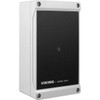
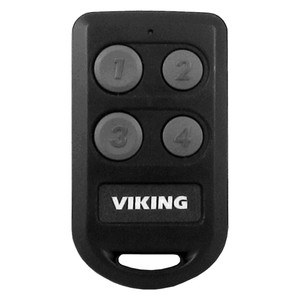
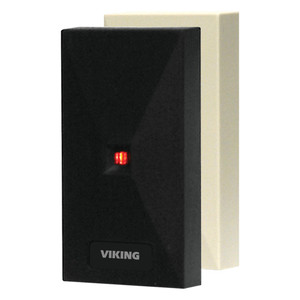
Viking Electronics LRR-4 Long Range 4-Channel Wireless Access Receiver
Overview
The Viking Electronics LRR-4 is a 4-channel, 433 MHz long-range wireless receiver engineered for access control deployments where cabling to the credential read point is impractical or cost-prohibitive. Delivering up to 400 feet of RF range and a 26-bit Wiegand output, the LRR-4 integrates directly into existing access control systems without requiring a proprietary controller — if your panel accepts a standard Wiegand reader, this unit speaks its language. Paired with the LRT-4 transmitter (often searched as LRR 4 in its keyfob form), the system gives you four independently coded buttons, each mapped to a discrete Wiegand data stream, so one receiver can manage up to four access zones or functions.
The receiver ships in a NEMA 4/4X-rated enclosure, making it appropriate for outdoor gate posts, covered parking structures, or industrial perimeters where weather exposure is a real factor. The 125 kHz HID-compatible proximity module built into the LRT-4 transmitter means users can present the fob like a standard prox card at close range — a meaningful UX detail at unmanned entry points. For a broader look at the Viking Electronics access and intercom line, the LRR-4 sits within a product family that spans intercoms, emergency phones, and door controllers.
Key Features
- 400 ft RF Range at 433 MHz: The receiver operates at 433 MHz with an adjustable read range up to 400 feet — practical for gated driveways, loading dock approaches, or parking lot entry lanes where a wired reader would require trenching. Adjustable range lets you tighten coverage deliberately to prevent phantom reads from adjacent lanes.
- 4-Channel Wiegand Output (26-bit): Each of the four transmitter buttons delivers a distinct 26-bit Wiegand code to the receiver's terminal block. That maps cleanly onto standard access panels (Lenel, Software House, HID VertX, and comparable platforms) — no custom driver, no middleware. One LRR-4 can feed up to four reader inputs on your panel.
- Optional External Antenna Connector: If the standard internal antenna can't overcome a structural obstruction — a metal gate post, a masonry wall in the RF path — the external antenna connector lets you mount a remote antenna where line-of-sight is recoverable without relocating the receiver enclosure.
- 125 kHz HID-Compatible Proximity Module: The LRT-4 transmitter doubles as a proximity credential at close range, reading as an HID-format prox card. This matters in mixed deployments where some lanes have a conventional prox reader and others use the long-range RF — the same fob works both scenarios for end users.
- NEMA 4 / 4X Enclosure: The receiver housing is rated NEMA 4 and 4X, meaning it withstands direct water ingress (hose-down, driving rain) and is corrosion-resistant. Deploy it on a gate post or exterior wall without a secondary weatherproof box.
- CR2032 Lithium Transmitter Battery: The LRT-4 runs on a standard CR2032 3V lithium coin cell — available everywhere, no proprietary battery, and end-user replaceable without tools or service calls.
- 12 VDC Receiver Power at 120 mA: The receiver draws a nominal 12 VDC at 120 mA. That's a small load on any access control power supply — compatible with the panel's auxiliary power output in most installations, no separate transformer required.
- Transducer and LED Indicators: The receiver includes both an audible transducer and LED output, giving on-board confirmation of successful reads — useful during commissioning to verify RF link at range without needing a second person at the panel.
- CE Mark Compliance: The LRR-4 carries CE marking, confirming it meets European electromagnetic compatibility and safety directives — relevant for deployments with EU compliance requirements or multi-region projects.
Integration and Compatibility
The LRR-4 outputs standard 26-bit Wiegand data, which is the de facto format for access control readers and keypads. Verify your panel supports four independent Wiegand reader inputs if you intend to use all four channels simultaneously — some panels share a single reader port and would require a multiplexer or additional input module. Per the SIA Wiegand specification, maximum cable run from receiver to panel is 400 feet (121.92 m); shield drain continuity must be maintained end-to-end. If your panel room is beyond that run, plan accordingly or consider a Wiegand extender inline. The LRT-4 transmitter's 125 kHz HID-compatible prox module provides an additional close-range read method — confirm your access panel's reader port handles both RF-sourced and prox-sourced Wiegand reads on the same input if you plan to use both modes at a single lane. For sites combining wireless entry with access control panel infrastructure, the LRR-4 is a direct wire-in solution that avoids proprietary gateways.
Frequently Asked Questions
Q: What is the maximum wireless range of the LRR-4?
A: The LRR-4 supports an adjustable read range up to 400 feet (approximately 121 meters) between the LRT-4 transmitter and the receiver, subject to line-of-sight conditions and RF environment. An optional external antenna connector is available to help recover range in obstructed installations.
Q: Does the LRR-4 output standard Wiegand data that my access control panel will recognize?
A: Yes. The receiver outputs 26-bit Wiegand data per the SIA Wiegand specification on a terminal block with four independent channel outputs. Any access panel with a standard 26-bit Wiegand reader input is compatible — no proprietary protocol or middleware is required.
Q: Can the LRR-4 receiver be mounted outdoors?
A: Yes. The LRR-4 receiver enclosure is rated NEMA 4 and NEMA 4X, meaning it is suitable for outdoor installations exposed to rain, hose-down conditions, and corrosive environments. No additional weatherproof enclosure is required for standard outdoor mounting.
Q: What battery does the LRT-4 transmitter use, and can end users replace it?
A: The LRT-4 transmitter uses a standard CR2032 3V lithium coin cell. This battery is widely available at retail and can be replaced by the end user without tools or a service call.
Q: How many access zones or functions can one LRR-4 receiver handle?
A: The LRR-4 provides four independent Wiegand output channels, one per button on the LRT-4 transmitter. This allows a single receiver to control up to four distinct access zones, relay functions, or panel inputs simultaneously.
Q: What is the maximum cable run from the LRR-4 receiver to the access control panel?
A: Per the SIA Wiegand specification, the maximum cable length from receiver to panel is 400 feet (121.92 m). Shield drain continuity must be maintained along the full run from receiver to panel for reliable data transmission.
I've specified the LRR-4 on several gated community and light industrial projects where the entry lane approach was too long for a conventional wired reader — 400 feet of RF range at 433 MHz covers a full driveway stack with room to spare, and the adjustable range control means you can dial back coverage deliberately to prevent the receiver from picking up fobs from the adjacent parking structure.
Technical Highlights:
- 26-bit Wiegand Terminal Block Output: Four independent Wiegand channels wire straight to standard panel reader inputs — no gateway box, no driver installation, no proprietary handshake. On panels with four available reader ports this is a clean drop-in.
- NEMA 4/4X Receiver Housing: Rated for direct rain and corrosive environments — I've mounted these on powder-coated steel gate posts at coastal properties without secondary enclosures and had zero weather-related failures.
- 125 kHz HID-Compatible Prox Module in LRT-4: The transmitter reads as a standard HID prox credential at close range, which matters on mixed sites where some lanes have a conventional reader. End users carry one fob for both the long-range lane and the lobby reader.
Deployment Considerations:
- The SIA Wiegand spec caps cable runs at 400 feet (121.92 m) from receiver to panel — if your IDF or panel room is further than that, plan a Wiegand extender before rough-in, not after. Shield drain must be continuous end-to-end; an unterminated drain wire at a junction box is the most common cause of intermittent read failures I see in the field.
- If you intend to use all four Wiegand output channels, confirm your access panel has four discrete reader input ports. Many mid-range panels provide two; using a single port for multiple channels requires a multiplexer that adds latency and a failure point.
The LRR-4 is the right tool for gated residential communities, surface parking lots, and light industrial vehicle lanes where trenching a wired reader to the approach point would exceed the access control budget — or simply isn't feasible given asphalt or concrete in the path.