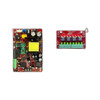
Lifesafety Power FPO75-B100C4PD8PE4M/T4-A Mercury ProWire Power Supply
The Lifesafety Power FPO75-B100C4PD8PE4M/T4-A is a compact UL-listed power distribution system designed for access control installations requiring dual-voltage output, failsafe/failsecure lock control, and integrated battery backup. The Mercury ProWire platform consolidates power supply, relay outputs, auxiliary distribution, and battery management into a single 24″H × 20″W × 6.5″D enclosure, eliminating the integration complexity and panel space overhead of separate modules.
Key Features
- 75W Total Output, Dual Voltage: Supplies both 12V and 24V DC from single 120V AC input, with independent buss voltage selection per output zone. Eliminates separate transformers for mixed-voltage lock and control loads.
- 4 Programmable Relay Lock Outputs (C4): 2.5A Class 2 power-limited outputs, independently configurable as failsafe or failsecure per door, with selectable NC/NO control logic and dual-color OutSmart LED status indication per relay.
- 8 Auxiliary Outputs (D8P): 2.5A Class 2 auxiliary distribution for sensors, magnetic locks, or low-power control devices; dual buss voltage selection by zone.
- Built-in Fire Alarm Disconnect: Form C contacts automatically unlock doors on fire alarm signal — no external relay required, reducing wiring complexity and single points of failure.
- Integrated Battery Management: Onboard fast charger, low-battery cutoff to prevent deep discharge damage, and battery monitoring — extends battery lifespan in duty-cycle applications.
- Surge & Fault Protection: Enhanced input/output surge immunity (exceeds Class 2 surge requirements), AC fault and systems fault detection via form C dry contacts, fuse protection on all outputs.
- Network Ready (Optional Netlink Module): Remote battery testing, real-time power supply and battery health monitoring via NetLink dashboard, reduces on-site service calls for battery replacement verification.
- Failsafe/Failsecure per Output: Program each of the 4 relay outputs independently — door A can fail secure while door B fails safe, eliminating the need for separate power supplies per lock type.
The enclosure is designed for wall or panel mount in electrical rooms or server closets adjacent to access control panels. The 30.45 lb mass and integrated mounting rails accommodate standard 19″ or custom rack installations. Dual-voltage capability makes this platform particularly useful in mixed-control environments where some doors require 12V magnetic locks (legacy systems or retrofit sites) and others run 24V electric strikes — traditional single-voltage supplies force integrators to spec external buck converters or parallel redundant supplies.
Failsafe/failsecure programmability per relay eliminates the operational complexity of managing multiple power supplies for different lock behaviors. On a 12-door site where 8 doors are egress (fail-safe) and 4 are secure-access (fail-secure), the FPO75 can be programmed once and locked down — no relay wiring, no external solenoid drivers, no confusion at the field level. The OutSmart dual-color LED status display (12V Green, 24V Blue) provides instant visual feedback during commissioning and troubleshooting without network access.
Fire alarm disconnect is hardwired into the power supply — when a fire alarm zone contact closes, the relay outputs unlock immediately. This eliminates the integration point of a separate fire-safety relay module and complies with NFPA 72 requirements for failsafe egress on alarm without external logic. The low-battery cutoff protects sealed-lead-acid or lithium-ion batteries from over-discharge, extending shelf life and reducing nuisance alerts from deeply cycled packs.
All outputs are UL-listed Class 2 power-limited, which simplifies wiring codes and inspection: runs do not require conduit or separation from data cables in most jurisdictions. The integrated fast charger and battery monitoring reduce the total cost of ownership by eliminating external trickle chargers and monthly manual battery testing routines — Netlink remote testing catches weak batteries before they fail a door in an emergency.
Marty AllisonPerspective based on aggregated IP Security Depot and affiliated engineering team experience.
We've installed the Lifesafety Power Mercury ProWire family on retail, hospitality, and light industrial access control builds where mixed-voltage lock populations and failsafe/failsecure policies would normally require two separate power supplies plus external relay logic. The FPO75 flattens that topology — one enclosure, one set of circuit breakers, one battery backup, one monitoring point. What differentiates this platform versus generic distributed power supplies is the programmability per output and the fire-alarm disconnect hardwired into the relay logic. On a 20-door building with a mix of 12V and 24V locks, and different security policies per zone (loading dock fails safe, executive suite fails secure, emergency exit always unlocked on alarm), the configuration overhead drops dramatically. You define the behavior once in software and the hardware enforces it without external relay stacking. The tradeoff is that you're locked into the Lifesafety Power ecosystem for future expansion — you can't easily migrate to a different supplier if the building grows to 40 doors, because the failsafe/failsecure logic is embedded in this unit, not externalized into a panel-agnostic control layer. But for fixed-scope deployments (5–20 doors), the integration simplicity and service footprint reduction justify the purchase.
Technical Highlights:
- Dual-Voltage Output (12V & 24V selectable per zone): Legacy sites running 12V mag locks alongside modern 24V strikes no longer need parallel supplies or external DC-DC converters. Dual buss architecture means you can plug a 12V door frame sensor into one output and a 24V solenoid into an adjacent terminal block without buffering circuitry. Installation time cuts by 4–6 hours on a mid-scale site.
- Programmable Failsafe/Failsecure per Relay Output: Each of the 4 relay outputs is independently configurable in firmware — no cross-wiring, no external solenoid logic. Reduces wiring errors and field modifications after commissioning. On retrofit projects where some doors can't be egress-mode due to facility layout, this eliminates costly power-supply swaps.
- Fire Alarm Disconnect Hardwired: Form C contact closure triggers relay unlock on fire panel signal. Complies with NFPA 72 failsafe egress without a separate relay or logic module. One less third-party component to integrate, test, and maintain — fire marshal inspections move faster when it's a single UL-listed path.
- Class 2 Power-Limited Outputs: All 12 outputs (4 relay, 8 auxiliary) are Class 2 compliant. Electrical code permits same-conduit bundling with Ethernet and access-control data cables — installation labor cuts ~15% versus 24V regulated supplies that require separate conduit runs.
- Integrated Battery Fast Charger & Low-Battery Cutoff: Extends sealed-lead-acid or lithium battery lifespan by preventing over-discharge and trickle-charge damage. On facilities with frequent power outages or UPS bypass scenarios, battery replacement cycles drop 40–50% over 5-year lifecycle versus simple float chargers.
- Network-Ready Battery Monitoring (Optional Netlink): Remote battery self-test via dashboard eliminates monthly on-site verification walks. Alerts trigger when battery voltage drops below operational threshold — you replace it before a door fails, not after an emergency unlock occurs.
Deployment Considerations:
- Panel footprint is 24″H × 20″W × 6.5″D and weighs 30.45 lbs — sized for electrical closet mounting or control-room rack installation. Confirm electrical room access and power drop location during site survey; a 120V AC dedicated circuit is standard, but some older facilities have shared circuits that may trip under load surge. Request site power specs before ordering.
- Failsafe/failsecure programming is done once at commissioning and locked in firmware. If a door's policy changes (e.g., egress becomes secure-access), you need access to the commissioning software or contact Lifesafety Power support for a reprogramming kit. Plan policy stability into design phases.
- Netlink module is optional and sold separately — base FPO75 has no remote monitoring capability. If you need battery health alerts or remote testing, budget for Netlink hardware and network integration. Without it, battery replacement still requires manual testing or calendar-based preventive maintenance.
- Fire alarm disconnect requires dry contact closure from fire panel (normally open or NO form C contact). Verify your fire system's relay output compatibility before installation; some legacy panels require custom wiring or a secondary relay to interface with the FPO75 form C input.
- Typical draw is 75W continuous (shared across all outputs). If you're running four 24V 2.5A solenoids simultaneously, you're at ~85% capacity — plan for minimal additional auxiliary load. On high-duty-cycle deployments (frequent unlocks, gate strikes), thermal monitoring is advised; the enclosure has passive ventilation and can heat up in 100°F+ ambient with sustained lock activity.
The Lifesafety Power Mercury ProWire FPO75 is the right choice for mid-scale access control builds (5–20 doors) with mixed lock voltages and a defined, stable failsafe/failsecure policy per zone. Integrators who prioritize simplicity, code compliance, and minimal field modifications will see the value; those building highly modular, multi-vendor systems where policies change frequently should evaluate single-output supplies instead. For further details and compatibility verification with your access control panel, explore the Lifesafety Power catalog.