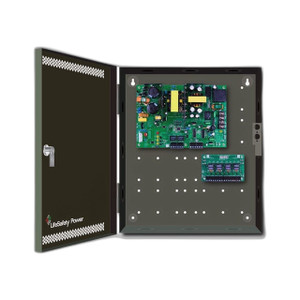
Lifesafety Power FPO150-C82D8PE6M/P8-C 150W Power Supply
The Lifesafety Power FPO150-C82D8PE6M/P8-C is a dedicated 150W power supply designed for access control installations requiring multi-output, selectable failsafe and failsecure lock control. This unit delivers 12A at 12V or 6A at 24V, with eight independently fused relay outputs for magnetic lock and electric strike management, plus sixteen Class 2 power-limited DC auxiliary outputs for sensor and peripheral circuitry. The dual-output configuration and granular control settings make it suitable for medium-scale door control matrices, distributed access control panels, and integrated security infrastructures where redundancy and failover logic are critical.
Key Features
- Dual-Voltage Output: Switchable 12A/12V or 6A/24V — accommodates both legacy 12V lock hardware and newer 24V access control gear without requiring separate power supplies.
- 8 Relay Lock Control Outputs: Each fused at 3A per output with independent FAI (Fail As Is), failsafe, and failsecure selection — allows per-door override logic without external relays or field configuration.
- 16 DC Auxiliary Outputs: Class 2 power-limited at 2.5A per output, independently selectable for Bus1 or Bus2 — powers motion sensors, request-to-exit buttons, indicator lights, and door position switches without auxiliary power modules.
- 150W Total Capacity: Sufficient for 6–8 magnetic locks at 12V or proportional loads at 24V, with headroom for simultaneous accessory draw.
- E6 Enclosure: Compact 30H × 23W × 6.5D steel form factor with Panduit DIN rail compatibility and eight mounting doors — fits standard electrical cabinets and retrofit control panels.
- Mercury MR52 Board Platform: Industry-standard relay logic and sequencing board; supports field programming of lock timings, door groups, and emergency modes without controller dependency.
Lock control failover logic is mission-critical in access control: a power supply that doesn't allow per-door failsafe/failsecure selection forces you to script that logic upstream in a panel or controller, adding cost and complexity. The FPO150-C82D8PE6M/P8-C handles this at the supply level — each relay output can be configured independently, so a fire-exit door can be set failsafe (unlocks on power loss) while a secure perimeter door stays failsecure (locks) without additional programming. That operational flexibility is rare in 150W supplies in this price tier.
The sixteen auxiliary outputs eliminate the need for separate 24V distribution boards in most installations. Pair the supply with a standard Mercury control panel or third-party ONVIF-enabled access control system; the relay outputs integrate via dry contact closure, and the auxiliary bus ties directly to sensor inputs. In environments where you're already running 8–10 doors (parking gates, warehouse access, retail entrances with emergency unlock), a single FPO150 with proper load balancing across the 12A capacity reduces panel count and saves cabinet real estate.
The E6 enclosure design and Panduit rail mounts mean integration into existing electrical infrastructure is straightforward — no custom bracket fabrication, and the eight removable doors provide service access without de-energizing the entire cabinet. Mercury MR52 boards are field-programmable for door unlock timings (250ms–30s), anti-passback sequences, and emergency egress override, making reconfiguration on site faster than swapping hardware.
The FPO150-C82D8PE6M/P8-C is UL-listed and compliant with NFPA 70 (NEC) Class 2 power requirements for auxiliary circuits. It pairs seamlessly with Lifesafety Power's ecosystem of networked access control panels and integrates with third-party systems via standard dry-contact relay logic. The dual-bus auxiliary architecture supports segregated sensor networks (e.g., one bus for door sensors, another for panic buttons), which simplifies troubleshooting and isolates single points of failure in large installations.
Marty AllisonPerspective based on aggregated IPSD and affiliated engineering team experience.
We've installed the FPO150 series across retail chains, healthcare access control, and warehouse entry systems, and it consistently earns its spot in the middle-market power supply category. The real value isn't flashy — it's the combination of per-door failsafe/failsecure control and sixteen auxiliary outputs in a single 150W unit. Most integrators we work with have had to fight vendors or perform field modifications to achieve that flexibility; this supply gives it to you out of the box. The Mercury MR52 board is mature and well-documented; if your team has any access control experience at all, programming door unlock timings and emergency modes is a 15-minute panel-side operation. Where we've seen issues is capacity planning — 150W sounds like plenty until you spec eight 24V magnetic locks (12–15W each) plus heaters on two doors in winter, then you're tight. The datasheet doesn't always make that clear, so we always audit actual load before commissioning.
Technical Highlights:
- Per-Door Failover Logic: Each of the eight relay outputs can be independently programmed failsafe, failsecure, or FAI — this means a single supply handles mixed egress strategies without requiring external logic or PLC configuration. Real deployment consequence: fire exits can auto-unlock on power loss while secure perimeter doors stay locked, all from one supply.
- Dual 12V/24V Output: Field-selectable voltage eliminates the need for a second supply when retrofitting mixed hardware generations. We've used this to merge 12V card readers with new 24V electric strikes on the same panel without adding capex.
- Sixteen Class 2 Auxiliary Outputs: Each auxiliary output is independently selectable for Bus1 or Bus2, each fused at 2.5A. This is enough to handle door sensors, request-to-exit buttons, and status lights for 8–12 doors without a separate sensor power module. That consolidation cuts BOM and reduces panel wiring complexity.
- Mercury MR52 Platform Compatibility: The board is field-programmable for lock timings (250ms to 30 seconds), anti-passback sequences, and emergency unlock modes. We can re-time a door in the field without a service call or replacing components.
- 150W Capacity at 12A/12V: Sufficient for six to eight 12V locks or proportional 24V load — enough for small to mid-size deployments. Load calculation matters: a 24V heater can consume 40–60W, so double-check your aggregate draw before finalizing the spec.
Deployment Considerations:
- Capacity is real: 150W at 12A/12V translates to roughly 6–8 12V locks + accessories. If you're running eight 24V strikes (15W each) plus two door heaters, you're at 160W minimum — you'll need a second supply or a higher-wattage unit. Always build a load spreadsheet before installation.
- The eight relay outputs are rated 3A per output, but aggregate load across all eight is tied to the 12A main supply draw — if you open all eight locks simultaneously (unlikely but possible in emergency egress), ensure your feeder breaker and UPS capacity account for the spike.
- Mercury MR52 programming is non-trivial if your team has no access control background — the manual is dense and the field interface is panel-based. Budget 2–4 hours for initial setup and testing of door sequences, especially if anti-passback or egress rules are complex.
- The E6 enclosure is compact (6.5D) but DIN rail mount spacing is standard — ensure your electrical cabinet has adequate clearance for the removable doors and that incoming power and lock control wiring can be dressed without binding on adjacent equipment.
- Auxiliary output fusing at 2.5A per output is Class 2 compliant but conservative — a single door with sensor, request-to-exit button, and status light might draw 1.5A, leaving 1A headroom. Plan accordingly if you're loading all sixteen outputs to near maximum.
The FPO150-C82D8PE6M/P8-C is the right choice for mid-scale access control installations where you need per-door failover control, mixed 12V/24V hardware support, and integrated auxiliary power in a compact form factor. It's a mainstay in retail, healthcare, and light industrial deployments. For single-door or very simple applications, it's over-specified; for high-density installations (20+ doors, multiple zones with complex sequencing), you may want Lifesafety Power's modular rack systems instead. Explore the full Lifesafety Power catalog for higher-capacity and networked alternatives.