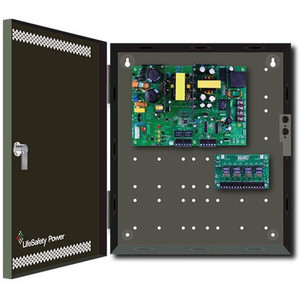
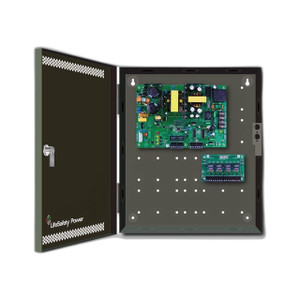
Lifesafety Power FPO150-B100C8D8E4 150W Power Supply Cabinet
Overview
The FPO150-B100C8D8E4 is a compact 150W enclosure-mounted power distribution platform designed for small-to-medium IP security deployments where supervised, fused output channels are required. It consolidates AC input, DC regulation, and field wiring termination into a single cabinet-ready module, eliminating the need to daisy-chain individual power supplies across a control room or sensor array.
Power Architecture
Supplies dual-voltage output: 4A at 12VDC and 4A at 24VDC simultaneously. This dual-rail design accommodates mixed-voltage loads — common in deployments mixing legacy 12V access-control readers with newer 24V IP intercoms or auxiliary relays. Each of the 8 supervised outputs is individually fused at 3A, protecting downstream circuits and preventing a single failed load from cascading shutdowns. Total available capacity is 150W across both rails; budget accordingly if running maximum-current devices on both channels simultaneously.
Supervision and Lock Reporting
The unit features 8 supervised lock outputs and 8 auxiliary outputs with integrated fusing. Supervision wiring enables the host system (access control panel, NVR management software, or third-party monitoring) to detect open-circuit or short-circuit faults on each output in real time — critical for detecting cut wires, tampered connections, or device failures before they compromise physical security.
Enclosure and Integration
Housed in a Mercury back plate E4M enclosure, designed for wall or cabinet mounting. The compact footprint and DIN-rail compatibility reduce installation labor in retrofit or new-build integrations involving access control systems or network video recorders requiring centralized auxiliary power distribution. Verify your site's AC input availability and thermal headroom before deployment in confined spaces.
Installation Considerations
Confirm the host system's supervision protocol (loop impedance, reporting format) before wiring; incompatible supervision schemes will render lock/auxiliary fault detection inoperative. All field connections must be made to supervised terminals; unsupervised spare outputs may not be available for off-protocol devices.