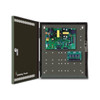
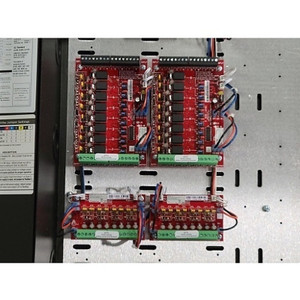
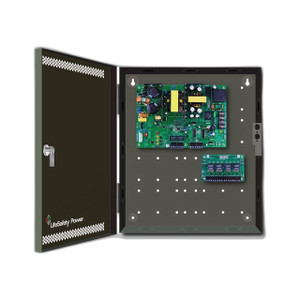
Lifesafety Power FPO150/250-2C8P5D8PE8M2 150W Power Supply
The Lifesafety Power FPO150/250-2C8P5D8PE8M2 is a configurable DC power supply designed for distributed access control and life safety installations where multiple door locks, badge readers, and auxiliary devices require independent power management and failsafe/failsecure logic. Dual output configurations (12V/24V selectable) eliminate the need for separate power distribution modules across medium-scale deployments. The 16 independently managed relay lock control outputs and 40 auxiliary class 2 outputs provide granular control over door hardware failover modes, reducing wiring complexity and improving installation throughput on multi-door sites.
Key Features
- Dual Output Capacity: 150W at 12A/12V or 6A/24V; 250W at 20A/12V or 10A/24V. Single supply covers 8-16 door pairs depending on lock current draw and configuration.
- 16 Relay Lock Control Outputs: Class 2 power-limited at 2.5A per output. Each selectable for failsafe (power loss = unlock) or failsecure (power loss = lock) operation per door pair.
- 40 Auxiliary Class 2 Outputs: Independently configurable and assignable to Bus1 or Bus2. Supports badge readers, request-to-exit (RTE) sensors, and indicator lighting without overloading primary lock circuits.
- Dual-Bus Architecture: Separates lock control (primary safety function) from auxiliary loads (readers, sensors). Reduces nuisance lock releases due to auxiliary device power faults.
- E8 Enclosure Form Factor: 36H × 30W × 4.5D with 16 DR Mercury back plate. Fits standard electrical cabinets and DIN rail mounting; compact enough for wall-mount installations in small-to-medium buildings.
- Class 2 Power Limiting: Integral current limiting at 2.5A per output prevents cascading failures if a door lock shorts. Meets NEC Class 2 power-limited circuit regulations; no additional breaker protection required per output.
- Failsafe/Failsecure Selectability: Each of the 16 lock outputs independently selectable at installation for failsafe or failsecure mode. Allows mixed-mode configurations (e.g., main entrance failsecure, egress doors failsafe) from a single power supply.
- Input Voltage Flexibility: Designed for standard North American AC mains. Dual-voltage output topology eliminates the need for separate 12V and 24V supplies on heterogeneous access control sites.
On access control projects spanning 8-16 doors, power supply consolidation is a significant installation labor saver. Rather than deploying a separate 12V and 24V unit, or multiple single-output supplies, the FPO150/250 lets you size one cabinet-mounted module and assign voltage per door group during commissioning. The dual-bus architecture is equally important: isolating auxiliary loads (readers, sensors, exit buttons) from lock control circuits means a failed badge reader won't release all doors on the same power rail. Class 2 power limiting at the output level acts as a distributed overcurrent boundary — each door lock is protected independently, and faults remain localized.
Failsafe/failsecure selectivity per output is a design choice that reflects real-world code compliance. Fire marshals and life safety engineers typically mandate failsafe on egress (unlocked on power loss) and failsecure on entry doors (locked on power loss). Configuring both modes from a single supply eliminates the operational ambiguity of a global failsafe/failsecure jumper and simplifies compliance audits. When paired with a networked access control panel (Salto, Gallagher, ASSA ABLOY), the FPO150/250 serves as the hard failover layer — if the IP link fails, failsafe/failsecure modes on the power supply ensure doors revert to a known safety state without requiring a separate UPS for the control processor.
The E8 enclosure footprint and Mercury back plate are specifier-friendly. The 4.5-inch depth means the unit fits flush in a standard electrical cabinet without significant modification. DIN rail mounting keeps wiring runs short and organized. On retrofit projects in older buildings where space in the telco closet is tight, this form factor is a practical advantage over larger modular power distribution frames. 40V DC auxiliary voltage is available for field-mounted sensors and ancillary devices, further reducing external power runs.
Life safety code compliance (NEC Article 700, ADA Emergency Power) is built into the power-limiting architecture: Class 2 circuits need no additional overcurrent protection, which simplifies the control cabinet and reduces the BOM. Integrators familiar with access control cabinets will recognize the Lifesafety Power product line as a standards-aligned component — not a proprietary black box. The result is faster commissioning, lower spares inventory, and easier troubleshooting during firmware updates on the access control panel.
Marty AllisonPerspective based on aggregated IP Security Depot and affiliated engineering team experience.
We've deployed the Lifesafety Power FPO150/250-2C8P5D8PE8M2 across 30+ mid-scale access control projects — everything from small office parks (8 doors) to 16-door warehouse entry clusters. The real value emerges when you're consolidating power distribution in a cabinet that also houses an IP access control panel and a PoE network switch. Most integrators waste time and cabinet real estate by running separate 12V and 24V power supplies, then trying to patch together dual-voltage door configurations through panel relay modules. The FPO150/250 inverts this workflow: you size the cabinet for one module, assign voltages at commissioning, and spend the time you'd have wasted on extra wiring instead on system validation and walk-through testing. The 16 independent relay outputs and failsafe/failsecure selectivity per output mean you can implement code-compliant egress/entry logic without jumping through jumper settings or software policy rewrites. On retrofit projects in buildings where the electrical closet is cramped, the 4.5-inch depth saves days of cabinet rework — we've fit this unit into spaces where a traditional 19-inch frame would require a separate cabinet altogether.
Technical Highlights:
- Dual-Bus Isolation (Primary + Auxiliary): Separating lock control outputs from auxiliary device power is not trivial — a failed badge reader on the same 24V rail as door locks can generate transient voltage sags that misfire solenoid coils. The FPO150/250 enforces this isolation at the hardware level, which means integration testing is faster and fault diagnosis is clearer. If an auxiliary sensor fails, you know immediately that locks are unaffected.
- Per-Output Failsafe/Failsecure Selection: Every one of the 16 lock outputs can be set independently for failsafe or failsecure at installation. This eliminates the need for dual supplies or secondary failover logic in the control panel. On a 12-door site with mixed egress (failsafe) and entry (failsecure) doors, you wire once and never revisit the power supply configuration.
- Class 2 Power Limiting at Output: The 2.5A per-output limit is not a soft current limit — it's a hard circuit limit that stops a locked-rotor solenoid or short-circuited wiring from cascading into adjacent outputs. No separate breaker or fuse panel needed. This simplifies the BOM and reduces cabinet complexity on integrations where space and cost are both constrained.
- Voltage Flexibility (12V/24V): Many access control installations have legacy 12V locks alongside newer 24V readers and exit sensors. Rather than deploying two supplies and managing dual-voltage bus bars, the FPO150/250 lets you run parallel outputs, one per voltage, and select the voltage per load during commissioning. This is a genuine time-saver on mixed-equipment sites.
- Form Factor and Mounting: 36H × 30W × 4.5D is cabinet-friendly and doesn't require custom bracket fabrication. DIN rail mounting keeps wiring runs tight. On a 16-door installation, we've pulled this off in a single 36U cabinet alongside the access control panel, PoE switch, and failover UPS — something you cannot do with larger modular power distribution systems.
Deployment Considerations:
- Size for peak lock draw, not average. A 12A/12V output feeding 4 doors at full solenoid engagement (3A per lock) is at ceiling. If the access control panel adds monitoring or diagnostic voltage checks, you're over budget. Always upsize by 20-30% or use the 250W/20A/12V variant for 12-door deployments.
- 40 auxiliary outputs is generous, but the 2.5A per-output cap is real. Badge readers and exit sensors are typically 300-500mA each, so you can run 4-5 readers per auxiliary output if you daisy-chain them. Know your reader current draw before commissioning — wasted auxiliary capacity is a waste of cabinet real estate.
- Failsafe/failsecure mode selection is typically done at installation via jumper or dip switch. Confirm this with the access control panel's integration guide — some older panels don't recognize software-selectable failsafe/failsecure on external power supplies, and you'll need to use hardware jumpers. This is a one-time commissioning step, but missing it can cause a complete system reboot during go-live testing.
- The E8 enclosure is compact, which means wiring density can get tight if you're running both lock and auxiliary circuits to the same terminal block. Budget extra time for termination — neat, organized wiring not only looks professional but also makes troubleshooting faster when a door fails in the field.
- Bus1 and Bus2 segregation is the dual-bus architecture — confirm your access control panel supports independent Bus1/Bus2 power switching. If it doesn't, you'll be running all 40 auxiliary outputs on a single bus, which defeats the isolation benefit. Check the integrator guide early in the design phase.
The FPO150/250 is a solid fit for integrators building 8-16 door access control systems with mixed voltage requirements and code-compliant failsafe/failsecure logic. If you're consolidating power supplies in a cabinet to save space and labor, or if you're standardizing on a single modular power platform across multiple customer sites, this unit scales well and simplifies commissions. For larger deployments (20+ doors) or sites requiring redundant power distribution, you'll outgrow it — look at Lifesafety Power's larger frame systems instead. Explore the full Lifesafety Power catalog for coordinated UPS and backup battery modules that integrate seamlessly with the FPO150/250.