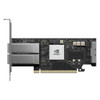
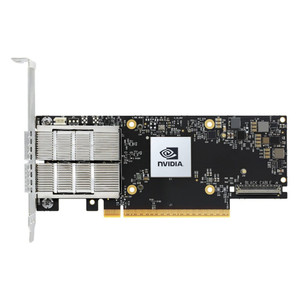
Lenovo 4XC7B03668 ConnectX-8 8240 Dual-Port 400GbE PCIe Gen6 Network Adapter
Overview
The Lenovo 4XC7B03668 is a dual-port 400GbE and 400Gb/s InfiniBand network adapter built on the NVIDIA ConnectX-8 8240 silicon, designed for ThinkSystem servers running AI inference, high-performance compute, or storage-intensive workloads where PCIe Gen5-era bandwidth has become the bottleneck. Two QSFP112 ports deliver aggregate 800Gbps of host-side throughput potential — the kind of headroom that makes a real difference when you're feeding GPU clusters or NVMe-oF storage fabrics that are waiting on the network, not the compute.
The adapter slots into a PCIe Gen6 slot, matching the interconnect generation now shipping on current-generation ThinkSystem platforms. If your server still runs PCIe Gen5 slots, the card will negotiate down — but you'll leave bandwidth on the table, so slot generation is worth verifying in your server's technical specifications before ordering.
Key Features
- Dual 400GbE / 400Gb/s IB ports via QSFP112: Each port independently handles 400Gbps — you can run both in Ethernet mode, both in InfiniBand mode, or split them across fabrics depending on your workload. That flexibility matters in converged AI/storage racks where one cable run needs to hit the GPU switch and another needs to reach NVMe-oF storage.
- NVIDIA ConnectX-8 8240 silicon: The ConnectX-8 generation adds RDMA, GPUDirect, and Smart NIC offload capabilities documented by NVIDIA for this chipset — offloading transport processing from the host CPU, which frees cores for actual workload execution rather than networking overhead.
- PCIe Gen6 host interface: PCIe Gen6 doubles the per-lane bandwidth of Gen5, meaning the bus itself no longer limits what two 400Gb/s ports can push to the host. On Gen6-equipped Lenovo ThinkSystem platforms, this adapter can fully utilize both ports simultaneously without PCIe becoming the constraint.
- QSFP112 connector format: QSFP112 supports 400G-SR4, 400G-DR4, and 400G-LR4 optical modules as well as DAC and active copper cables — giving you choices across short reach (within-rack), medium reach (cross-row), and long reach (inter-building or campus) deployments without changing the adapter. Match the transceiver to your physical plant, not the other way around.
- 1.00 lb form factor: Standard PCIe add-in card weight — installs in any PCIe Gen6 full-height slot without special mechanical considerations. No riser adapter required on standard tower or rack server configurations.
- Dual-protocol flexibility (Ethernet + InfiniBand): The same physical card supports both 400GbE for IP-routed Ethernet fabrics and 400Gb/s InfiniBand for latency-sensitive HPC and AI training clusters. You're not locked into one fabric architecture at purchase time — the mode is configurable, which protects the investment if your fabric strategy evolves.
Integration and Compatibility
The 4XC7B03668 is positioned within the Lenovo server adapter lineup as a ThinkSystem-validated option, meaning it carries Lenovo's firmware and driver qualification for ThinkSystem rack and tower servers. For network adapters at this speed tier, OS and driver support is a real variable — verify your Linux distribution version and kernel against Lenovo's ServerProven compatibility matrix before deployment, particularly for RHEL, SLES, and Ubuntu LTS releases on AI workload stacks.
In converged Ethernet deployments, pair this adapter with a 400GbE-capable data center switch that supports RoCEv2 for RDMA traffic — a standard 400GbE L3 switch without RoCE support will carry the packets but lose the latency advantage that makes this class of adapter worth deploying. For InfiniBand fabrics, an NVIDIA Quantum-2 or equivalent IB switch is required; standard Ethernet switches do not bridge IB traffic.
Power draw and slot requirements should be verified against the target server's PCIe slot power budget. High-speed 400G adapters in this class typically require 25–75W depending on operating mode and transceiver type — confirm your server's slot power allocation supports the adapter's actual draw under full load. Lenovo's ServerProven tool is the authoritative source for per-server slot compatibility.
Frequently Asked Questions
Q: What PCIe slot does the Lenovo 4XC7B03668 require?
A: The 4XC7B03668 uses a PCIe Gen6 host interface. It will physically fit and negotiate down in PCIe Gen5 slots, but full dual-port 400Gbps throughput requires a Gen6 slot. Verify your ThinkSystem server's slot generation in Lenovo's ServerProven compatibility matrix before ordering.
Q: Can this adapter run both Ethernet and InfiniBand simultaneously?
A: The ConnectX-8 8240 silicon supports both 400GbE and 400Gb/s InfiniBand protocols, but port mode configuration depends on firmware and driver settings. Each port can be independently configured. Consult Lenovo's firmware documentation for dual-protocol simultaneous port assignments on your specific ThinkSystem platform.
Q: What transceivers are compatible with the QSFP112 ports?
A: QSFP112 is the connector standard for 400G optics. Compatible module types include 400G-SR4 (short reach, multi-mode fiber), 400G-DR4 (medium reach, single-mode), 400G-LR4 (long reach, single-mode), and passive/active DAC cables. Use Lenovo-qualified transceivers to maintain firmware compatibility and warranty coverage.
Q: Is the 4XC7B03668 compatible with non-Lenovo servers?
A: The adapter is validated and sold as a ThinkSystem option card. While the underlying NVIDIA ConnectX-8 silicon is industry-standard, Lenovo firmware and driver packages are tuned for ThinkSystem platforms. Compatibility with third-party servers is not covered under Lenovo's qualification program — use at your own risk outside that ecosystem.
Q: What cabling infrastructure is needed for 400GbE operation?
A: 400GbE over QSFP112 requires either direct-attach copper (DAC) cables for within-rack use (typically up to 3–5m), active optical cables (AOC) for longer within-row runs, or optical transceivers with OM4/OS2 fiber depending on reach. Your switch must also support 400GbE QSFP-DD or QSFP112 ports — most current-generation 400G data center switches do, but confirm port type compatibility before cabling.
The 4XC7B03668 is the adapter you spec when your ThinkSystem server needs to stop being the network bottleneck in a 400G AI or HPC fabric — the dual QSFP112 ports on the ConnectX-8 8240 give you 800Gbps of aggregate host-side capacity, and PCIe Gen6 means the bus itself isn't choking that throughput before it reaches your GPUs or NVMe-oF storage targets.
Technical Highlights:
- 400GbE + 400Gb/s IB dual-protocol: Both ports are independently configurable between Ethernet and InfiniBand — you're not buying a single-protocol card that locks you into one fabric architecture. That matters when your AI cluster design is still in flux or when you're running converged storage and compute traffic on the same host.
- PCIe Gen6 interface: Gen6 doubles per-lane bandwidth versus Gen5, which means two simultaneous 400Gb/s port streams don't compete for host bus headroom. On a Gen5-slot server this card still works, but you cap out well below the adapter's rated throughput — slot generation is the first thing to check in your server spec sheet.
- QSFP112 connectivity: The QSFP112 form factor supports the full range of 400G optics from short-reach SR4 to long-reach LR4 and DAC cables — you pick the reach, the adapter accommodates it without a hardware change.
Deployment Considerations:
- Transceiver qualification matters at this speed tier — use Lenovo-qualified QSFP112 modules to avoid firmware compatibility issues and maintain support coverage. Third-party optics may work but are outside the validated configuration.
- For RoCEv2 RDMA workloads (the primary reason to deploy 400G ConnectX-8 NICs), your top-of-rack switch must support RoCEv2 with Priority Flow Control (PFC) and ECN — a standard L3 switch without these features will pass traffic but eliminate the latency advantage entirely.
This adapter fits best in new ThinkSystem rack builds anchored around AI inference or distributed storage workloads where PCIe Gen6 slots are already populated and the fabric is 400G from day one — it's overkill for general enterprise workloads and the right call for anything feeding NVIDIA GPU nodes at scale.