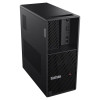
Lenovo 30HT0079US ThinkStation P3 Tower Gen 2 Workstation
Overview
The Lenovo 30HT0079US is a second-generation ThinkStation P3 tower workstation built around Intel's Core Ultra 5 235 vPro processor, with e-cores reaching up to 4.40GHz. The tower form factor gives integrators and IT architects room to expand — discrete GPU, additional storage bays, and PCIe cards — without the thermal and density constraints of a small-form-factor chassis. At 9 lb, the P3 Gen 2 is light enough to relocate during a deployment but substantial enough to indicate a full-size expansion envelope inside.
The vPro platform designation on the Core Ultra 5 235 matters in enterprise environments: it enables hardware-level manageability via Intel AMT (Active Management Technology), which allows out-of-band remote access for IT teams even when the OS is unresponsive — a meaningful operational advantage for distributed deployments where on-site access is expensive.
Key Features
- Intel Core Ultra 5 235 vPro (e-cores up to 4.40GHz): The hybrid core architecture handles mixed workloads efficiently — background tasks offload to efficiency cores while performance-sensitive processes get priority access. The 4.40GHz e-core ceiling is unusually high for efficiency cores, narrowing the gap with p-core burst speeds on lightly threaded tasks.
- Tower form factor (9 lb): A full-size tower chassis provides multiple PCIe slots and storage bays for expansion — relevant if this workstation will serve as a local VMS server, a video analytics processing node, or a security operations workstation requiring a dedicated GPU add-in card.
- vPro manageability: Hardware-level remote management (Intel AMT) functions independently of the OS state, meaning IT can push firmware updates, reboot a hung system, or remotely diagnose hardware faults without dispatching a technician — a hard operational requirement for many enterprise deployments.
Frequently Asked Questions
Q: What processor is in the 30HT0079US?
A: The 30HT0079US ships with an Intel Core Ultra 5 235 vPro processor, with efficiency cores boosting up to 4.40GHz.
Q: Does the 30HT0079US support Intel vPro for remote management?
A: Yes. The Core Ultra 5 235 vPro designation confirms Intel AMT (Active Management Technology) support, enabling out-of-band remote management capabilities for enterprise IT environments.
Q: What is the form factor of the 30HT0079US?
A: The 30HT0079US is a tower workstation. It weighs 9 lb and provides a full-size expansion envelope for add-in cards, storage, and GPU upgrades.
Q: Where can I find complete specifications for the 30HT0079US — RAM, storage, GPU, and OS?
A: Full configuration details including memory, storage, graphics, and operating system are listed on the product listing above. Specifications vary by configuration; confirm the exact build before ordering.
The 30HT0079US is a tower-class workstation built on Intel's Core Ultra 5 235 vPro — and the vPro designation is the spec I'd focus on first when evaluating this unit for a security or enterprise environment. It's not a marketing label; it's a hardware platform that enables out-of-band management via Intel AMT, which is a real operational differentiator when you're managing workstations across multiple sites.
Technical Highlights:
- Intel Core Ultra 5 235 vPro (e-cores up to 4.40GHz): The hybrid architecture handles concurrent workloads well — VMS client, analytics processing, and background OS tasks can distribute across core types without starving each other.
- Tower chassis (9 lb): Weight tells you this is a standard ATX or similar full-size tower — not a compact form factor. That means real PCIe slot access and multi-drive storage bays, both relevant if you're adding a capture card, GPU, or NVMe expansion for local video storage.
- vPro / Intel AMT: Out-of-band remote management works even when Windows is unresponsive. For a VMS workstation at a remote site, this eliminates a truck roll for many common failure scenarios.
Deployment Considerations:
- Verify RAM, storage, GPU, and OS configuration against your VMS vendor's minimum requirements before ordering — those specs are not confirmed in current evidence and vary by SKU configuration.
- The tower form factor assumes a fixed desk or rack shelf installation; plan for adequate airflow clearance, especially if a discrete GPU is added post-deployment.
Best fit: a security operations workstation or local VMS server node at a mid-size enterprise site where IT needs remote manageability and the flexibility to add hardware over the deployment lifecycle.