Lenovo 30HA006FUS ThinkStation P3 Ultra SFF Workstation
Overview
The Lenovo ThinkStation P3 Ultra (30HA006FUS) is a small-form-factor workstation built around Intel's 14th-generation Core i9-14900K — a 24-core, 32-thread processor that hits 6 GHz boost — in a chassis weighing just 9 lb. That combination targets deployments where rack space or desk real estate is limited but compute demand is not: physical security command centers running simultaneous high-channel VMS decoding, forensic review stations, and edge AI inference nodes are the natural fits. Starting with 16GB of RAM, the platform is designed to scale as workload requirements grow. If your VMS or analytics workload has been bottlenecked by CPU decoding cycles, the P3 Ultra's processor headroom is the primary reason to look at this platform.
Key Features
- Intel Core i9-14900K (24 Cores / 32 Threads): Eight Performance cores clock up to 5.6 GHz max turbo; sixteen Efficient cores reach 4.4 GHz. In a multi-stream VMS environment decoding 64+ channels of H.265, having discrete P-core and E-core pools means latency-sensitive decode threads stay on P-cores while background analytics and indexing offload to E-cores — without manual thread affinity tuning.
- 6 GHz Max Boost Frequency: The highest single-thread clock in Intel's 14th-gen desktop stack. Tasks that are inherently single-threaded — forensic video export, report generation, database queries — complete faster than on any lower-clocked i7 or Xeon W variant in the same generation.
- 36 MB Intel Smart Cache: A 36 MB shared LLC keeps frequently accessed video frame buffers and analytics model weights resident on-die. Reduced cache misses translate directly to more consistent frame decode latency under peak load — a practical advantage when 30+ streams are live simultaneously.
- Performance-Core Base / Boost: 3.2 GHz / 5.6 GHz: The 2.4 GHz spread between base and max turbo means sustained multi-stream workloads still hold meaningful clock rates, not just momentary peaks. Thermal and power headroom (124 W base / 253 W max turbo) is the variable to monitor when configuring chassis cooling.
- Efficient-Core Base / Boost: 2.4 GHz / 4.4 GHz: The 16 E-cores handle parallelizable background tasks — thumbnail generation, motion indexing, log aggregation — without starving foreground decode threads. For operations teams running VMS plus access control management on the same workstation, this core architecture reduces the need for a dedicated secondary machine.
- 16GB Starting RAM Configuration: Baseline memory covers light-to-moderate VMS workloads. Deployments targeting 64+ camera channels or running local AI inference models (people counting, license plate recognition) should budget for memory expansion before deployment — plan the upgrade path at procurement time, not after go-live.
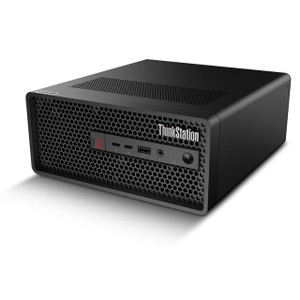
- Small-Form-Factor Chassis (9.00 lb): At under 10 lb, the P3 Ultra fits under a monitor, mounts behind a display, or drops into a security console cabinet without a dedicated equipment rack. The compact footprint does not sacrifice the i9-14900K's compute output — it just constrains expansion slot count relative to a full tower.
- 124 W TDP Base / 253 W Max Turbo Power: Under sustained all-core load the processor can draw up to 253 W. Verify that the facility's UPS and circuit capacity accounts for this alongside GPU, storage, and display draw — particularly relevant in retrofitted security operations centers where electrical infrastructure predates high-TDP workstations.
Integration and Compatibility
The 30HA006FUS runs on Intel's 14th-generation desktop platform. Most enterprise video management software packages — including those leveraging GPU-accelerated decode — will install and license on this platform via standard Windows or Linux pathways; confirm GPU model compatibility with your VMS vendor before finalizing the order, as the base configuration's GPU is not specified in available evidence. The platform's UNSPSC code (43211515) classifies it as a workstation desktop computer, which matters for procurement teams routing purchases through commodity IT approval workflows. For deployments pairing this workstation with a network video recorder in a hybrid architecture, the P3 Ultra serves the analytics and management plane while the NVR handles raw storage — a split that preserves both platforms' strengths. Review your PoE switch and network infrastructure capacity in parallel, since the camera count a 24-core workstation can manage will typically exceed what an underpowered network core can deliver.
Frequently Asked Questions
Q: What processor is in the 30HA006FUS and how many cores does it have?
A: The 30HA006FUS ships with an Intel Core i9-14900K — a 14th-generation processor with 24 cores (8 Performance + 16 Efficient) and 32 threads. Max boost reaches 6 GHz on a single Performance core.
Q: Is 16GB of RAM sufficient for a multi-channel VMS deployment?
A: 16GB covers light-to-moderate workloads. High channel counts (64+) or local AI analytics (license plate recognition, people counting) typically require more. Plan the upgrade path at procurement — confirm the platform's maximum supported RAM before ordering.
Q: What is the weight of the ThinkStation P3 Ultra 30HA006FUS?
A: The unit weighs 9.00 lb per verified distribution data, making it practical for under-desk, behind-monitor, or security console cabinet mounting without a full equipment rack.
Q: What is the processor's base and max turbo power draw?
A: The i9-14900K has a 124 W base processor power and can reach 253 W at maximum turbo. Factor both figures into UPS sizing and circuit capacity planning for the installation site.
Q: Is the 30HA006FUS compatible with enterprise VMS platforms?
A: The platform runs standard Intel 14th-gen architecture compatible with major VMS software. GPU-accelerated decode compatibility depends on the specific GPU installed — verify with your VMS vendor before procurement since the GPU is not confirmed in available specification data.
The 30HA006FUS is the platform I'd reach for when a customer's VMS is CPU-decode-bound and they need results in a compact chassis. The i9-14900K's 24-core, 32-thread architecture with a 6 GHz single-core ceiling is not marketing noise — the P-core / E-core split maps well to how VMS software actually threads: decode on P-cores, analytics and indexing on E-cores, without the integrator having to manually configure thread affinity.
Technical Highlights:
- 36 MB Smart Cache: Keeps active video frame buffers and inference model weights on-die, reducing decode latency spikes under 30+ simultaneous stream loads.
- 6 GHz Max Boost / 5.6 GHz P-Core Turbo: Highest single-thread ceiling in the 14th-gen desktop stack — matters for forensic export and single-threaded VMS report jobs that don't parallelize.
- 253 W Max Turbo Power Envelope: The processor alone can pull 253 W at peak. In a compact SFF chassis, thermal management and UPS sizing are not afterthoughts — they're prerequisites to sustained performance.
Deployment Considerations:
- At 9.00 lb in an SFF form factor, this workstation fits behind a monitor or inside a security console cabinet — but the 253 W processor TDP means the facility's electrical circuit and cooling need to be sized for a machine that runs hotter than it looks.
- The base 16GB RAM configuration is the most common procurement mistake on this platform. If the deployment involves 64+ camera channels or local AI inference, budget for RAM expansion before the system is racked — retrofitting memory post-deployment in a locked console cabinet is a maintenance headache.
The P3 Ultra 30HA006FUS is the right fit for a security operations center that needs a sub-10-lb workstation doing the decoding and analytics work of a full tower — specifically where desk or cabinet space is the binding constraint and single-thread clock speed for forensic workflows is non-negotiable.