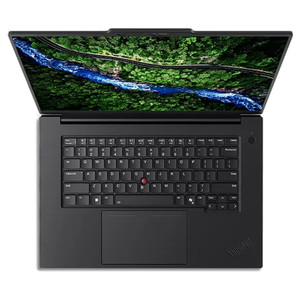
Lenovo 21Q8001FUS ThinkPad P1 Gen 8 Mobile Workstation
Overview
The Lenovo ThinkPad P1 Gen 8 (21Q8001FUS) is a 16-inch clamshell mobile workstation built around the Intel Core Ultra 7 265H vPro processor and NVIDIA RTX PRO 2000 Blackwell Laptop GPU — a combination aimed squarely at engineering, architecture, and compute-intensive field deployments where a desktop workstation isn't practical. The aluminum chassis keeps the unit at 6.70 lb while delivering a display and GPU stack that competes with much heavier platforms. If your team runs CAD, simulation, video analysis, or large-dataset workflows from the field or a home office, this is the configuration worth evaluating. Browse the full Lenovo mobile workstation line to compare Gen 8 configurations.
Key Features
- 3.2K OLED Touchscreen (3200 × 2000) with 1500 cd/m² HDR Peak Brightness: A 3200 × 2000 resolution on a 16-inch panel gives you roughly 240 PPI — enough pixel density that text and fine geometry in CAD views are genuinely sharp rather than aliased at normal working distance. The OLED panel's 1500 cd/m² HDR peak and 600 cd/m² SDR sustained brightness mean it stays readable in mixed-light environments like open-plan offices or client sites with harsh ambient lighting. For video analysts reviewing security camera footage or GIS operators working with aerial imagery, the 100% DCI-P3 color gamut means color-critical detail is not being compressed by a mediocre panel.
- 100% DCI-P3 Color Gamut with Anti-Glare, Anti-Reflective, and Anti-Smudge Coatings: DCI-P3 coverage at 100% is the standard used in professional post-production and medical imaging. It also matters for any workflow where accurate color differentiation carries operational weight — reading thermal maps, reviewing satellite imagery, or QA-ing product renders. The three-layer surface treatment (anti-glare, anti-reflective, anti-smudge) reduces screen fatigue on long shifts and keeps the display usable in environments that aren't carefully light-controlled.
- 16:10 Native Aspect Ratio: A 16:10 panel puts more vertical real estate on screen versus standard 16:9 — meaningful when working with long documents, code editors with multiple panes, or dashboards with dense data tables. You lose fewer rows to letterboxing when viewing video or widescreen content, and you gain usable rows when working in productivity apps. For analysts who split screen constantly, this is a non-trivial ergonomic upgrade over 16:9 mobile workstations.
- Intel Core Ultra 7 265H vPro (E-cores up to 4.50 GHz, 24MB Cache): The 265H is a hybrid-architecture processor with both Performance and Efficiency cores. The E-core turbo ceiling of 4.50 GHz means background tasks — compile jobs, file indexing, cloud sync — run fast without starving the P-cores handling foreground compute. The 24MB cache reduces main memory round-trips on large working sets. vPro inclusion means IT departments can manage, provision, and remotely remediate this machine through Intel's management stack without a VPN tunnel — a real factor for enterprise fleet management.
- NVIDIA RTX PRO 2000 Blackwell Laptop GPU, 8GB VRAM: The RTX PRO 2000 is a professional-class GPU, not a consumer gaming card — it carries ISV certifications relevant to engineering software and is tuned for stability under sustained workloads rather than burst gaming frames. 8GB of dedicated VRAM handles large 3D scenes, high-resolution viewport rendering, and ML inference tasks without spilling to system memory. For teams running AI-assisted video analytics or large point-cloud processing, this GPU tier is the floor to stay on the right side of performance.
- 64GB RAM with 2TB PCIe Gen5 TLC Opal SSD (M.2 2280): 64GB of system memory means you can hold large datasets, multiple VMs, or memory-hungry simulation environments in RAM simultaneously. The 2TB PCIe Gen5 SSD delivers meaningfully faster sequential throughput than Gen4 — relevant when loading large project files or transferring high-bitrate video. The Opal-compliance means hardware-based encryption is available for data-at-rest, which matters for enterprise security policies without incurring the CPU overhead of software encryption.
- Aluminum Clamshell at 6.70 lb / 20.40 × 13.00 × 3.10 in: The all-aluminum enclosure on the mobile workstation is a deliberate tradeoff — heavier than a consumer ultrabook, but substantially more rigid than magnesium-alloy or plastic competitors at this display size. At 6.70 lb it's portable enough for daily transit without being a burden. The 3.10-inch depth figure (closed) is thicker than a thin-and-light, which is the price of the thermal headroom needed to sustain GPU workloads without throttling.
- PCIe and Ethernet Connectivity: On-board Ethernet means you aren't dependent on a USB-C dongle for wired network access — critical in enterprise environments where Wi-Fi is restricted or bandwidth-sensitive applications need a stable link. PCIe expansion via M.2 2280 form factor is already populated by the 2TB SSD, but the interface architecture supports the Gen5 throughput ceiling. For teams deploying this unit in a docked configuration, the Ethernet port eliminates a common failure point in dongle-dependent setups.
- Bluetooth 5.4: BT 5.4 is the current specification generation, offering improved connection stability and reduced interference compared to 5.0/5.1 — relevant when pairing wireless peripherals in dense RF environments like conference rooms or open-plan offices with many concurrent BT devices.
Integration and Compatibility
The ThinkPad P1 Gen 8 ships with Windows 11 Pro 64-bit, making it immediately deployable into Active Directory or Azure AD-joined enterprise environments without an OS upgrade step. The vPro platform enables Intel AMT-based out-of-band management for IT teams running centralized fleet administration. The 21Q8001FUS M.2 2280 PCIe Gen5 slot uses a standard form factor, compatible with a wide range of NVMe storage upgrades should capacity requirements grow. For deployments involving external GPU enclosures or high-bandwidth docking stations, the PCIe interface architecture provides the bandwidth headroom those peripherals require. Teams running NVR-based video management or AI analytics workloads from the field can leverage the RTX PRO 2000's CUDA and Tensor core support through standard NVIDIA driver stacks — no custom software environment needed.
Frequently Asked Questions
Q: What operating system does the 21Q8001FUS ship with?
A: The ThinkPad P1 Gen 8 21Q8001FUS ships with Windows 11 Pro 64-bit (US/UK English).
Q: Is the display touchscreen capable?
A: Yes. The 16-inch 3.2K OLED panel is a full touchscreen display with anti-glare, anti-reflective, and anti-smudge surface coatings.
Q: What storage interface does the SSD use?
A: The included 2TB SSD uses the M.2 2280 form factor with a PCIe Gen5 interface — the current-generation NVMe standard, which delivers higher sequential throughput than PCIe Gen4.
Q: Does the 21Q8001FUS support hardware-level encryption?
A: Yes. The 2TB SSD carries Opal compliance, enabling hardware-based self-encrypting drive (SED) functionality for data-at-rest without CPU encryption overhead.
Q: What are the physical dimensions and weight?
A: The unit measures 20.40 × 13.00 × 3.10 inches (L × W × H) and weighs 6.70 lb.
Q: Is this machine suitable for AI or machine learning workloads?
A: The NVIDIA RTX PRO 2000 Blackwell Laptop GPU with 8GB VRAM includes CUDA and Tensor core support, making it viable for inference tasks, AI-assisted video analytics, and small-to-mid-scale ML workflows from the field.
The 21Q8001FUS is one of the more purposeful mobile workstation configurations I've seen at this weight class — the combination of a 1500 cd/m² peak-brightness OLED at 3200 × 2000 and a Blackwell-generation RTX PRO 2000 GPU is not something you assemble by accident. Lenovo is clearly targeting operators who need professional GPU stability and a panel that won't wash out under mixed lighting, not just a fast consumer laptop in a ThinkPad shell.
Technical Highlights:
- 3200 × 2000 OLED at 1500 cd/m² HDR: At 240 PPI on a 16-inch panel, fine geometry and text are sharp enough that you're not pixel-hunting in CAD viewports or zoomed video review. The HDR ceiling puts it well above most workstation-class panels in this form factor.
- PCIe Gen5 NVMe SSD (2TB, M.2 2280, Opal): Gen5 sequential throughput is the right call when your workflow involves loading large project files or high-bitrate video — the Opal compliance adds hardware encryption without the CPU tax that software-based BitLocker carries on sustained read/write loads.
- Intel vPro on Core Ultra 7 265H: Out-of-band management via Intel AMT means IT can remotely access, remediate, or reprovision this machine even when the OS is unresponsive — a non-negotiable for enterprise fleets deployed off-site or in distributed field operations.
Deployment Considerations:
- At 6.70 lb and 3.10 inches deep, this isn't a machine you'll mistake for an ultrabook — budget for a quality carry bag and confirm the end user's commute tolerance before specifying it for daily transit roles.
- The single M.2 2280 slot is populated by the 2TB SSD from the factory; if a future storage expansion is planned, this configuration leaves no secondary internal slot, so external or dock-attached storage is the expansion path.
The ThinkPad P1 Gen 8 21Q8001FUS is the right call for field engineers, GIS analysts, and security operations personnel who need a professional GPU, a color-accurate high-brightness display, and enterprise management capability in a single portable package — without resorting to a desktop workstation at every site.