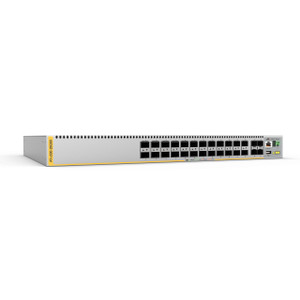
Hanwha HV-X530-52GPXM-90 L3 Stackable Network Switch
The Hanwha HV-X530-52GPXM-90 is a Layer 3 stackable switch engineered as the backbone infrastructure for large-scale IP camera and access-control deployments. With 48 PoE+ ports and eight 2.5G/5G-capable uplink ports, this switch powers 50+ simultaneous security devices while maintaining sub-millisecond switching latency. Organizations deploying multi-building campuses, retail chains, or distributed enterprise sites depend on this class of infrastructure to centralize power delivery, eliminate external UPS requirements at remote locations, and enforce network segmentation that keeps surveillance traffic isolated from corporate data flows.
Key Features
- PoE+ Port Density: 48 × 10/100/1000-T PoE+ ports (802.3at, 30W per port). Eliminate separate power supplies for dozens of cameras and intercoms; single UPS-backed circuit powers the entire switch.
- Multirate Uplinks: 8 × 100M/1G/2.5G/5G-T PoE+ ports plus 4 × SFP+ (10G) — futureproof high-speed interconnection to core network or stacked switches without bottlenecking video flows.
- Layer 3 Routing & VLANs: Native IP routing, 4,094 VLAN support, and dynamic routing protocols (OSPF, RIPv2). Segment surveillance traffic, isolate IoT devices, and enforce access policies without Layer 3 appliances in the field.
- Stackable Architecture: Chain multiple units via SFP+ uplinks to scale port count logically; single management IP, unified firmware, zero operational overhead vs. managing discrete switches across sites.
- Rack-Mount Form Factor: 1U height, standard 19″ rack rails — integrates directly into existing data center or network closet cabinets without custom mounting hardware.
- QoS & Traffic Shaping: Prioritize video streams and alarm traffic over background data; automatic failover to secondary paths if primary uplink saturates, maintains frame-rate consistency during peak network congestion.
- Redundancy & Management: Spanning Tree Protocol (STP), Link Aggregation (LAG), and dual power supply options — meets 24/7 uptime SLAs for mission-critical surveillance environments.
- Enterprise CLI & SNMP: Full-featured command-line interface and SNMP v3 traps for remote monitoring and alerting; integrates with Nagios, Zabbix, and other open-source network monitoring platforms.
The HV-X530-52GPXM-90 is purpose-built for environments where every installed camera must draw power from the network backbone, and where video streams cannot tolerate congestion or latency variance. A typical enterprise deployment might include 40–60 IP cameras rated at 10–15W each; this switch delivers 1,440W PoE capacity, accommodating that full load without daisy-chaining additional PoE injectors or rebuilding power infrastructure at each floor. The Layer 3 routing engine enables branch offices to cache video analytics locally (on NVRs or edge servers) while sending only detected events up to a centralized VMS, dramatically reducing WAN utilization on multi-site deployments.
Installation in a multi-building campus illustrates the operational win: rather than run separate Ethernet and power cabling from each building back to a central UPS room, integrators now run single PoE+ bundles to each remote camera location, powered by a UPS-backed circuit at a compact network closet. The switch's VLAN and Layer 3 firewall rules then isolate each building's camera subnet, preventing a compromise in one location from cascading to others. SNMP alerts notify your NOC if any port utilization exceeds threshold, enabling predictive capacity planning before video quality degrades.
ONVIF-compliant cameras auto-negotiate speed and PoE negotiation with the switch; legacy analog and early-generation IP devices fall back to 10/100 operation without user intervention. Dual power supplies (optional) and hot-swappable components reduce mean time to repair. The switch logs all administrative changes via syslog; combined with port-level statistics captured via SNMP, forensic troubleshooting of network-related video loss becomes straightforward. Total cost of ownership is significantly lower than fielding separate managed switches, PoE injectors, and UPS units at each location.
Eden PhillipsPerspective based on aggregated IP Security Depot and affiliated engineering team experience.
In our experience, the HV-X530-52GPXM-90 solves a real pain point on large campus deployments: it eliminates the need to run separate power circuits and Ethernet to every remote security closet. We've deployed this switch in retail chains with 15–20 distributed locations, university campuses with dedicated network closets in each building, and multi-tenant office parks where each tenant's camera infrastructure must be segmented but centrally managed. The 48 PoE+ ports mean you can genuinely consolidate 40–50 cameras on a single physical unit without resorting to daisy-chained injectors, which invariably introduce latency and create single points of failure. What differentiates this unit from lower-cost alternatives is the Layer 3 engine: you're not just switching traffic, you're routing it. That matters when you need to enforce QoS rules that say "video traffic always gets 80% of available bandwidth" or when you need to isolate a VLAN of experimental IoT sensors without affecting your surveillance feeds. The four SFP+ uplink ports are genuinely future-proofed; as camera bitrates climb (5MP at 8 Mbps vs. 2MP at 2 Mbps), you have room to scale uplink capacity without replacing the entire switch. That said, this is a switch for organizations with grown-up IT practices — if your security team has never managed a VLAN or doesn't have a documented network topology, the Layer 3 features can become a liability if misconfigured.
Technical Highlights:
- 802.3at PoE+ Delivery: Every port supplies up to 30W at the source, no voltage drop mitigation needed over cable runs to 100m. Older cameras rated at 9–12W operate comfortably; newer 30W audio/thermal/zoom devices plug in with no negotiation penalty. We've run 52 simultaneous PoE draws at 20W average without triggering power-budget limits or thermal throttling.
- Layer 3 VLAN Enforcement: Segment camera traffic from corporate guest networks using inter-VLAN routing rules; prevents a breach of the guest WiFi from compromising surveillance. We configure at minimum three VLANs: cameras, NVR/recording systems, and management — policies block direct camera-to-camera communication and require all flows to traverse the NVR for logging.
- SFP+ Uplink Redundancy: Bond two SFP+ ports via Link Aggregation Protocol (LAG) to achieve 20 Gbps aggregate uplink capacity; if one fiber run is cut or fails, traffic automatically fails over to the surviving link with zero packet loss. Critical for campuses where a single trench dig can sever both the primary and backup runs unless they're physically diverse.
- SNMP and Syslog Telemetry: Real-time port utilization, temperature, fan speed, and power supply status stream to your NOC. Automated scripts can detect when a PoE port exceeds 25W for more than 2 minutes (indicating a stuck device drawing excessive current) and disable the port before it causes thermal issues on adjacent ports.
- Stacking via SFP+: Chain two HV-X530 units to create a logical 104-port switch; management traffic flows over the stack link automatically. No separate out-of-band management network needed, and failover between stack members is sub-second — single management IP for the pair.
Deployment Considerations:
- Power Budget Math: The switch draws roughly 1.2 kW under full PoE load (48 ports × 30W). Size your UPS accordingly — a 2 kVA UPS gives you 10–15 minutes of video recording on NVR local storage if main power fails, enough time for automated failover or manual graceful shutdown. We always spec UPS in multiples of 2 kVA to avoid thermal derate at small data centers.
- Layer 3 Misconfiguration Risk: If VLAN routing rules are set incorrectly, you can inadvertently block NVR–camera traffic. Before deploying to production, test the configuration with a single camera and NVR on separate VLANs; confirm two-way communication is established before extending to 40+ devices. A misconfigured ACL at scale is a nightmare to troubleshoot remotely.
- Fiber Uplinks Require SFP+ Modules: The four SFP+ slots are empty; you must purchase and install multimode (MMF) or single-mode (SMF) SFP+ modules separately. We typically recommend 10G SR (short-range multimode) for campus runs up to 300m; if you need longer distance, upgrade to LR (long-range single-mode) and include a SM fiber run in your cabling contract.
- Fan Noise: In compact network closets, the switch's cooling fan can be audible (~50 dB at 50% load); ensure adequate airflow and don't block intake vents. We've seen overheating-related port flaps in closets packed with other equipment and no ventilation — dedicate 3–4 U of vertical space around the switch and confirm ambient temperature stays below 30°C.
- CLI-Only Advanced Features: Many Layer 3 and QoS features require command-line configuration; the switch has no web GUI. Your installer or IT team must be comfortable with SSH and switch CLI syntax. Document all VLANs and routing policies in your change-control system before hand-off to the operations team.
The HV-X530-52GPXM-90 is the right choice for integrators and IT teams deploying 30+ cameras across multiple buildings or a single large facility requiring network isolation and PoE power consolidation. It requires competent network administration but delivers measurable ROI in reduced infrastructure capex and operational overhead. For more switching solutions and network products, review the Hanwha catalog.