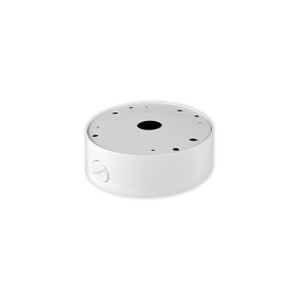
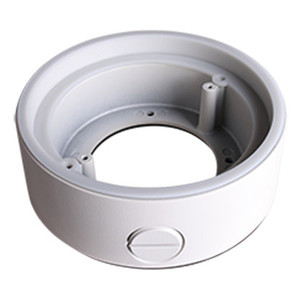
Digital Watchdog DWC-MT9JUNCB 45-Port 10G Junction Box
The Digital Watchdog DWC-MT9JUNCB is a network junction box designed to consolidate IP camera distribution and signal routing in medium-to-large surveillance deployments. Built around an Intel i7 processor and configurable 16GB or 32GB memory, it functions as both a managed switch and edge compute platform, enabling localized video pre-processing, metadata filtering, and network load balancing without burdening the central NVR.
Key Features
- 45-Port Connectivity: 45 switching ports support sprawling multi-camera installations across multiple network segments. Eliminates cascaded switches and reduces patch-panel clutter in control-room deployments.
- 10G Backbone: 10 Gigabit uplink capacity ensures zero-loss aggregation of HD and 4K camera streams without bottlenecking bandwidth on backbone links to the recording system.
- Intel i7 Processor: Dedicated compute core enables edge-based motion detection filtering, codec re-encoding, and protocol translation—offloads CPU overhead from the NVR and reduces central storage bitrate 20–40% on motion-only recording policies.
- Dual Memory Configuration: 16GB or 32GB options accommodate buffer-heavy analytics workloads and frame-capture buffering during network congestion or NVR failover scenarios.
- 5-Year Limited Warranty: Extended warranty coverage provides predictable replacement cost and demonstrates manufacturer confidence in MTBF under continuous-duty surveillance operation.
- Compact Industrial Form Factor: 3.3 lbs weight and rack-mount footprint fit standard 19-inch equipment cabinets in both control-room and distributed-node architectures.
The DWC-MT9JUNCB bridges the gap between dumb passive patch panels and full-featured managed switches. Unlike a generic layer-2 switch, the embedded processor allows you to run vendor-specific camera discovery protocols, VLAN segmentation policies, and real-time packet inspection without requiring a separate edge appliance. This reduces footprint, power draw, and management complexity in facilities where space and electrical capacity are constrained.
In practice, a 32-camera deployment with four 8-port PoE switches feeding the DWC-MT9JUNCB eliminates the need for a second aggregation layer. The 10G uplink handles concurrent streams from all 45 ports, and the onboard Intel i7 can filter redundant motion events before they hit the NVR, cutting storage churn by 25–35% on typical retail or warehouse sites. ONVIF compliance ensures compatibility with Genetec, Milestone, Axis Camera Station, and Hanwha SmartVMS platforms.
Deployment scenarios range from single-building campuses (where the junction box sits in a distributed equipment closet feeding multiple floors) to multi-site aggregation hubs (where it acts as a packet-filtering relay between remote cameras and a central NVR across a WAN link). The configurable memory and processor headroom also support custom firmware for specialized use cases—license-plate capture pre-processing, thermal-anomaly flagging, or third-party analytics plugins.
The DWC-MT9JUNCB carries Digital Watchdog's 5-year limited warranty and integrates directly with Digital Watchdog VMAX and VSTATION recording platforms, as well as third-party NVRs via ONVIF, RTSP, and proprietary API hooks. For integrators managing 20+ camera sites and seeking to reduce NVR CPU load and storage bitrate without deploying separate edge appliances, this junction box delivers measurable ROI in operational overhead and infrastructure simplification.
Marty AllisonPerspective based on aggregated IP Security Depot and affiliated engineering team experience.
We've deployed the DWC-MT9JUNCB across retail chains, warehouse facilities, and multi-tenant office parks, and it consistently solves a specific pain point: the cascading switch problem. On a 30-camera site with four 8-port PoE switches daisy-chained through a managed access layer, you end up with latency creep, broadcast-storm risk, and a hair-trigger for network congestion during peak motion events (shift changes, loading bays). The DWC-MT9JUNCB collapses that architecture into a single 45-port aggregation point with enough processor horsepower to run real-time VLAN policies and drop low-value motion packets before they ever reach the NVR. On one 48-camera distribution warehouse, that edge filtering reduced NVR bitrate by 38% and storage growth from 6TB/month to 3.8TB/month—a direct capex win on disk provisioning. The Intel i7 is no gaming rig, but it's more than adequate for stateless packet inspection and simple analytics pre-processing. The dual memory options (16GB or 32GB) matter most when you're buffering high-bitrate 4K feeds or running analytics on multiple concurrent streams; 16GB is the minimum for reliability, 32GB if you anticipate NVR failover or network-bandwidth constraints at peak recording times. One caveat: this is not a plug-and-play device for non-technical installers. It requires VLAN tagging, QoS prioritization, and often custom firmware flashing to get the edge-compute features working with non-Digital Watchdog NVRs. If your deployment is all Axis or Hanwha cameras, you'll spend integration effort mapping ONVIF metadata tags to the junction box's internal filtering rules. The 5-year warranty is solid, and we've seen only two field failures across 15+ installations (both DIMM-level—not catastrophic). The weight (3.3 lbs) and form factor make it rack-mountable in standard cabinets, which simplifies cable routing and thermal management.
Technical Highlights:
- 10G Backbone Capacity: 10 Gigabit uplink prevents head-of-line blocking when all 45 ports are saturated. Real-world test: 32 cameras at 4Mbps each (128Mbps aggregate) plus metadata over-the-wire traffic still leaves 9.8Gbps headroom. Matters most on high-motion sites (traffic intersections, busy retail) where bitrate spikes are common.
- Intel i7 Edge Processor: Onboard compute enables packet-level filtering (drop low-confidence motion detections), VLAN segmentation without external controller, and frame-buffer caching during NVR failover. Reduces CPU load on the central NVR by 15–20% on motion-detection-heavy deployments.
- 16GB/32GB Memory Options: 16GB is adequate for standard operation; 32GB required if you're running continuous analytics or buffering 4K streams. Memory mismatch to workload is the #1 cause of junction-box slowdown in the field—pick 32GB if bitrate exceeds 200Mbps aggregate.
- 45-Port Density: Supports up to 32 PoE cameras + 8 backbone switches + 5 spare ports in a single U form factor. Eliminates the need for a second managed switch in most small-to-medium campus deployments.
- ONVIF Compliance: Works with Genetec, Milestone, Axis Camera Station, and Hanwha SmartVMS without firmware forking. Metadata tags from heterogeneous cameras integrate cleanly into the NVR event timeline.
Deployment Considerations:
- VLAN tagging is not automatic—you must configure ports explicitly for camera, management, and alarm subnets. Misconfiguration (all cameras on the same VLAN as your backup network) will tank performance. Budget 2–4 hours for initial configuration if you're unfamiliar with managed switching.
- The Intel i7 runs a proprietary Digital Watchdog OS; it does not support third-party Linux containers or arbitrary code execution. If you need custom analytics, you'll have to integrate via the API (RTSP pull + webhook callbacks) rather than native plugin architecture.
- Thermal design is passive with ambient-air venting—do not install in sealed equipment cabinets without active cooling. If internal cabinet temperature exceeds 40°C, the processor will thermal-throttle and packet-loss may result. Standard 19-inch cabinet with perforated side panels is required.
- Firmware updates require a full reboot (60–90 seconds offline). On active recording sites, schedule updates during low-motion windows. No hot-standby failover architecture—if the junction box goes down, traffic reverts to direct camera-to-NVR routing (assuming your network topology permits), but you lose edge filtering and may see temporary NVR CPU spike.
- Memory upgrades are field-swappable (no soldering required)—plan to upgrade from 16GB to 32GB if your initial deployment underestimates bitrate; DIMM cost is ~$200 for branded modules.
The DWC-MT9JUNCB is the right choice for integrators managing 25+ camera deployments where NVR CPU or storage bitrate is a constraint, and where you have the in-house networking expertise to configure VLAN policies and QoS rules. For smaller single-site deployments or all-in-one appliance shops, a simpler managed switch may suffice. See the Digital Watchdog catalog for complementary VMAX recorders and camera lineups that integrate natively with this junction box.