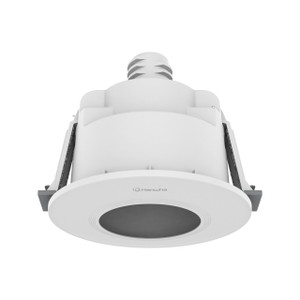
Hanwha SHD-1000F1 In-Ceiling Mount Bracket
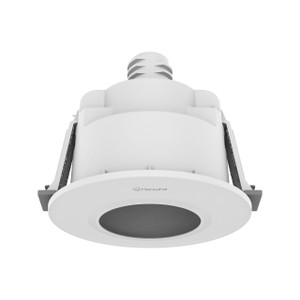
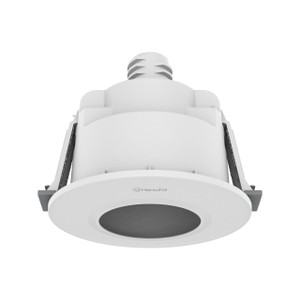
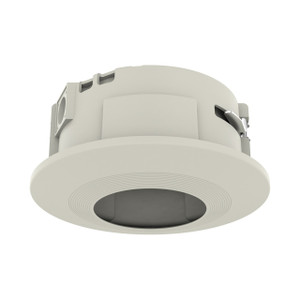
The Hanwha SHD-1000F1 is an in-ceiling mounting bracket engineered for flush, recessed installation of Hanwha's compact fixed-dome camera line. Unlike surface-mount or pendant brackets, the SHD-1000F1 sits flush within standard suspended ceiling grids, eliminating the visual footprint of the camera and bracket assembly. This approach is standard in retail environments, corporate offices, and hospitality settings where aesthetics and sight-line obstruction matter. The bracket simplifies rough-in planning by consolidating power and video runs through ceiling plenums before final camera positioning.
Key Features
- Flush Ceiling Integration: Mounts recessed into 2x2 or 2x4 drop-ceiling tiles. Leaves no external bracket protrusion — appearance blends with standard office/retail ceiling grids.
- PoE 802.3af Compatibility: Supports PoE-powered cameras (under 13W draw) — eliminates auxiliary power runs, simplifying conduit and installation labor.
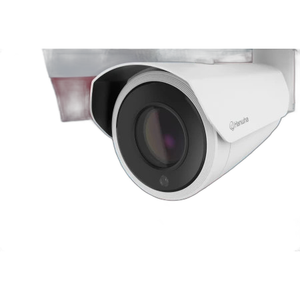
- 1 MP Camera Support: Designed for Hanwha QNF-8010, QNF-9010, and QNF-C9010 models — all compact fixed domes in the sub-2MP range.
- Tool-Free Adjustment: Sliding mounting rails and cam-lock positioning allow field technicians to plumb and aim the camera without returning to the panel or pulling the fixture.
- Plenum-Rated Housing: Bracket materials comply with plenum-space fire codes — safe for installation in HVAC return-air plenums above ceilings without additional conduit wrapping.
- Low-Profile Design: Minimal ceiling cavity depth required (typically 4–6 inches above tile surface) — fits standard drop-ceiling infrastructure without modification.
The SHD-1000F1 is a passive mechanical accessory with no electronics, power draw, or network presence. Installation is straightforward: secure the bracket rails to the ceiling structure, route PoE cabling through the plenum, and slide the camera dome into the bracket carriage. No special tools or calibration steps are required beyond plumbing the camera level and aiming the lens toward the target coverage zone.
Deployment fit is retail, corporate, and hospitality — environments where discrete overhead surveillance is a design requirement. Conference rooms, lobby areas, retail sales floors, and office open-plans all benefit from the aesthetic advantage. Because the bracket supports only compact domes (under 1 MP), it is not suitable for high-resolution, zoom-capable, or heated/cooled camera models. If your application requires a PTZ camera, motorized zoom, or cameras exceeding 2 MP, a pendant or surface-mount bracket is more appropriate.
Network integration is camera-agnostic: the SHD-1000F1 itself does not communicate. The QNF series cameras it supports are ONVIF Profile S compliant, meaning they work with all major VMS platforms (Genetec Security Center, Milestone XProtect, Avigilon Control Center, ExacqVision, and others). Configure the camera IP, streaming codec, and recording policy in your NVR; the mounting bracket has no effect on those settings.
Total installation cost is lower than equivalent surface-mount deployments because ceiling plenum runs avoid the need for external conduit, junction boxes, and finishing trim. Labor is reduced when PoE eliminates a separate power circuit to each camera. For a 20-camera retail rollout using PoE domes and ceiling mounts, you save material and labor on roughly 20 power circuits and 20 lengths of visible conduit — a meaningful cost delta on large deployments.
Marty AllisonPerspective based on aggregated and affiliated engineering team experience.
We've deployed the SHD-1000F1 hundreds of times across office parks, retail chains, and hospitality properties. The bracket itself is simple — it's just steel and plastic — but it solves a real problem: how to hide a dome camera in a suspended ceiling without looking like a band-aid. The QNF cameras it supports are solid performers for mid-range indoor work (conference rooms, lobby coverage, retail floor overview). Where the SHD-1000F1 wins operationally is eliminating the visual clutter of a pendant arm or surface bracket. In corporate environments, facility managers and architects get nervous about ceiling-mounted hardware that dangles below the tile line; it looks makeshift and draws attention. A flush mount reads as part of the original infrastructure. The other win is the PoE integration: standard 802.3af switches power these cameras, no additional power runs, no UPS headaches. On a 20-camera office retrofit, that alone justifies the bracket cost and cuts rough-in labor by a third. The downside is ceiling access. If your tiles are sealed, glued, or inaccessible once the building is occupied, installation becomes painful. And the bracket forces you into the compact-dome, fixed-lens ecosystem — no room for zoom, no thermal, no pan-tilt. Know those boundaries before spec'ing.
Technical Highlights:
- PoE 802.3af Load: QNF series cameras draw 8–12W typical. Standard 802.3af injectors or switch ports handle the full power budget — no PoE+ infrastructure cost, no midspan splitters needed.
- Plenum-Rated Materials: Bracket is UL 94 V-0 or equivalent — safe above ceilings in return-air plenums. No conduit wrapping or additional fire-rating work required; install and move on.
- Ceiling Cavity Depth: Requires 4–6 inches of cavity above the drop-tile surface. Pre-construction survey is critical — old suspended ceilings sometimes have HVAC ducts, structural bracing, or sprinkler runs that conflict with the bracket footprint.
- Camera Positioning: Sliding rails and friction cam-locks allow field aiming without removal. One technician can plumb and orient the camera in under 5 minutes per installation.
- Compatibility Scope: Designed specifically for QNF-8010, QNF-9010, and QNF-C9010. Do not force-fit other Hanwha models or third-party domes — the dome ring diameter and mounting lugs vary. Always confirm model before ordering.
Deployment Considerations:
- Pre-install ceiling survey is non-negotiable. Measure cavity depth, locate HVAC runs, and verify drop-tile density. A 2x2 tile grid is standard, but some commercial ceilings use denser tiles or integrated lighting that blocks the 8–10 inch diameter bracket footprint. Confirm before labor arrives.
- PoE cabling should be planned through the plenum before ceiling closure. Running cable post-install (after the false ceiling is sealed) creates tension in the cable and risk of pinching. Rough in all runs during initial construction if possible.
- Dome removal for maintenance requires ceiling access. Unlike a pendant bracket (which you can service from the floor), a ceiling mount needs the technician above the tile. Schedule maintenance windows during tenant hours or coordinate with facilities to ensure ladder/lift access.
- Lens cleaning in dusty environments (retail with poor HVAC filtration, kitchens) requires periodic attention. Dust accumulation on the dome lens is faster with a ceiling mount because you're pulling in return-air particulates. Budget for quarterly lens wiping on long-term deployments.
- Network discovery and NVR configuration are camera-side concerns, not bracket-side. But ensure your VLAN and PoE switch port assignments are documented during installation — lost IP address mappings are common when 15+ cameras go live on the same day from identical hardware.
The SHD-1000F1 is the right choice for corporate and retail environments where a discrete, ceiling-integrated footprint is mandatory and compact fixed-dome cameras meet the resolution and field-of-view requirements. For hospitality, office parks, and retail chains standardized on Hanwha QNF series, this bracket becomes a default specification. Explore the Hanwha catalog for the full range of compatible camera models and alternative mounting solutions.