HPE S7U41A 48-Port 128GB Short Wave Integrated Fibre Channel Switch Blade
Overview
The HPE S7U41A is a 48-port short wave integrated Fibre Channel switch blade designed for blade server enclosure environments where consolidating SAN fabric connectivity into the chassis backplane reduces external cabling overhead and simplifies fabric management. At 14.33 lb, it is sized for blade infrastructure deployments where per-chassis switching density matters — 48 ports in a blade form factor means fewer standalone switches to rack, license, and manage across a SAN fabric expansion.
The S7U41A carries a 128GB buffer capacity, relevant in environments where bursty I/O from multiple blade nodes — virtualization hosts, database workloads, or backup streams — can create congestion at the fabric layer. Adequate buffer depth helps the switch absorb traffic spikes without dropping frames, which translates directly to storage application stability under mixed workloads.
As part of the HPE storage and networking line, this blade is intended to integrate with HPE blade enclosure platforms, allowing Fibre Channel fabric capacity to scale with the enclosure rather than requiring separate top-of-rack SAN switches. This matters in dense compute environments where rack space and cable management are constrained.
Key Features
- 48-Port Capacity: 48 Fibre Channel ports in a blade form factor provides high per-chassis port density — relevant when connecting multiple blade servers plus uplinks to core SAN directors without deploying additional standalone switches.
- 128GB Buffer: The 128GB integrated buffer is the spec to watch in write-heavy or bursty workloads. Insufficient fabric buffers cause credit starvation and frame drops; this capacity is sized for multi-node blade chassis deployments where several hosts may burst simultaneously.
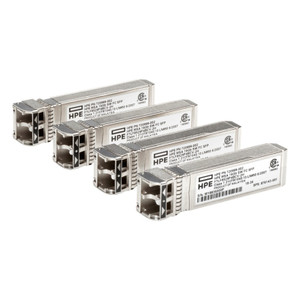
- Short Wave (SW) Optics: Short wave transceivers operate over multimode fiber, the standard in data center structured cabling. If your SAN runs OM3 or OM4 multimode, SW connectivity integrates without requiring long-wave optics or single-mode plant — lower cost per port.
- Blade Form Factor: Installing SAN switching as a blade module rather than a standalone appliance eliminates dedicated switch rack units and the associated power, cooling, and patch cable overhead. For HPE blade enclosures, this is the correct integration path for embedded FC fabric.
- Weight at 14.33 lb: At just over 14 pounds, this blade module occupies its chassis slot without adding significant floor-load overhead — relevant when calculating enclosure weight limits in raised-floor data centers with per-rack load specifications.
Integration and Compatibility
The S7U41A is designed for installation within compatible HPE blade enclosure switching infrastructure. Before procuring, confirm the target enclosure model and blade bay specifications against HPE's enclosure compatibility matrix — Fibre Channel switch blades are enclosure-specific and are not interchangeable across generations or competing blade platforms. Verify supported FC speeds and supported SFP transceiver types with HPE's QuickSpecs for the specific enclosure you are deploying into.
For environments running VMware, Hyper-V, or similar hypervisors on HPE blades, fabric-integrated FC switching simplifies the storage path: each blade server connects to the SAN fabric via the enclosure backplane rather than discrete HBA cabling, which reduces points of failure and eases zoning administration. Pair with compatible HPE storage arrays or third-party SAN directors depending on your fabric topology.
SAN architects planning fabric expansion should also review Fibre Channel switch documentation for inter-switch link (ISL) port allocation and supported fabric topologies before committing port counts to a design.
Frequently Asked Questions
Q: What blade enclosure platforms is the HPE S7U41A compatible with?
A: The S7U41A is an HPE blade switch module. Compatibility is enclosure-specific — consult HPE's QuickSpecs and enclosure compatibility matrix for your target BladeSystem or Synergy chassis before ordering.
Q: What fiber type does the S7U41A short wave interface require?
A: Short wave Fibre Channel optics operate over multimode fiber (typically OM3 or OM4). Single-mode or long-wave infrastructure requires different optic modules not covered by this blade's SW designation.
Q: What is the port count on the S7U41A?
A: The S7U41A provides 48 Fibre Channel ports in a blade module form factor.
Q: What does the 128GB specification refer to on the S7U41A?
A: Based on the product designation, 128GB refers to the switch blade's buffer or memory capacity. Verify the precise technical meaning (shared buffer vs. dedicated per-port) against HPE's official QuickSpecs for this part number.
Q: Can the S7U41A be used as a standalone rack-mount switch?
A: No. As a blade module, the S7U41A installs into a compatible HPE blade enclosure. It is not a standalone appliance and requires the enclosure infrastructure for power, cooling, and backplane connectivity.
The HPE S7U41A comes up most often in conversations about consolidating SAN fabric into an existing HPE blade enclosure rather than deploying standalone FC switches. The 48-port count is the headline number — in a dense blade chassis, that port density covers server-side connections plus ISL uplinks without a separate switch consuming rack space and power budget. That said, the evidence available for the S7U41A is limited to distribution feed attributes; I'd strongly recommend pulling HPE's QuickSpecs for this part before finalizing a design.
Technical Highlights:
- 48 FC Ports: Enough port capacity to connect a fully populated blade chassis and reserve ports for ISL uplinks to a core director — eliminates a standalone edge switch entirely in mid-size SAN deployments.
- 128GB Buffer Capacity: Buffer depth matters when multiple blade nodes burst I/O simultaneously (backup jobs, VM migrations, database checkpoints). Adequate buffer prevents credit starvation that would otherwise cause frame drops and storage application timeouts.
- Short Wave Multimode: SW optics keep per-port cost down versus long-wave, and they match the OM3/OM4 multimode plant already present in most enterprise data center structured cabling — no rewiring required.
Deployment Considerations:
- Blade switch modules are enclosure-generation-specific — confirm the S7U41A is listed in HPE's compatibility matrix for your specific BladeSystem or Synergy chassis before ordering. A mismatch means a non-functional blade bay, not a degraded one.
- The distribution feed lists the interface as 'Ethernet,' which conflicts with the Fibre Channel designation in the product name. Treat that attribute as a feed artifact and verify the actual port technology with HPE QuickSpecs before designing zoning or selecting HBAs.
This blade fits cleanly into HPE blade enclosure environments where the SAN fabric needs to scale with compute without adding external switch infrastructure — the right call for mid-size virtualization clusters or database tiers already running on HPE blades where simplifying the storage path is the priority.