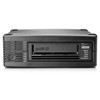
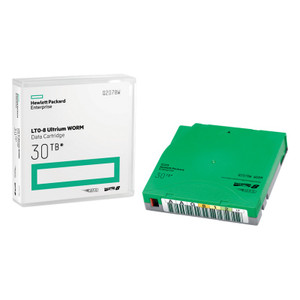
HPE Q2079W LTO-9 Ultrium WORM Data Cartridge
The HPE Q2079W is an LTO-9 Ultrium WORM (Write Once Read Many) data cartridge rated at 18 TB native capacity (45 TB compressed at 2.5:1) — the right choice for regulated industries and long-retention compliance archives where data must be provably unalterable after write. Built on Barium Ferrite (BaFe) magnetic media on a Poly-Ethylene-Napthalate (PEN) base film, this cartridge is engineered to the full LTO-9 Ultrium specification with 8,960 data tracks across a 12.65 mm tape width. If your retention policy, legal hold process, or audit framework requires immutable tape storage, the Q2079W is the cartridge to spec.
Overview
WORM cartridges occupy a specific and non-negotiable role in storage architecture: once data is written, it cannot be overwritten or erased. The Q2079W enforces this at the cartridge hardware level — not through software policy alone — which is what gives it standing in SEC 17a-4, HIPAA, FINRA, and similar compliance frameworks. This is not a general-purpose backup cartridge; it is a compliance storage medium. Pair it with an LTO-9-capable tape library or standalone drive in your tape backup and storage environment, and you have a fixed-cost, air-gapped, immutable record that no ransomware attack or administrative error can silently corrupt.
HPE's HPE storage tape media line spans LTO-8 through LTO-9 in both standard read/write and WORM variants. The Q2079W is the LTO-9 WORM entry; the Q2079A is the standard read/write equivalent at the same 18 TB native capacity if your workload doesn't require write-once enforcement.
Key Features
- 18 TB Native / 45 TB Compressed Capacity: At 18 TB native per cartridge, a single Q2079W holds more than three times what an LTO-8 cartridge holds at its native capacity — meaning fewer cartridges to manage, label, and store per TB of compliance data. The 45 TB compressed figure assumes a 2.5:1 compression ratio; real-world numbers depend on data type (already-compressed video or encrypted files compress poorly).
- WORM Hardware Enforcement: Write-once behavior is enforced at the cartridge level, not only through software. This distinction matters for auditors and legal hold reviewers who need hardware-level evidence that data has not been altered post-write. Software-only WORM policies can be bypassed by administrators with sufficient privilege; hardware WORM cannot.
- Barium Ferrite (BaFe) on PEN Base Film: BaFe formulation provides the magnetic stability needed for the 8,960-track, 1.16 μm track pitch geometry of LTO-9 recording. PEN base film contributes dimensional stability across temperature and humidity ranges — the cartridge spec shows temperature sensitivity below 10 nm/°C and humidity sensitivity below 20 nm/%RH, which matters if your tape vault isn't climate-controlled to data-center tolerances.
- 997 m of Usable Data Tape (1,035 m Total): The 38 m difference between total and usable length is leader/trailer. The 997 m of active tape at an RLL recording bit density of 21.459 Kb/mm and 21,890 tracks per inch contributes directly to the 18 TB native figure. This isn't a marketing number — it is an engineering derivation from the physical tape geometry.
- 9 m/s Rewind Speed: Fast rewind matters in high-volume library environments where cartridge swap time drives throughput. At 9 m/s over 997 m of usable tape, full-cartridge rewind completes in roughly 115 seconds — relevant when you are cycling through multiple cartridges in a restore job or end-of-day compliance snapshot.
- 32,756-Byte Cartridge Memory (CM): The embedded cartridge memory chip stores tape usage history, write counts, load cycles, and data location indexes. This lets LTO-9 drives perform fast file searches without full tape traversal, and it gives your library management software the data it needs for predictive media health monitoring. On WORM cartridges, CM also records write-once status flags that the drive reads before allowing any write operation.
- 280 Wraps / 4 Data Bands / 8,960 Data Tracks: These geometric parameters define the LTO-9 recording layout. Four data bands allow simultaneous multi-channel reads and writes across the tape width, which is part of how LTO-9 achieves its transfer rates. More wraps mean more passes per band — the density gain over LTO-8 is largely delivered here.
- Dimensional Stability Specification: TDScreep below 100 nm, TDSenv_age below 175 nm, and TDSusage below 200 nm — these are not marketing claims, they are mechanical tolerances that define how much the tape track geometry shifts under storage aging, environmental changes, and mechanical use. Staying within these tolerances is what keeps an LTO-9 drive able to read back data written years earlier.
Integration and Compatibility
The Q2079W is compatible with LTO-9 Ultrium tape drives and libraries. LTO-9 drives also read LTO-8 media (one generation back), but they do not write to LTO-8 cartridges — so in a mixed environment, verify your drive generation before ordering WORM media. WORM cartridges require explicit WORM support in the host backup application; confirm your tape library management software or backup application (Veeam, Commvault, Veritas NetBackup, IBM Spectrum Protect, etc.) supports LTO WORM before deploying. The Q2079W carries the HPE product number Q2079W — note that Q2079A is the standard (non-WORM) LTO-9 variant; verify you have ordered the correct SKU for your compliance requirement. Consult your backup software vendor's compatibility matrix to confirm LTO-9 WORM support in your specific version. For organizations building out a full data protection strategy, pairing WORM cartridges with an off-site rotation policy or vault service closes the air-gap loop against both ransomware and physical site loss.
Frequently Asked Questions
Q: What is the difference between the HPE Q2079W and the Q2079A?
A: Both are LTO-9 Ultrium cartridges with 18 TB native / 45 TB compressed capacity. The Q2079W is a WORM (Write Once Read Many) cartridge — data written to it cannot be overwritten or erased. The Q2079A is a standard read/write cartridge. Choose Q2079W when your compliance, legal hold, or regulatory framework requires provably immutable media.
Q: What drives are compatible with the Q2079W?
A: The Q2079W requires an LTO-9 Ultrium-capable tape drive or library. LTO-9 drives read LTO-8 media but do not write to it. WORM cartridge operation also requires that the host backup application explicitly supports LTO WORM — verify compatibility with your backup software vendor.
Q: How much data does the Q2079W hold?
A: 18 TB native. The 45 TB compressed figure assumes a 2.5:1 compression ratio, which is achievable on uncompressed or low-entropy data. Already-compressed or encrypted data (video files, ZIP archives, encrypted backups) will compress minimally — plan capacity around native figures for those workloads.
Q: Can data written to the Q2079W ever be erased or overwritten?
A: No. WORM enforcement on the Q2079W is at the cartridge hardware level. Once data is written to a WORM segment, neither software nor administrative override can alter it. The cartridge memory flags are also write-once for WORM status, so the drive enforces this on every load.
Q: What is the tape base film material and why does it matter?
A: The Q2079W uses Barium Ferrite (BaFe) magnetic particles on a Poly-Ethylene-Napthalate (PEN) base film. PEN provides superior dimensional stability compared to earlier base materials — the cartridge spec shows temperature sensitivity below 10 nm/°C and humidity sensitivity below 20 nm/%RH, which reduces read errors in environments where temperature and humidity fluctuate.
Q: What compliance frameworks is the Q2079W appropriate for?
A: Hardware WORM tape media is commonly used to satisfy immutable storage requirements under SEC Rule 17a-4, FINRA, HIPAA, and similar regulations that mandate non-alterable records retention. Consult your compliance officer or legal counsel to confirm the Q2079W meets your specific regulatory requirements — the cartridge provides the hardware enforcement mechanism, but compliance depends on your full storage and process architecture.
The Q2079W is one of those SKUs where the spec that matters most is the one that doesn't appear on a throughput chart: hardware-enforced WORM. At 8,960 data tracks across a 12.65 mm tape width and a cartridge memory capacity of 32,756 bytes logging every write event, this cartridge gives compliance teams something they can actually take to an auditor — not a software policy that an admin can toggle, but a physical medium where the drive's own firmware refuses to overwrite. I've seen too many organizations deploy software WORM and then discover their backup application version had a flag that bypassed it. That risk doesn't exist here.
Technical Highlights:
- 18 TB Native / 8,960 Tracks: The track density of 21,890 TPI and 1.16 μm track pitch is what enables the 18 TB figure on a 997 m usable tape length. This is fully LTO-9 Ultrium specification — not a vendor-proprietary format. Any LTO-9 drive that supports WORM media will read and write this cartridge.
- BaFe / PEN Dimensional Stability: Temperature sensitivity below 10 nm/°C and humidity sensitivity below 20 nm/%RH mean this cartridge can be stored in environments that drift — an off-site vault or a remote office tape rotation — without the track geometry shifting enough to cause read failures on retrieval years later.
- 32,756-Byte Cartridge Memory: CM is what makes fast partial restores possible on LTO-9. The drive indexes data location into CM on write; on restore, it navigates directly rather than traversing the full 997 m. On a WORM cartridge, CM also carries the immutable write-once status flag — the hardware enforcement starts here, before the drive ever moves the tape.
Deployment Considerations:
- Verify your backup application version explicitly supports LTO-9 WORM before deploying Q2079W in production. Not all backup software versions that support LTO-9 read/write have WORM-aware write policies enabled by default — check the release notes, not just the compatibility matrix header.
- Plan capacity on native (18 TB), not compressed (45 TB), for any workload involving encrypted backups, compressed video, or pre-compressed databases. The 2.5:1 ratio is a best-case figure for uncompressed structured data; encrypted or already-compressed streams will land at or near 1:1.
The Q2079W is the right cartridge for financial services, healthcare, and legal hold environments where an external auditor or regulator will ask for evidence that archived records have not been altered — and where a software policy statement is not sufficient to close that question.