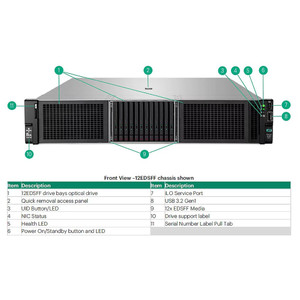
HPE P65984-B21 DL380 Gen11 All-Flash Node for Microsoft Azure HCI
The HPE P65984-B21 is a purpose-built all-flash server node in the ProLiant DL380 Gen11 family, configured specifically for Microsoft Azure Stack HCI deployments. If you are architecting a hyperconverged infrastructure stack that requires validated Azure HCI hardware, this is HPE's factory-configured answer — a node that ships ready to join an Azure HCI cluster without custom assembly or firmware guesswork. At 91.09 lb, it is a dense 2U platform intended for permanent rack installation in a data center or hardened server room, not edge or branch closets.
The "AF" designation signals an all-flash storage configuration, which means no spinning-disk bottlenecks during VM I/O bursts — the workloads Azure HCI is designed to run (VMs, virtual desktops, containerized workloads) benefit directly from consistent low-latency storage response versus hybrid or HDD-based nodes. For teams consolidating compute and storage under a single Microsoft-managed fabric, the all-flash profile removes a common performance variable from capacity planning.
The DL380 Gen11 platform is HPE's workhorse 2U chassis, widely deployed across enterprise, healthcare, and government infrastructure. Sourcing a node in this validated Azure HCI configuration means the hardware-software compatibility has already been verified against Microsoft's HCI catalog requirements — avoid the friction of manually validating firmware, driver stacks, and BIOS settings against the Azure HCI compatibility list.
The P65984-B21 (also searched as P65984 B21) ships as a factory-new unit. Integration into an existing HPE or Microsoft environment should be coordinated with your storage and virtualization teams ahead of rack installation — this node is designed to operate within a cluster, not as a standalone server. Confirm your Azure HCI cluster sizing, network topology (RDMA/RoCE or iWARP fabric requirements), and HPE iLO management network plan before deployment.
Frequently Asked Questions
Q: What is the HPE P65984-B21 used for?
A: The P65984-B21 is a DL380 Gen11 All-Flash Node configured for Microsoft Azure Stack HCI deployments. It is intended to be racked as part of a validated hyperconverged infrastructure cluster.
Q: Is the P65984-B21 a standalone server or cluster node?
A: It is a cluster node. Azure HCI requires a minimum of two nodes to form a cluster — this unit is not designed to operate as a standalone single-server deployment.
Q: What does the "AF" designation mean in the P65984-B21 product name?
A: AF stands for All-Flash, indicating the node is configured with solid-state storage rather than spinning-disk or hybrid drives.
Q: How much does the P65984-B21 weigh?
A: The unit weighs 91.09 lb. Plan for appropriate rack load ratings and at least two people or a lift for physical installation.
The P65984-B21 sits in a specific lane: it is not a general-purpose ProLiant — it is an Azure HCI-validated all-flash node, which means HPE and Microsoft have pre-qualified the hardware configuration against the HCI compatibility catalog. That matters in practice because Azure HCI is sensitive to driver and firmware versions, and buying a validated node eliminates a significant pre-deployment checklist.
Technical Highlights:
- All-Flash Storage Configuration: The AF designation means every storage tier in this node is solid-state — no rotational latency penalty during peak VM I/O, which is the workload Azure HCI is built around.
- DL380 Gen11 Platform: The Gen11 chassis is HPE's current-generation 2U, with broad ecosystem support for HPE iLO, OneView, and Agentless Management — relevant if your ops team already manages HPE infrastructure at scale.
- 91.09 lb Unit Weight: Dense platform — rack installation requires physical planning. Confirm your rack's rated load capacity before adding additional nodes to the same rail set.
Deployment Considerations:
- Azure HCI minimum cluster is two nodes — budget and rack space accordingly before ordering a single P65984-B21 unit.
- Network fabric planning (RDMA over RoCE or iWARP) must be completed before cluster commissioning; the node itself does not define the fabric — your switch selection does.
This node is the right fit for enterprise IT teams standardizing on Microsoft's Azure HCI platform who want an HPE-validated all-flash foundation rather than assembling a compatible configuration from parts.