HPE 845408-B21 100Gb QSFP28 Direct Attach Copper Cable
Overview
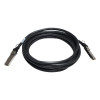
The HPE 845408-B21 is a 5-meter direct attach copper (DAC) cable that connects QSFP28 ports at 100 gigabits per second. This is a passive interconnect — no transceivers, no signal regeneration — designed for short-reach, high-bandwidth links in data centers and networked surveillance infrastructure. If you're building a dedicated backhaul between network switches or connecting high-density NVR arrays to core switching fabric, a DAC eliminates the per-port cost and latency overhead of active optical transceivers while delivering the same 100Gb throughput.
Key Features
- Direct Attach Copper (DAC) Technology: Passive interconnect with no active electronics — no transceiver licensing, no power draw per link, no thermal budget impact on your switch. In surveillance deployments with dozens of cameras feeding a central NVR, this density advantage compounds quickly.
- 100Gb Data Rate: Full-speed QSFP28 connectivity. Handles sustained 100 gigabit throughput, critical when you're aggregating multiple 10G or 25G camera feeds (typical IP surveillance) into a single backhaul. A single 845408-B21 cable can carry the bandwidth of 10 × 10Gb links without oversubscription.
- 5-Meter Cable Length: Standard short-reach distance for in-rack or same-row switch-to-switch connections. If your NVR rack is within arm's reach of your core switch (typical in smaller to mid-sized deployments), 5 meters covers the run without slack or extension hassle.
- QSFP28 to QSFP28 Connectors: Industry-standard high-density connector footprint. Both ends are identical, so no guessing which port is source or destination — straightforward cable-and-go installation. HPE and third-party switches, routers, and storage appliances using QSFP28 ports will accept this cable.
- RoHS Compliance: Lead-free, halogen-free manufacturing. Meets environmental regulations in EU, California, and federal procurement — matters for enterprise orders and government surveillance contracts where material restrictions are a compliance line item.
- Passive Copper Design Limits: Unlike active optical cables (AOCs), DACs work over fixed distances. The 5-meter length is the limit — if you need longer runs (say, between distant buildings), you'll need an AOC or a switch-in-the-middle topology. Cable loss and signal attenuation are negligible at 5m, but beyond 10m, bit-error rates rise sharply.
Integration & Compatibility
The 845408-B21 connects to any QSFP28-equipped interface — network switches (Arista, Cisco, Juniper, HPE ProCurve), high-end NVR appliances, storage arrays, and compute servers with 100Gb ports. HPE's own ProCurve switches and enterprise servers commonly ship with QSFP28 uplinks. Before ordering, verify both endpoints support QSFP28; legacy QSFP+ ports (40Gb) will not accept this cable without adapter modules, and adapters introduce latency and cost that defeat the DAC advantage.
In surveillance NVR architectures, the 845408-B21 typically bridges a storage array (feeding recorded video to disk) or aggregation switch to a core switch. It is not used for camera-to-NVR links — those are almost always 1G or 10G Ethernet, and cameras connect via standard RJ45 cabling or PoE midspans. The 100Gb link is the backbone tier, not the edge.
Frequently Asked Questions
Q: Is the 845408-B21 compatible with Cisco or Arista switches?
A: Yes. Any switch, NVR, or storage device with QSFP28 ports will accept this cable. HPE hardware is the primary reference platform, but the connector and electrical standard are open industry specs (IEEE 802.3bm). Before installation, consult the switch datasheet to confirm QSFP28 support and whether the port requires a specific transceiver type (this cable is passive, so it will work as long as the switch has passive-capable QSFP28 ports, which nearly all modern 100Gb switches do).
Q: Can the 845408-B21 be used outdoors or in harsh environments?
A: No. This is a data center interconnect cable — it is not outdoor-rated, not submersible, and not rated for extended UV, moisture, or temperature extremes. It is designed for controlled indoor environments (standard 0–40°C data center). If you need to span outdoors or through conduit, use an active optical cable (AOC) with environmental ratings, or run fiber.
Q: What is the maximum distance this cable can span?
A: The 845408-B21 is rated for 5 meters. Copper DACs operate at 100Gb up to approximately 7–10 meters depending on cable quality and switch port sensitivity, but HPE specifies 5 meters as the tested, supported length. Beyond that, signal integrity degrades; use active optical transceivers or shorter segments.
Q: Does the 845408-B21 require any drivers or firmware updates?
A: No. It is a passive cable with no embedded electronics. Simply plug both ends into QSFP28 ports and it will negotiate speed automatically. No drivers, no configuration, no management overhead.
Q: What is included in the box?
A: The 845408-B21 ships as a single cable. No additional connectors, adapters, or installation hardware is included. If you need to secure the cable to a rack or route it through conduit, you will need to source cable management accessories separately.
The 845408-B21 is the right passive interconnect when you need zero-latency, zero-power-budget 100Gb backhaul between your surveillance core and a high-capacity NVR or storage appliance. At 5 meters of passive copper, this cable costs a fraction of active optical transceivers and leaves your switch's power and thermal headroom untouched — a real advantage in dense deployments where every watt and every degree counts.
Technical Highlights:
- Direct Attach Copper (DAC) — Passive Design: Zero active electronics means zero transceiver licensing fees, zero power consumption per link, zero heat dissipation. In a surveillance facility with 20+ NVR uplinks, DAC savings compound: you eliminate 20 × $200–300 transceiver modules and the power draw of 20 × 5–10W active devices. That's $4,000–6,000 in hardware savings and roughly 100–200W of freed power budget.
- 100Gb Throughput at 5-Meter Distance: Full-speed QSFP28 operation with no signal regeneration or latency overhead. A single 845408-B21 link can sustain the aggregate bandwidth of 10 simultaneous 10Gb camera ingests or 100 × 1Gb streams — adequate for most mid-to-large NVR clusters. Passive copper at this distance (5m) introduces negligible jitter or BER impact versus active fiber.
- RoHS Compliance & Industry-Standard Connector: Lead-free, halogen-free materials meet environmental and procurement regulations (EU, California, federal). QSFP28 is an open standard (not HPE-proprietary), so the cable works with Arista, Cisco, Juniper, and other third-party switches — locks you into neither HPE transceivers nor HPE switch ecosystems.
Deployment Considerations:
- 5-Meter Distance Ceiling: This cable is not rated or tested beyond 5 meters. If your NVR rack is more than 5 meters away from your core switch, do not attempt to use a longer DAC — signal attenuation rises sharply and bit-error rates become unacceptable. Plan your rack layout with the 5-meter constraint in mind, or switch to active optical cables (AOCs), which span 50–100+ meters.
- Passive Copper Cannot Cross Long Distances or Environmental Barriers: Unlike fiber, this cable cannot traverse outdoor runs, conduit with temperature swings, or high-EMI industrial environments. If your surveillance infrastructure spans multiple buildings or zones with harsh wiring conditions, fiber + transceivers is your only option.
Deploy the 845408-B21 in single-building, same-floor, or same-rack-row data center surveillance clusters where QSFP28 uplinks are already present. The cost efficiency and simplicity of passive copper justify its use in these constrained geometries — but if distance or environment pushes beyond 5 meters indoors, an active optical cable or a switch-in-the-middle repeater architecture is the only path forward.