Product images are provided for reference and may not represent the exact model, configuration, or included
components.
Build a complete system in one click
Manufacturer-verified compatible cameras, recorders, mounts, accessories, and licenses for this product.
Build Your Complete System
Manufacturer-verified compatible cameras, recorders, mounts, accessories, and licenses for this product. Adjust quantities and add the entire bundle to your cart in one click.
ItemQtyStatusPrice
Mounts & Accessories recommended
Recorders, NVRs & Storage recommended
Licenses & Software where applicable
Services & Training optional
$0.00$0.00$0.00$0.00$0.00$0.00
No Bots, Just Experts
Questions about this product? Free pre-sales support from a senior specialist — product questions, compatibility checks, BOM quotes, price confirmation — typically answered within one business day. Need camera placement or system design work? Engineering time is $175 per hour (qty 1 = 1 hour). Hardware buyers get up to one hour ($175) credited back on their order.
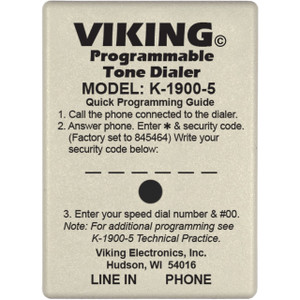
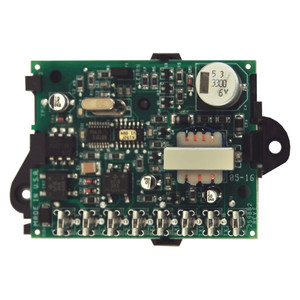
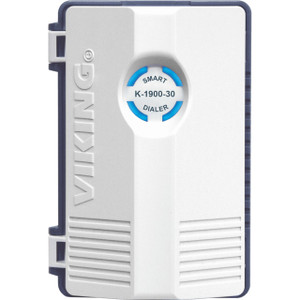
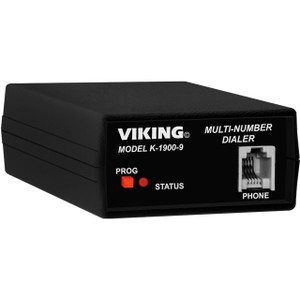
Viking Electronics K-1900-4 Hot-Line Telephone Line Dialer
Overview
The Viking Electronics K-1900-4 is a telephone line-powered hot-line dialer built for environments where a single-button or automatic outbound call to a pre-programmed number is exactly what the job demands — guard stations, emergency call points, elevator phones, and access-controlled entry vestibules. Because the K-1900-4 draws power directly from the telephone line, there is no separate power supply to provision, no battery to replace, and no AC outlet required at the installation point. Non-volatile E2 memory retains the programmed speed dial number through power interruptions without a backup battery — a meaningful advantage in facilities where the dialer may sit dormant for weeks between events.
Programming is handled via any touch-tone phone, so field technicians can configure or reprogram the unit without special hardware or proprietary software. The K-1900-4 (often searched as K 1900 4) connects via a standard RJ-11 plug, dropping into any analog POTS line or compatible analog FXS port on a PBX or VoIP gateway.
Key Features
Telephone Line Powered: The K-1900-4 derives all operating power from the telephone line itself — no AC outlet, no power supply, no battery. This eliminates a failure point and simplifies rough-in on remote or hard-to-access installations like elevator cabs or gate pillars.
Non-Volatile E2 Memory: Programmed speed dial numbers survive power loss without a backup battery. In emergency call applications, this matters: the dialer will not lose its target number if the line is interrupted and restored.
Touch-Tone Programmable: Configure the unit using any touch-tone phone connected to the line. No laptop, no proprietary dongle, no on-site software — useful when technicians need to reprogram remotely or during commissioning without carrying extra tools.
1–16 Digit Speed Dial: Supports programmed numbers up to 16 digits, covering standard domestic extensions, direct-dial long-distance numbers, and internal PBX extensions without truncation.
Selectable Dialing Speed — 10 pps or 20 pps: Dual pulse-per-second options let you match the dialer to the line equipment at the other end. Older central office equipment and some legacy PBX systems require 10 pps; 20 pps accelerates call setup on capable infrastructure.
6-Digit Security Code: A six-digit code protects the programmed speed dial number from unauthorized reprogramming. In public-facing or unsupervised locations, this prevents casual tampering with the emergency destination.
Ring Detection: The unit detects inbound ring signals and will not auto-dial on an incoming call — an important behavioral guardrail that prevents false outbound calls triggered by inbound ring voltage.
RJ-11 Interface: Standard modular RJ-11 connection integrates with any analog telephone port — POTS, FXS on a PBX, or an ATA adapter — without adapters or punch-down terminations at the device.
FCC Part 15 Class A: Meets FCC Part 15 Class A digital device requirements and carries a Ringer Equivalence Number below 5, confirming it will not overload standard telephone line capacity when combined with other devices on the same line.
Hearing Aid Compatible Amplified Handset (K-1900 Series): The K-1900 series supports hearing aid compatible amplified handsets with rotary volume control, making the platform viable for ADA-sensitive installations such as public emergency phones and assisted-living facilities.
Integration and Compatibility
The K-1900-4 connects to any analog two-wire telephone line via its RJ-11 plug. It is compatible with POTS lines, analog extensions from traditional PBX systems, and FXS ports on VoIP gateways or ATAs — the key requirement is a standard analog loop-start line that supplies loop current. The dialing speed selection (10 pps or 20 pps) allows compatibility tuning to the receiving switch or central office. Installers integrating the unit behind a VoIP gateway should verify that the ATA or gateway supplies adequate loop current and supports DTMF detection, as touch-tone programming requires DTMF recognition on the line. The sub-5 REN rating means the K-1900-4 can share a line with other devices without exhausting the line's ringer load limit.
For facilities requiring access control integration at entry points, the K-1900-4 pairs naturally with door entry systems that include an analog telephone interface — the dialer handles the outbound call leg while the door controller manages strike or latch release. Review the broader Viking Electronics catalog for companion products including door controllers, amplified handsets, and entry systems designed to work within the same telephone-line-powered architecture. Integrators planning multi-point emergency call systems should also consider intercom systems for sites where two-way audio to a central console — rather than a speed-dial call — is the right topology. For trunk capacity and analog port planning, reference a network infrastructure review to confirm adequate FXS port availability on your gateway or PBX. Sites with VoIP conversion needs should consult an analog-to-VoIP migration guide for gateway compatibility notes.
Frequently Asked Questions
Q: Does the K-1900-4 require an external power supply or batteries?
A: No. The K-1900-4 is telephone line powered — it draws all operating power from the telephone line itself. No AC outlet, no power supply, and no batteries are required or included.
Q: Will the programmed speed dial number be lost if power is interrupted?
A: No. The K-1900-4 uses non-volatile E2 memory, which retains the programmed number through power interruptions without a battery backup.
Q: How do I program the speed dial number on the K-1900-4?
A: Programming is done using any touch-tone phone connected to the telephone line. No proprietary software or hardware is required. The unit is protected by a 6-digit security code to prevent unauthorized reprogramming.
Q: What dialing speeds does the K-1900-4 support?
A: The K-1900-4 supports selectable pulse dialing at either 10 pulses per second (pps) or 20 pps, allowing compatibility with a range of central office and PBX switching equipment.
Q: Can the K-1900-4 be used on a VoIP or PBX analog extension?
A: Yes, provided the FXS port or analog extension supplies standard loop-start signaling and adequate loop current. The standard RJ-11 interface connects to any analog telephone port. Confirm that the gateway or PBX supports DTMF detection for touch-tone programming to function correctly.
Q: What is the maximum speed dial number length the K-1900-4 can store?
A: The K-1900-4 supports speed dial numbers from 1 to 16 digits, covering standard extensions, direct-dial numbers, and long-distance numbers.
Senior Specialist · Typically replies within 1 business day
Message sent!
A representative will reply to your email within one business day.
Build a complete system in one click
Manufacturer-verified compatible cameras, recorders, mounts, accessories, and licenses for this product.
Build Your Complete System
Manufacturer-verified compatible cameras, recorders, mounts, accessories, and licenses for this product. Adjust quantities and add the entire bundle to your cart in one click.