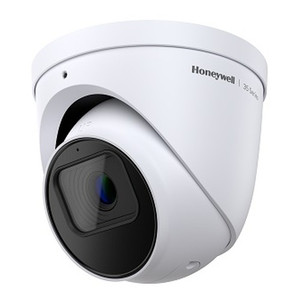
Honeywell HC35WE8R2 S35 8MP Ball Camera with PoE
Overview
The Honeywell HC35WE8R2 is an 8-megapixel ball-style IP camera from Honeywell's S35 series, powered over a single Ethernet run via PoE — no separate power supply needed at the camera location. At 8MP, it delivers substantially more pixel density than a standard 4MP or 1080p camera, giving you the ability to crop and zoom digitally in post-review without losing the detail needed for evidence-grade identification. If you're specifying cameras for retail, commercial interiors, or light industrial environments where resolution matters for identification at range, the HC35WE8R2 is worth evaluating against your project's coverage requirements.
The ball form factor is well-suited to corner and wall mounting where quick pan adjustment during commissioning is practical — the ball joint allows the installer to aim the camera before locking down, reducing rework compared to fixed-mount designs. As part of the Honeywell IP camera lineup, the HC35WE8R2 sits in the S35 performance tier, targeting commercial deployments that need meaningful resolution without moving up to a full 4K platform.
Key Features
- 8MP Resolution: Four times the pixel count of 1080p — at a given field of view, you get more identifiable detail per subject. Useful when a single camera needs to cover a wider area without sacrificing face or license plate legibility at the edges of frame.
- PoE Powered: Draws power directly from your PoE network switch over the same Cat5e/Cat6 run carrying video. Eliminates the need for a local power outlet at each camera position, simplifying installation in drop-ceiling and conduit runs.
- Ball-Style Mounting: The S35 ball housing allows the installer to freely adjust aim across a wide angular range before locking, which reduces time spent on fine positioning during commissioning — a practical advantage on multi-camera installs.
- S35 Series Platform: Designed within Honeywell's S35 commercial camera family, providing a consistent ecosystem for sites that standardize on a single vendor platform for simplified support and sparing.
Integration and Compatibility
The HC35WE8R2 connects over standard Ethernet and is powered via PoE, making it compatible with any 802.3af/at-capable switch in your infrastructure. For VMS integration, confirm ONVIF profile support with your video management platform prior to deployment — Honeywell's commercial cameras are generally supported by major VMS platforms, but verify against your specific version. Pair with a network video recorder sized for your channel count and retention requirements. For a guide on matching cameras to storage and NVR capacity, see our camera selection guide.
Frequently Asked Questions
Q: What resolution does the HC35WE8R2 record at?
A: The HC35WE8R2 captures at 8 megapixels, which provides significantly more detail than standard 4MP or 1080p cameras — useful for scenes where you need identifiable detail across a wider field of view.
Q: Does the HC35WE8R2 require a separate power supply?
A: No. The HC35WE8R2 is PoE-powered, drawing power directly over the Ethernet cable from a compatible PoE switch. No local power outlet is required at the camera location.
Q: What does the 'ball' form factor mean for installation?
A: The ball-style housing allows the camera body to be freely repositioned within the mount before locking, making aim adjustment straightforward during commissioning without special tools or bracket changes.
Q: Is the HC35WE8R2 suitable for outdoor use?
A: Environmental ratings (IP/IK) for the HC35WE8R2 are not confirmed in the available specification data. Verify ingress protection rating with Honeywell's current datasheet before specifying for outdoor or harsh-environment use.
The HC35WE8R2 is one of those cameras where the 8MP sensor is the primary argument for selection — if your scene requires identification-grade detail at the edges of a wide field of view and you want to avoid adding a second camera to cover the same zone, the pixel density here gives you room to crop digitally in review without the image falling apart. That said, I'd want to confirm IP rating and lens specification from Honeywell's current datasheet before finalizing a spec for any outdoor or semi-exposed location.
Technical Highlights:
- 8MP Sensor: Delivers four times the pixel count of a 1080p camera — at equivalent field of view, you get more identifiable detail per subject, which matters in evidence review scenarios.
- PoE Power Input: Single-cable installation over Cat5e/Cat6 simplifies conduit planning and eliminates local power drops at each camera position — a real labor and materials saving on multi-camera projects.
- Ball-Mount Design: Faster to aim and lock during commissioning compared to fixed-bracket designs, reducing per-camera install time on larger deployments.
Deployment Considerations:
- Confirm current IP/IK ratings from Honeywell's product datasheet before specifying for outdoor, wash-down, or exposed environments — environmental ratings are not confirmed in the available evidence for this SKU.
- At 8MP, storage and bandwidth requirements are meaningfully higher than lower-resolution cameras — size your NVR and network infrastructure accordingly, especially on 24/7 continuous recording deployments.
Best fit for commercial interior deployments — retail floors, lobbies, warehouses — where 8MP resolution provides the detail margin needed for post-event identification without requiring multiple overlapping lower-resolution cameras to cover the same zone.