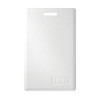
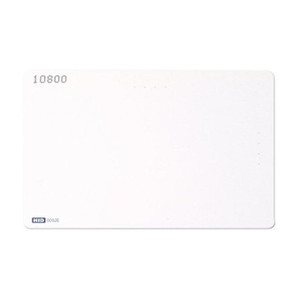
Honeywell PX-KEY-H Proximity Keytag FOB
Overview
The Honeywell PX-KEY-H is a commercial-grade RF proximity keytag credential designed for use with compatible Honeywell access control systems. In the keytag FOB form factor, it clips to a keychain or badge reel — keeping the credential on the user rather than buried in a wallet or lanyard pouch, which reduces the habit of "loan me your card for a second" workarounds that plague flat-card-only deployments. If you are provisioning a Honeywell-based access control system and need a keychain-friendly credential option alongside or instead of proximity cards, the PX-KEY-H is the format to specify.
Key Features
- RF Proximity Technology: Contactless RF read means the user presents the fob to the reader without physical insertion — faster throughput at high-traffic doors and less mechanical wear on both the credential and the reader.
- Keytag FOB Form Factor: The compact keytag shape attaches directly to a key ring. Users are less likely to leave a fob behind than a loose card, which reduces re-issue costs in high-turnover environments like warehouses, retail back-of-house, and light industrial facilities.
- Commercial-Grade Construction: Specified for commercial security deployments, the PX-KEY-H is built to handle the daily abuse of a shared keychain — pocket friction, drops, and the occasional spin cycle.
- US Origin: Manufactured in the United States, which is a relevant factor for procurement teams with domestic-sourcing requirements or TAA-sensitive contracts. Verify TAA compliance status with your procurement team against current GSA schedule requirements before specifying for federal work.
- Honeywell Ecosystem Fit: Designed to integrate within the broader Honeywell commercial security access control line — coordinate with your panel and reader model to confirm credential format compatibility before bulk ordering.
Integration and Compatibility
The PX-KEY-H is positioned as a commercial proximity credential within the Honeywell security portfolio. Proximity credentials operate on standardized RF frequencies and bit formats (commonly 26-bit Wiegand), but exact compatibility depends on the reader and panel configuration in your specific installation. Before deploying PX-KEY-H fobs across a site, confirm the facility code and bit format match what your access control panels and readers are programmed to accept. Mixing credential formats from different procurement batches without verifying facility codes is one of the most common — and avoidable — commissioning problems in access control rollouts. Review the proximity credentials section for companion card formats if a mixed card-and-fob deployment is required.
Frequently Asked Questions
Q: What access control systems is the PX-KEY-H compatible with?
A: The PX-KEY-H is designed for use with compatible Honeywell commercial access control systems. Verify reader and panel compatibility — specifically the credential format (bit length and facility code range) — with your Honeywell system documentation or a pre-sales engineer before bulk ordering.
Q: Is the PX-KEY-H a 26-bit Wiegand credential?
A: The available evidence does not confirm the specific bit format. Contact Honeywell or a pre-sales specialist to confirm the bit format and facility code configuration before ordering for a live system.
Q: Can the PX-KEY-H be used with third-party access control readers?
A: Proximity credentials using standard Wiegand output can often work across brands, but compatibility is not guaranteed. Confirm the reader protocol and credential format match before specifying the PX-KEY-H for a non-Honeywell reader installation.
Q: What is the warranty on the PX-KEY-H?
A: The PX-KEY-H carries a manufacturer warranty. Contact Honeywell or your point of purchase for specific warranty duration and terms applicable to this SKU.
Q: Is the PX-KEY-H NDAA Section 889 compliant?
A: Honeywell is a US-based manufacturer and the PX-KEY-H is noted as US-origin. However, NDAA Section 889 compliance status for this specific SKU has not been confirmed in the available evidence. Verify directly with Honeywell for procurement requiring NDAA documentation.
The PX-KEY-H is the kind of credential decision that gets made quickly in the field and causes headaches six months later if the facility code and bit format weren't confirmed upfront. As a keytag FOB, it solves a real end-user compliance problem — people keep their keys on them, so the credential travels with the user rather than getting left at a desk or loaned to a coworker. That alone justifies specifying the FOB format over flat cards for certain user populations.
Technical Highlights:
- RF Proximity (Contactless): No physical contact with the reader means faster door throughput and no reader slot wear — meaningful in high-cycle entryways like shift-change access points.
- Keytag Form Factor: Attaches to a key ring, which structurally ties the credential to something the user already carries. In high-turnover environments, this reduces lost-credential re-issue frequency compared to card-only deployments.
- US Manufacture: Domestically manufactured origin supports TAA-sensitive procurement pipelines — confirm formal TAA compliance documentation with Honeywell before specifying for federal or GSA contract work.
Deployment Considerations:
- Before ordering in volume, lock down the facility code and bit format with your Honeywell panel and reader configuration. Ordering a batch of PX-KEY-H fobs without confirming these parameters against your installed reader hardware is a common commissioning error that requires a full re-order to fix.
- The published evidence does not include read range, operating frequency, or specific panel compatibility list for the PX-KEY-H — obtain the full Honeywell credential datasheet from Honeywell directly to validate fit before specifying for a new installation.
The PX-KEY-H fits best in commercial facilities running Honeywell access control where the user population benefits from a keychain credential — warehouse floor workers, light industrial shift staff, or any site where flat cards get lost, shared, or left at home regularly.