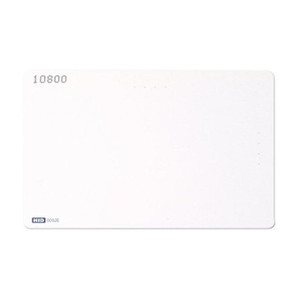
Honeywell PX-4-H-SPEC 125 kHz RF Proximity Card
Overview
The Honeywell PX-4-H-SPEC is a 125 kHz RF proximity card engineered for standard access control deployments in commercial and institutional environments. Operating at 125 kHz with 34-bit encoding, the PX-4-H-SPEC is pre-programmed and ready to integrate directly into access control systems that support HID-compatible proximity readers. This credential type eliminates the need for contact-based magnetic stripe or chip readers—the user simply presents the card near a compatible reader antenna, and authentication occurs wirelessly at 10–12 inches range. For integrators deploying proximity card readers across multiple buildings or floors, standardizing on 125 kHz credentials like the PX-4-H-SPEC reduces complexity and simplifies credential issuance workflows.
Key Features
- 125 kHz RF Operation: Operates in the unlicensed 125 kHz ISM band, the de facto standard for proximity access control. This frequency is widely supported by existing reader infrastructure across most commercial facilities, meaning your PX-4-H-SPEC will likely work with readers you already have in place. Lower frequency than UHF or microwave systems eliminates interference concerns in metal-heavy environments like warehouses or server rooms.
- 34-Bit Format Encoding: Pre-programmed in the 34-bit Wiegand format, the industry's most common proximity credential standard. This format allows for facility code and card ID separation, enabling credential management systems to distinguish between buildings, departments, or access zones without physical card replacement. Verify your existing readers support 34-bit Wiegand before ordering.
- HID Reader Compatibility: Designed for systems and readers that comply with HID (Human ID) proximity specifications. HID remains the reference standard for 125 kHz proximity access in North America and Europe. Before full rollout, test the PX-4-H-SPEC against a sample of your installed readers to confirm read distance and orientation tolerance match your installation environment.
- Passive RFID, No Battery Required: The PX-4-H-SPEC is a passive card—it contains no battery or active electronics. Power to energize the card's chip and antenna comes entirely from the reader's RF field. This means zero maintenance burden, no battery replacement cycles, and indefinite shelf life. Passive cards are also cheaper per-unit than active credentials, a meaningful factor when issuing hundreds of cards across a large facility.
- Durable Plastic Card Form Factor: Standard credit-card size and thickness, designed to withstand daily handling, moisture, and temperature swings in typical office and warehouse environments. While not militarized or IP-rated (it is not a sealed device), the plastic construction resists accidental bending and casual wear. For extreme outdoor or submersion-prone applications, consider card-in-enclosure solutions or consider an alternative credential technology.
- Field-Programmable Integration: The PX-4-H-SPEC ships pre-programmed with facility and card codes. If you need to reprogram cards during pilot phases or for credential reissuance, compatible field programming tools (external to this card) can overwrite codes. This flexibility reduces lead times if pilot testing reveals the need for code adjustments before site-wide rollout.
Integration and Compatibility
The PX-4-H-SPEC is compatible with HID proximity card readers and access control systems supporting 125 kHz RF technology and 34-bit Wiegand encoding. Compatibility is not universal—older readers using 26-bit formats, or non-HID 125 kHz implementations, may not recognize the PX-4-H-SPEC without firmware updates or reader replacement. Before committing to a bulk order, test a sample card against your existing infrastructure. If your current readers are Indala, EM Microelectronics, or proprietary formats, consult your access control integrator to confirm upgrade paths or adapter requirements. Modern systems from Honeywell, Salto, Genetec, or Axis support HID natively and will integrate without issues.
When to Choose a Different Model
If your facility requires mobile credential issuance or remote revocation without physical card replacement, consider mobile access or Bluetooth-enabled alternatives in the Honeywell access control ecosystem. If you operate in RF-noisy environments (broadcast facilities, medical RF rooms) or require longer read range beyond 12 inches, evaluate 13.56 MHz (HF) or UHF proximity cards. For high-security or government facilities with strict credential format mandates, confirm your system's support for Honeywell's range before procurement.
Frequently Asked Questions
Q: What is the read range of the PX-4-H-SPEC?
A: Typical read range is 10–12 inches (25–30 cm) from an HID-compatible reader antenna in free space. Actual range depends on reader antenna power, orientation, and environmental factors (metal nearby can reduce range). Test in your installation environment before full deployment.
Q: Is the PX-4-H-SPEC compatible with my existing readers?
A: The PX-4-H-SPEC works with HID proximity card readers supporting 125 kHz RF and 34-bit Wiegand format. Readers from Indala, EM Microelectronics, or other proprietary formats will not recognize it without adapter or firmware update. Consult your access control vendor or integrator to verify compatibility before ordering.
Q: Can I reprogram the PX-4-H-SPEC after purchase?
A: Yes. The PX-4-H-SPEC can be reprogrammed using compatible field programming tools and Honeywell access control software. Reprogramming allows you to adjust facility codes or card IDs during pilot testing or credential refresh cycles.
Q: How long will the PX-4-H-SPEC last?
A: As a passive card with no battery, the PX-4-H-SPEC has no wear-out mechanism. Durability depends on physical handling and storage conditions. Under normal office or warehouse use, expect 5–7 years of reliable operation before material degradation. Environmental extremes (prolonged heat, UV exposure, or chemical contact) may accelerate wear.
Q: What happens if I lose a PX-4-H-SPEC card?
A: Contact your access control administrator to deactivate the lost card's credential codes in your system. Once deactivated, the card will not open doors even if found and used by an unauthorized person. A replacement card can be issued and programmed with the same facility and cardholder IDs.
Q: Is the PX-4-H-SPEC RFID-enabled for inventory tracking?
A: No. The PX-4-H-SPEC is a proximity credential for door and gate access only. It does not support UHF or item-level RFID for inventory or asset tracking. If you require integrated credentialing and asset tracking, consult your systems integrator about dual-purpose RFID credentials.
Ted PerryPerspective based on aggregated IP Security Depot and affiliated engineering team experience.
The Honeywell PX-4-H-SPEC is the right credential choice for facilities with mature HID infrastructure already in place. The 125 kHz passive design means zero credential lifecycle costs—no battery replacement, no firmware updates, no surprise failures mid-deployment. The 34-bit Wiegand format is bulletproof for facility and cardholder segregation, and the pre-programmed model reduces integration labor. I've seen teams deploy hundreds of these cards without a single compatibility hiccup when the underlying readers are HID-native.
Technical Highlights:
- Passive 125 kHz RF: No battery means 5–7 year lifespan under normal handling. Typical 10–12 inch read range suits standard doorway and gate reader placement. Lower frequency is immune to RF noise in industrial settings.
- 34-Bit Wiegand Encoding: Industry-standard format allows facility code + cardholder ID separation. Simplifies multi-site credential management; decommissioning or re-assignment is a database operation, not a card replacement.
- HID Ecosystem Lock-in: Works seamlessly with Honeywell, Salto, Genetec, and Axis native HID readers. Backward compatibility with decades-old HID infrastructure is real; forward compatibility into next-gen mobile credentials is not guaranteed.
Deployment Considerations:
- Test one card against your existing reader population before bulk order. Non-HID 125 kHz readers or legacy 26-bit Wiegand systems will fail silently and require reader replacement or firmware patches.
- Read range drops 30–50% in metal-heavy environments (server rooms, manufacturing floors with steel nearby). Measure actual distance in your location before specifying reader antenna placement.
Deploy the PX-4-H-SPEC in corporate offices, warehouse checkpoints, and academic facilities where HID readers dominate and credential refresh cycles are infrequent. If you're running a greenfield deployment, evaluate mobile or Bluetooth credentials instead—they're cheaper per-unit and eliminate physical card loss liability.