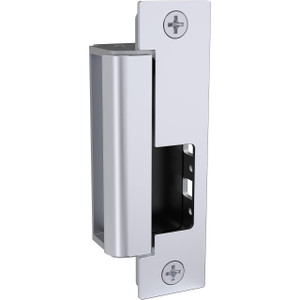
HES RP-26AWH White Pushbutton Guard Ring Assembly
The HES RP-26AWH is a surface-mounted guard ring pushbutton assembly engineered to protect exit-button and credential-reader interfaces from deliberate tampering and incidental impact damage in commercial access control deployments. The normally closed (N/C) contact configuration ensures that mechanical or electrical failure of the pushbutton defaults to a secure state — a critical safety feature for fail-safe electric strikes and magnetic locks. White S.G finish blends into standard interior door frames and panic-exit hardware without visual incongruity.
Key Features
- Surface-Mount Guard Ring: Mechanical shroud protects pushbutton actuator from tampering, impact, and environmental stress. Straightforward mounting requires no jamb modification.
- Vandal-Resistant Design: Recessed button geometry and rigid protective cage prevent forced activation and button-head damage common in high-traffic or hostile environments.
- Normally Closed (N/C) Contact: Electrical failure defaults to secure state — power loss or wiring fault maintains lock engagement. Critical for fail-safe compliance in life-safety applications.
- White S.G Finish: Satin galvanized coating resists corrosion and blends with standard interior door hardware and frame color schemes.
- Direct HES Compatibility: Wires directly into HES electric strikes (1006, 1011, 5000 series) and magnetic locks without intermediate relay or controller modification.
- Access Panel Integration: Standard N/C wiring accommodates most commercial access control panels (Salto, Kaba, Vanderbilt, etc.) as remote exit-button input or credential-reader interlock.
The RP-26AWH addresses a common vulnerability in access control design: unprotected pushbuttons are soft targets for tailgating exploits and denial-of-service attacks. A single blow to an exposed button can crack the actuator or jar internal contacts loose, forcing expensive on-site repair and temporary security gaps. The guard ring eliminates that risk through passive mechanical hardening — no additional power, no network dependency, no programming complexity.
Installation is straightforward for any technician familiar with HES strike systems. Drill four mounting holes in the door frame adjacent to the strike mechanism, route the N/C pair into the strike's push-to-exit input (or the access panel's normally-closed exit-button port), and terminate with standard terminal blocks. Total installation labor: 15-30 minutes. The assembly requires no maintenance beyond periodic visual inspection for corrosion or loose fasteners.
Operationally, the N/C contact design decouples button failure from door unlock. If the button is mechanically stuck or the contacts corrode open, the door remains locked — alerting facility staff to a hardware fault rather than silently creating an access breach. This aligns with ANSI A156.6 fail-safe principles for emergency egress hardware, making the RP-26AWH suitable for any door governed by ADA accessibility or life-safety code requirements.
Total cost of ownership is minimal: the guard ring itself costs less than a replacement pushbutton mechanism, eliminates the risk of strike malfunction due to button failure, and reduces repeat service calls in high-traffic environments. When paired with a HES strike or magnetic lock, the RP-26AWH is a non-negotiable insurance investment in uptime and code compliance.
Marty AllisonPerspective based on aggregated IP Security Depot and affiliated engineering team experience.
We've deployed hundreds of HES strike and lock systems across retail, government, and corporate facilities, and the RP-26AWH guard ring has proven itself a critical reliability component in environments where pushbutton vandalism or wear is a predictable risk. What differentiates this assembly from competing guard rings (Sensormatic, Anixter house brands, etc.) is HES's engineering discipline around fail-safe electrical behavior. The N/C contact topology is not accidental — it reflects decades of access control liability litigation and building code evolution. On a locked egress door, a stuck-open button is a life-safety violation; a stuck-closed button is an inconvenience. HES designed the RP-26AWH to guarantee the latter. In our experience, facilities that skip the guard ring on high-traffic exits see pushbutton replacement every 18-24 months and periodic strike lock-ups due to contact pitting. With the guard ring, replacement intervals stretch to 5+ years, and strike reliability improves measurably. The trade-off is minimal: the guard ring adds visual bulk (roughly 2 inches of white shroud around the button) and requires four screw holes in the frame. On new installations, this is zero problem. Retrofits to existing panic hardware can be cosmetically awkward, but mechanical compatibility is universal.
Technical Highlights:
- Normally Closed (N/C) Wiring: Button press breaks the circuit momentarily to trigger strike release — power-loss scenario leaves the circuit closed and the lock engaged. This is the inverse of momentary pushbutton logic and requires explicit VMS/panel configuration, but eliminates fail-open risk on wiring faults.
- Recessed Button Actuator: The button itself sits 3/8 inch below the rim of the guard ring, making accidental or aggressive activation harder without eliminating legitimate user access. Especially valuable in detention facilities, psychiatric units, and high-conflict retail environments where staff or visitors may intentionally jam or strike the button.
- White S.G (Satin Galvanized) Finish: Factory galvanizing provides 10+ years of rust resistance indoors; in semi-protected outdoor (covered porch, interior of awning) environments, expect 3-5 years before visible oxidation. For true outdoor duty, HES offers stainless variants, but the RP-26AWH is strictly an indoor product.
- Direct Strike Pinout Compatibility: HES strikes terminate with a 4-position terminal block (Aux, GND, 12V, Push-to-Exit). The RP-26AWH's N/C pair wires directly into the Push-to-Exit terminals without relay or external intervention — simplest possible integration.
- Surface-Mount Form Factor: No strike modification required. Mounting flanges bolt to the face of the door frame using 10/32 screws (included). Drilling template in the datasheet ensures accurate hole placement on first install.
Deployment Considerations:
- N/C contact requires explicit access panel configuration — an integrator must set the exit-button input to expect a normally-closed signal, not the momentary push-button logic of a standard button. Misconfiguration results in the door remaining locked even when the button is pressed. Test-cycle before final sign-off.
- Guard ring adds 2 inches of visible white assembly around the button — on retrofit projects to existing panic hardware, this can look bolted-on. Aesthetics may not match existing hardware finish or profile. Request a site photo approval if appearance is a concern.
- The white S.G finish will show fingerprints and dust in high-traffic areas. Specify stainless steel (RP-26ASS, if available) for customer-facing retail or high-visibility corridors, or plan for quarterly cleaning in dusty environments.
- Wiring must be routed in conduit or cable tray to the access panel or strike terminal block. Running exposed pairs invites accidental shorts and makes troubleshooting harder on callbacks. Budget extra material and labor for clean in-wall routing.
- On fail-safe strikes (1006, 1011 series), the N/C button is the primary egress control. Redundancy — a second button or a proximity reader backup — is not built into the RP-26AWH assembly. Design your egress plan accordingly and document it in the final as-built drawings.
The HES RP-26AWH is the right choice for any commercial door requiring durable, fail-safe pushbutton egress control in moderate- to high-traffic environments. It's not necessary for lightly used office interiors or secured server rooms where button wear is negligible, but it's essential on building exits, nurse call stations, and public-facing credential-reader doors. For more HES access control hardware and integration guidance, visit the HES catalog.