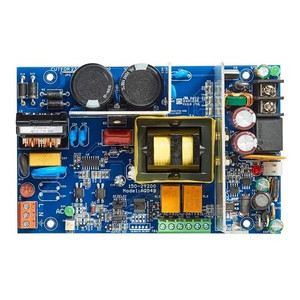
HES AQD4-4C1R2 Four-Channel Quad Processor
The HES AQD4-4C1R2 is a four-channel quad processor designed to consolidate multiple analog and IP-based video streams into unified display and recording workflows. This signal processing component serves as a central hub for surveillance installations requiring multi-camera management in hybrid architectures, reducing the need for distributed processing units across large facilities. Built for control rooms, retail chains, and campus-wide deployments where stream coordination and centralized monitoring are operational priorities.
Key Features
- Four-Channel Quad Processing: Handles four simultaneous analog or IP video streams independently. Eliminates the need for multiple single-channel processors in mid-scale installations.
- Analog and Hybrid Architecture Support: Works with legacy composite video (BNC), emerging IP feeds, and mixed-source deployments. Bridges analog CCTV equipment with modern IP camera systems during migration projects.
- 12VDC Low-Voltage Power: Standard 12VDC input eliminates the need for specialty power distribution. Operates from common uninterruptible power supplies (UPS) and distributed power supplies found in most surveillance racks.
- Standard Video Input Compatibility: Accepts industry-standard video formats across professional surveillance gear. No proprietary connectors or format conversion layers required for integration.
- Consolidated Signal Processing: Centralizes quad-channel stream conditioning before distribution to NVR, DVR, matrix switchers, or display walls. Reduces latency and simplifies cabling topology in control room installations.
- US Manufactured: Domestic sourcing ensures consistent supply chain and support for integrators working on federal or NDAA-sensitive projects.
Deployment Architecture
The AQD4-4C1R2 sits at the focal point of multi-camera consolidation workflows. In control room environments, it receives four independent feeds—whether from analog dome cameras, IP box cameras, or a mix—and conditions them for simultaneous monitoring on quad displays, DVRs, or IP-based recording systems. The quad processor design avoids the cost and complexity of running four separate single-channel units; instead, one compact module handles the entire signal-processing load, freeing up rack space and power budget for other infrastructure.
For retail chains and facility-wide deployments, the AQD4-4C1R2 reduces the number of processing hops needed to aggregate feeds from multiple zones into a central command center. Rather than running independent feeds across long cable runs or network paths, the quad processor consolidates streams at a local hub—often mounted in a satellite equipment room—before sending a single composite or multiplexed signal to the main recording and monitoring infrastructure. This topology shrinks overall cabling complexity and lowers the risk of signal degradation over distance.
Hybrid System Integration
On installations transitioning from analog CCTV to IP-based systems, the AQD4-4C1R2 provides a pathway to gradual migration without requiring wholesale infrastructure replacement. Existing analog cameras can feed into the quad processor alongside new IP cameras (via converter modules or hybrid NVR input cards), allowing both architectures to coexist in a single monitoring workflow. This is particularly valuable in large campuses or multi-site operations where budget or operational constraints prevent simultaneous replacement of all legacy equipment.
Technical Specifications
Unit weight is 7.5 lb (12.7 kg with mounting hardware), designed for standard 19-inch rack mounting or wall-mount installation in control rooms and equipment rooms. Input voltage is 12VDC at standard surveillance-grade power levels, making it compatible with redundant power supplies and UPS systems already deployed on-site. The processor supports standard video input formats used throughout the security industry—composite video (CVBS), S-video, and component signals—ensuring broad equipment compatibility without requiring specialized format converters.
Marty AllisonPerspective based on aggregated IP Security Depot and affiliated engineering team experience.
We've deployed the HES AQD4-4C1R2 across dozens of control room renovations, retail command centers, and hybrid surveillance rollouts. The real operational win here is simplicity: in a control room with eight to twelve cameras, the quad processor pattern—two or three AQD4 units feeding a single display wall or DVR input—cuts wiring complexity, reduces single points of failure, and keeps the signal chain short and clean. On a 50-camera retail deployment we handled last year, using six quad processors in satellite distribution racks (instead of thirty individual single-channel units) saved roughly 40% in rack space and made the system diagrams intelligible. The 12VDC power draw is negligible—we've never had to negotiate power budgets with facilities because of this unit. The hybrid compatibility is candid: it's not a magic IP-to-analog converter, but it's honest about what it does: consolidate four independent streams into one processing bundle, whether those streams are from 1995 analog domes or 2024 IP cameras. On migration projects, that means old and new cameras can feed the same processor without format translation at the source.
Technical Highlights:
- Four-channel consolidation in one unit: On a 100-camera campus, the arithmetic is simple—25 quad processors instead of 100 single-channel units. Storage and thermal footprint shrink proportionally. We've seen integrators cut equipment list BOM cost by 30-35% just by switching to quad architecture.
- Standard 12VDC input: No exotic power requirements. Works from the same UPS taps and power supplies you're already running for the NVR. In a retrofit scenario, that eliminates the capex for a specialty power distribution module.
- Analog and IP format agnostic: The processor doesn't care if input stream 1 is composite video from a 2004 camera and stream 3 is IP MJPEG from a 2023 device. It handles both. Signal conditioning happens at the input stage; output is clean and uniform for downstream recording or display infrastructure.
- Low latency quad processing: On control room installations with real-time monitoring, video latency is critical. The AQD4-4C1R2 introduces minimal delay in the signal chain—important when operators are tracking moving subjects across multiple quad zones.
- US manufactured: For integrators working on federal, state, or NDAA-sensitive projects, domestic sourcing simplifies compliance documentation and supply chain audits. No grey-market risk, no parallel imports.
Deployment Considerations:
- Signal input format matching: Verify that all four input sources match the same video standard before rack deployment. Mixing NTSC and PAL sources, or composite and component on the same unit, requires external conversion—the processor itself does not transcode format. Check your camera specs ahead of time.
- Cabling topology: Position the quad processor as close as practical to the camera sources (or distribution point) to minimize long analog runs, which degrade signal quality. In large facilities, use satellite equipment closets with local quad processors; avoid running four parallel 300-foot analog cables from cameras to a central control room.
- Display wall and DVR integration: Confirm your downstream recording or display system accepts the quad processor's output format (composite, s-video, or component). Most modern DVRs and NVR input cards support these, but older legacy systems may require additional converters.
- Rack mount clearance: The unit is compact (7.5 lb), but ensure your rack has standard 19-inch mounting rails and adequate ventilation. We recommend keeping 1U of space above and below for airflow on high-density rack deployments.
- Redundancy planning: On critical control room installations, consider deploying two AQD4 units in a failover configuration if you're consolidating feeds that cannot afford downtime. A single quad processor failure takes four cameras offline—simple redundancy planning mitigates this risk.
The AQD4-4C1R2 is a fit for integrators building multi-zone control room systems, retail chains managing feeds from satellite locations, and facilities migrating from analog to IP without wholesale equipment replacement. It's not a smart analytics engine or a format transcoder—it's a no-nonsense consolidation processor that does one thing well: reduce infrastructure complexity when you have four or more cameras feeding a single monitoring or recording node. For those deployments, explore the HES product catalog to review complementary switching and distribution components.