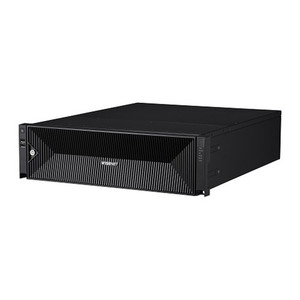
Hanwha SPD-152 64-Channel Video Decoder
Overview
The Hanwha SPD-152 is a professional-grade 64-channel decoder engineered for large-scale IP surveillance deployments. It centralizes multi-camera feeds onto single or dual displays, transforming complex surveillance networks into intuitive, manageable visual displays. The SPD-152 (often searched as SPD 152) supports simultaneous decoding of up to 64 IP camera streams and integrates seamlessly with Hanwha IP cameras as well as any ONVIF-compliant third-party camera ecosystem.
Key Features
- 64-channel simultaneous decoding: Processes up to 64 live streams at once, eliminating the need to subscribe to multiple display devices or software licenses. Scales cost-effectively across large facilities.
- Dual HDMI outputs with asymmetric resolution: HDMI#1 supports 4K (3840×2160@30Hz) for detailed multi-zone monitoring, while HDMI#2 outputs 1080p for secondary displays or backup operator stations. Reduces cabling and infrastructure overhead compared to deploying separate decoders per output.
- Clone and Expand layout modes: Clone mode replicates all 64 channels on a single 4K display for rapid overview scanning. Expand mode distributes channels across both outputs (36 channels on HDMI#1, 25 on HDMI#2) for dedicated zone monitoring. Operators switch layouts without configuration changes.
- Hardware-accelerated H.265 decoding with 8MP@60fps throughput: H.265 compression cuts bandwidth and storage costs roughly in half compared to H.264 — a meaningful factor when recording 24/7 across 30+ simultaneous streams. Maximum sustained performance reaches 8MP at 60 fps, or 2MP at 360 fps for lower-resolution multi-camera overviews.
- Multi-codec support (H.265, H.264, MJPEG): Works with legacy H.264 and MJPEG cameras alongside modern H.265 deployments. No forced camera upgrades; heterogeneous ecosystems integrate without transcoding overhead.
- PoE (IEEE 802.3af) and 12VDC dual power options: Draws 12.95W via standard PoE, so it won't strain typical switch power budgets. Retrofit installations benefit from PoE's single-cable deployment; permanent installations may prefer optional 12VDC. Flexibility reduces site-specific infrastructure costs.
- Up to 20 customizable layouts with sequence mode: Operators design and save distinct monitoring workflows (e.g., perimeter only, retail zones only, entrance detail). Sequence mode cycles through layouts on a timer, automating dynamic surveillance without manual switching.
- Gigabit Ethernet with 150 Mbps maximum bandwidth cap: Network interface maxes out at 150 Mbps sustained throughput. Works with standard 1 Gbps switch infrastructure without bottlenecks. For environments with 30+ high-bitrate cameras, validate upstream bandwidth availability during design.
- Web-based and local UI management: Configure, monitor, and troubleshoot via browser or direct touchscreen interface (if available). No software install required. Simplifies setup and remote support across geographically distributed SOCs.
- Compact form factor (140×29.5×115.4mm, 260g): Fits in tight control-room racks or desktop mounting. Minimal footprint reduces cabling complexity and cooling load.
Integration & Compatibility
The SPD-152 supports IP camera protocols including ONVIF, SUNAPI (CGI), RTSP, RTP, and HTTP. Audio codecs include G.711, G.726, and AAC, with HDMI#1 audio output for talkback or alarm notification audio. Enterprise-grade security features include IP filtering, 802.1X authentication, AES encryption, device certificate verification via Hanwha Techwin Root CA, and signed firmware protection. Configuration import/export enables rapid deployment and backup across multiple units. When planning NVR and decoder architectures, coordinate video bitrates, network sizing, and redundancy — this unit excels as a centralized display node rather than a recording device.
Performance & Environment
Operating temperature range of 0°C to +40°C suits typical command centers and indoor SOCs; confirm ventilation in enclosed racks. Humidity tolerance of 20–85% RH accommodates most climate-controlled environments. System logging up to 100,000 entries aids troubleshooting and compliance audits. NTP and manual time synchronization keep decoder clocks aligned with centralized time sources — essential for forensic video timeline accuracy across multi-site deployments.
Frequently Asked Questions
Q: Can the SPD-152 record video or does it only decode and display?
A: The SPD-152 is a display decoder only. It processes and displays live or playback streams from upstream cameras and NVRs but does not record. Pair it with an NVR or storage system for retention.
Q: What happens if I exceed 150 Mbps network bandwidth?
A: The decoder will prioritize higher-resolution or lower-latency streams and may drop frames on lower-priority camera feeds. For dense deployments (30+ cameras), conduct bandwidth testing during design and consider H.265 compression on upstream cameras to stay within the 150 Mbps limit.
Q: Does the SPD-152 work with third-party cameras or only Hanwha models?
A: It supports any ONVIF-compliant IP camera. Hanwha cameras integrate seamlessly, but you can mix vendors. Test ONVIF compatibility with specific camera models during pilot deployment.
Q: Can I daisy-chain multiple SPD-152 units for larger deployments?
A: No daisy-chaining capability. Each SPD-152 operates independently. For 100+ simultaneous display channels, deploy multiple units with separate network connections and manual operator hand-off between displays.
Q: What is the power consumption difference between PoE and 12VDC operation?
A: PoE draws 12.95W; 12VDC operation draws 11.0W. The difference is negligible. Choose PoE for simplicity (single cable) or 12VDC for sites where PoE budget is limited.
Q: Is the SPD-152 NDAA Section 889 compliant or suitable for U.S. federal deployments?
A: Hanwha is a South Korean manufacturer. Verify compliance status with your procurement officer or contact the distributor for formal NDAA compliance documentation if required.
Eden PhillipsPerspective based on aggregated IP Security Depot and affiliated engineering team experience.
The SPD-152 distinguishes itself through hardware-accelerated H.265 decoding and dual HDMI output architecture. The 8MP@60fps throughput and staggered resolution support (4K on primary, 1080p on secondary output) provide operators maximum flexibility in multi-monitor deployments. Clone mode's ability to replicate a full 64-channel feed on one display is ideal for quick overview scanning, while Expand mode distributes channels across both outputs for detailed multi-zone surveillance.
Technical Highlights:
- H.265 hardware acceleration at 8MP@60fps: Handles high-resolution streams without CPU strain on your network infrastructure. At 2MP resolution, the SPD-152 can sustain 360 fps — useful for playback acceleration or extremely dense multi-camera overviews. This deterministic performance beats software-based decoders running on general-purpose servers.
- 150 Mbps network bandwidth ceiling: Watch this limit in deployments with 35+ simultaneous high-bitrate (5+ Mbps each) streams. Plan for H.265 compression on cameras or implement multi-decoder horizontal scaling for larger facilities.
- Dual power (PoE + 12VDC), 12.95W max draw: PoE operation eliminates a second power conductor and reduces PSU cost in retrofit installations. The 11W 12VDC variant works equally well in permanent rack deployments where dedicated power is available.
Deployment Considerations:
- The SPD-152 is a display-only device — it does not record. Upstream NVRs or camera-side edge recording handle retention; the decoder merely aggregates and displays.
- ONVIF compliance is solid, but test codec and layout stability with your specific camera mix (especially MJPEG fallback scenarios) before commissioning high-volume sites.
- Sequence mode is powerful for 24/7 SOCs but requires operator familiarity. Train staff on layout switching and custom sequence creation during commissioning.
For command centers, SOCs, and retail networks deploying 30+ simultaneous streams across 3–4 operator positions, the SPD-152 offers superior total cost of ownership versus server-based software decoding. The compact form factor and PoE option make retrofit installations feasible without extensive infrastructure overhaul. If your site consistently exceeds 150 Mbps or requires integrated recording, pivot toward a dedicated NVR system with built-in decode and storage instead.