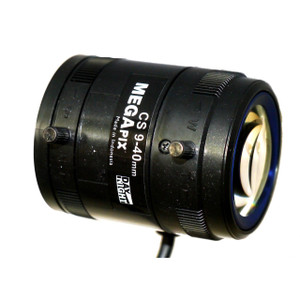
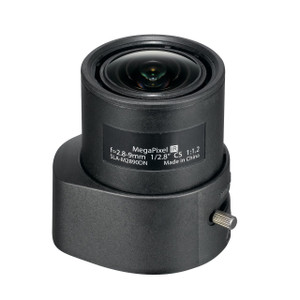
Hanwha SLA-T-M410DN 12MP DC-Iris Varifocal Lens
The Hanwha SLA-T-M410DN is a professional varifocal lens designed to pair with high-resolution IP camera bodies in surveillance systems where image clarity and exposure control across varying light levels matter. Built for IP surveillance cameras requiring 12-megapixel and 4K capability, this CS-mount lens delivers a 4–10mm focal length range — wide enough for general area monitoring, narrow enough for targeted detail capture — without requiring lens swaps during installation. The DC auto-iris mechanism automatically compensates for changing ambient light, eliminating the need for manual iris adjustment or separate iris controllers in many deployments.
Key Features
- 4–10mm varifocal range: Covers wide-area viewing at 4mm (approximately 68° horizontal angle) down to tighter coverage at 10mm, reducing the number of cameras needed in medium-sized spaces. Minimum focus distance of 0.5m to infinity lets you place this lens close to objects without sacrificing distant clarity.
- 12MP/4K resolution support: Matches high-megapixel sensors, ensuring the lens does not degrade sharpness in systems deploying 12-megapixel or 4K cameras. Typical aperture of F/1.4 at 4mm and F/2.4 at 10mm gathers sufficient light for low-light performance when paired with cameras having reasonable sensor sensitivity.
- DC auto-iris with 30cm control cable: Automatically opens and closes the iris in response to scene brightness, maintaining consistent exposure without manual adjustment. Eliminates overexposed day scenes or crushing shadow detail at night — a real operational benefit in 24/7 unattended surveillance.
- IR-corrected optics: Compensates for the shift in infrared wavelength transmission across the lens, keeping night-vision images sharp when paired with IR-equipped cameras. Without correction, IR scenes can appear softer than daylight scenes on the same camera.
- Compact TTL under 64mm: Space-constrained enclosures, tight turrets, or compact camera housings benefit from a short back-focus distance. Verify your camera body's available depth before ordering.
- Operating range -20°C to +60°C: Covers most indoor and outdoor temperate deployments; storage tolerance extends to -30°C to +70°C. Not suitable for extreme cold (below -20°C) without thermal management or arctic-rated housing.
- CS-mount standard: Compatible with any CS-mount camera body — common on many industrial and compact IP surveillance cameras. Do not confuse with C-mount (requires an adapter).
Integration & Compatibility
The DC auto-iris control requires a DC power connection from the camera body or an external iris driver. Verify your camera supports DC-iris or has a compatible output before installing. The 30cm cable provides some routing flexibility but may require extension if the iris control port is far from the camera's back panel. Check the camera manual for DC-iris pin configuration — standards vary across manufacturers.
This lens is part of the Hanwha IP camera accessory ecosystem and pairs naturally with Hanwha box and turret camera bodies, though CS-mount compatibility is broader than the Hanwha brand alone. If your camera uses C-mount exclusively, a mechanical adapter is required and may affect focus distance.
Ideal Deployment Scenarios
Warehouses, retail floors, and light-industrial spaces where flexible coverage and consistent night-vision performance are expected. The varifocal range suits facilities where some zones need wide area monitoring (loading docks, shop floors) while others benefit from tighter detail (merchandise aisles, entry points). The DC-iris shines in mixed lighting — partially lit warehouses with skylights and artificial fixtures, or outdoor facilities with variable sun angle. For surveillance in consistent stable lighting or fully dark environments requiring external IR illumination, the iris contribution is smaller.
When selecting an IP camera lens for a multi-camera deployment, confirm sensor resolution across all bodies; mixing 5MP and 12MP sensors on the same lens will not cause failure but defeats the resolution advantage of the SLA-T-M410DN. Refer to a camera selection guide to match lens and sensor specs for consistent image quality across your system.
Frequently Asked Questions
Q: Is the SLA-T-M410DN compatible with my C-mount camera?
A: No, the SLA-T-M410DN is CS-mount only. C-mount cameras require a different lens or a mechanical C-mount to CS-mount adapter, which adds ~5mm to back-focus distance and may affect close-focus performance.
Q: Does the DC auto-iris work with all IP cameras?
A: No. Your camera must provide a DC-iris control output. Verify your camera's specifications or consult the manual for iris control support. Some cameras lack iris drivers entirely and require an external iris controller module.
Q: What is the difference between the 4mm and 10mm focal length settings?
A: At 4mm, the lens provides a wider field of view (approximately 68°) for general area coverage. At 10mm, the field narrows to approximately 28°, isolating details over a smaller area. Rotate the focus ring to adjust focal length during installation; focus at your chosen focal length before tightening the lens.
Q: Will the SLA-T-M410DN work in outdoor environments?
A: The lens itself operates at -20°C to +60°C and has no weatherproofing rating. It must be housed in an outdoor camera enclosure or weatherproof turret with IP66 rating or higher. The lens alone does not provide environmental protection against rain, dust, or extreme temperature swings.
Q: Can I use the SLA-T-M410DN with a standard PoE camera?
A: Yes, if the PoE camera supports DC-iris control output. The lens itself draws no power; only the camera's iris control circuit is required. Standard PoE power to the camera is unaffected.
Q: How does IR correction affect daytime performance?
A: IR correction is a passive optical design element and does not degrade daytime sharpness. It optimizes night-vision clarity when paired with IR-equipped camera bodies. Daytime images remain unaffected.
Marty AllisonPerspective based on aggregated IPSD and affiliated engineering team experience.
The SLA-T-M410DN occupies a solid middle ground in the varifocal accessory space: good 4–10mm range, genuine DC-iris automation, and IR correction baked into the optics. If your deployment is 12MP/4K, mixed lighting, and CS-mount compatible, this lens eliminates the guesswork around exposure control and focus clarity across day/night cycles.
Technical Highlights:
- DC auto-iris with 30cm control cable: Real-time exposure compensation across day-to-night transitions means fewer overexposed or crushed scenes in unattended monitoring. Manual iris adjustment creates operator overhead and introduces human error; automatic iris removes that friction.
- 4–10mm focal length with 0.5m minimum focus: Enough range flexibility to eliminate second lens swaps on a single site. The 0.5m close-focus capability supports retail shelf monitoring and small-detail capture without hunting for a macro variant.
- IR-corrected optics: When paired with an IR-capable camera body, you get consistent sharpness across visible and near-infrared spectra. Skip this and your night scenes soften compared to day — a telltale sign of uncorrected optics.
- Sub-64mm TTL: Compact back-focus distance fits tight turrets and modular camera housings. Verify your body's flange-to-sensor distance against the spec sheet before committing.
Deployment Considerations:
- DC-iris requires camera-side iris driver support. A hard reality: not every IP camera body provides this, even high-end models. Check the camera's datasheet for "DC-iris control output" before purchasing. No output = you need an external iris module (additional cost and wiring).
- CS-mount is a fixed detail. If your installation is C-mount, you'll need a mechanical adapter that eats into back-focus headroom. Plan ahead or swap camera bodies.
- The -20°C to +60°C operating window excludes arctic and extreme-heat deployments without thermal management. Indoor warehouses and temperate outdoor sites are fine; cold-chain facilities and desert installations need verification.
Best-fit scenario: A multi-camera warehouse or retail deployment on 12MP/4K bodies where you need variable coverage (wide bay views + detail aisles) and want consistent night-vision sharpness without manual iris tweaking. The DC auto-iris pays for itself in reduced operational friction and fewer focus adjustments across lighting transitions.