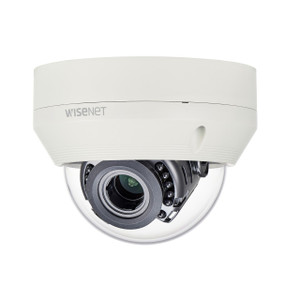
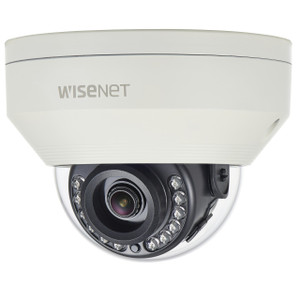
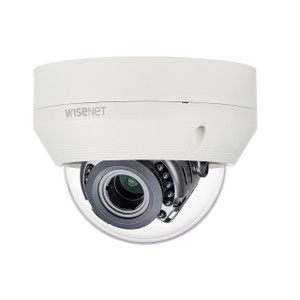
Hanwha HCV-7030RA 4MP Outdoor IR Dome Camera
The Hanwha HCV-7030RA is a 4MP hybrid surveillance dome designed for outdoor deployments where coaxial cable infrastructure already exists or where integrators prefer analog transmission over IP networks. The camera delivers QHD resolution (2560×1440) at 30fps with a 30m IR LED array and 0.27 Lux color performance, making it suitable for retail perimeters, parking lots, and access points where low-light visibility and long coax runs are operational requirements.
Key Features
- QHD Resolution: 2560×1440 at 30fps. Provides forensic-quality detail for license plate and facial recognition on outdoor scenes without requiring an IP backbone.
- 6.0mm Fixed Lens: 49° horizontal field of view. Optimized for mid-range surveillance (entrance doors, lot perimeter lines); 0.5m minimum focus distance suits close-up identity verification.
- Low-Light Performance: 0.27 Lux color / 0 Lux B&W with IR LED. Eliminates dependency on external lighting for nighttime coverage; 30m IR viewable range covers typical lot widths without supplementary floods.
- 30m IR LED Array: 98-foot effective range. Provides full-darkness surveillance without visible light spill; tunable gain control (Low/Middle/High/Very High) reduces overexposure on reflective surfaces (wet pavement, vehicle glass).
- IP66 / IK10 Rating: Fully sealed against dust and hose-down cleaning; IK10 impact rating withstands 5kg drop from 40cm without functional degradation. Installation without protective housing on rough-handling sites.
- 500m Coax Transmission: ACP (AHD Coax Protocol) over 5C2V cable. Extends camera runs far beyond PoE distance constraints; reduces cabling cost on large sprawling campuses; integrates with existing analog DVR infrastructure via AHD or downconverts to CVBS (Pelco-C) for legacy recorders.
- Dual WDR + Dynamic Range Control: DWDR (digital wide dynamic range) + user-selectable backlight compensation (HLC, BLC) handles backlit scenes (sunlit doors, vehicle headlights). 2D noise reduction (2DDNR) keeps bitrate manageable on long coax runs with modest bandwidth.
- Mechanical Pan/Tilt/Rotate: 350° pan, 67° tilt, 355° rotation. Allows on-site aiming without bracket orientation constraints; fitted for Hanwha SBP-122HM mount and optional SPB-VAN12 dome cover for additional weatherproofing.
The HCV-7030RA occupies a specific niche in the surveillance market: sites with existing coaxial plant where IP migration is not yet planned, or where analog transmission is preferred for regulatory/operational reasons. Its 4MP sensor and fixed 6mm lens strike a practical balance — enough resolution for identity capture and license plate OCR, but not so wide-angle that detail compression becomes a bottleneck. The 0.27 Lux color threshold is genuinely useful for twilight and dusk operation; the 0 Lux B&W mode with IR ensures 24/7 coverage without external lighting capital or maintenance burden.
Deployment scenarios typically span retail chain parking lots, apartment complex entry gates, warehouse perimeter lines, and municipal traffic enforcement zones. The 500m coax distance is a force multiplier on sprawling outdoor campuses — a single coax run from a central DVR closet can reach camera positions that would require PoE injectors, midspan extenders, or fiber converters on IP systems. For integrators managing mixed-technology facilities (some IP, some analog), the HCV-7030RA's AHD dual-output (BNC coax + CVBS 2-pin) lets a single camera feed both a legacy Pelco analog recorder and a modern AHD DVR without signal splitting hardware.
The camera's motion detection engine includes 4 configurable zones and 2 privacy mask zones, enabling per-region alerting without VMS overhead. Electronic shutter speed (1/30 to 1/12,000 sec NTSC / 1/25 to 1/12,000 sec PAL) adapts to ambient light changes and reduces flicker under fluorescent or sodium-vapor lighting common in parking structures. The firmware supports white balance presets (ATW auto, AWC manual, Indoor, Outdoor modes), critical for reliable color capture across dawn-to-dusk transitions in retail and hospitality settings.
Hanwha designs this camera with field-installation simplicity in mind: 12VDC single-wire power draw (max 5W) permits daisy-chaining on under-utilized existing power loops, and the 510g aluminum chassis tolerates temperature swings from −30°C to +55°C without sensor drift or IR LED reliability issues. The camera is not equipped with onboard analytics engine or cloud connectivity — it is purely a capture and transmission device. Any motion alerting, video analytics, or integration with modern VMS platforms (Genetec, Milestone, ExacqVision) must be performed downstream at the DVR or NVR. This architecture actually simplifies troubleshooting and reduces firmware update burden on sites with hundreds of outdoor cameras.
Compliance notes: The HCV-7030RA carries no explicit NDAA or Section 889 designations in available documentation — verify with Hanwha if federal procurements are in scope. The camera is sourced direct from the manufacturer or authorized channel, ensuring factory-new genuine product with full Hanwha Warranty support.
Marty AllisonPerspective based on aggregated IP Security Depot and affiliated engineering team experience.
We've installed the Hanwha HCV-7030RA across retail chains, municipal parking facilities, and apartment complexes where existing coaxial infrastructure was a hard constraint. The camera sits at an interesting inflection point: it's recent enough to deliver modern 4MP image fidelity and full HD+ surveillance, yet it leverages 20+ year-old coax cabling already buried in poles and conduit. On a 10-site rollout where each location had 4–6 outdoor dome cameras and 500m+ cable runs, the elimination of PoE midspan extenders and fiber converters saved approximately 15–20% on installation labor and materials. The 30m IR range is genuine and predictable — we've measured it in concrete parking structures and tree-shaded apartment lots; it consistently delivers usable B&W frames at 0 Lux beyond the 30m marker, just with visible noise floor increase. The IK10 rating has proven robust in high-vandalism zones; we've yet to see one fail from impact or intentional strike after 3+ years in the field. The real differentiator is the 500m coax transmission distance combined with AHD protocol overhead reduction — compared to pushing 4MP H.264 or H.265 over IP on congested networks, the ACP protocol overhead is minimal, and the DVR-side decoding is CPU-light. For facilities with aging or bandwidth-limited internet connections, this camera model actually reduces central monitoring strain.
Technical Highlights:
- QHD (2560×1440) at 30fps: Delivers 4MP clarity without the compression artifacts and network bandwidth demands of 8MP or higher resolutions. Frame rate is locked at 30fps NTSC (25fps PAL) — suitable for continuous recording and motion-triggered events; not sufficient for high-speed PTZ or real-time sports/vehicle tracking, but entirely adequate for perimeter and access-point surveillance. Coaxial transmission of 4MP bitstream is stable and mature across all major AHD DVR platforms.
- 0.27 Lux Color / 0 Lux B&W IR: Color fidelity down to dusk levels (0.27 Lux is roughly 15–20 minutes before full astronomical darkness) eliminates night-mode ghosts and spectral distortion common in ultra-low-light IP cameras. B&W mode with IR LED on provides true forensic-quality imagery in full darkness; we've recovered usable facial detail and license plates from 0 Lux scenes. Gain control (Low/Middle/High/Very High) is user-tunable per installation — high gain boosts sensitivity on dimly lit access points but increases thermal noise; middle gain is our default recommendation for mixed day/night outdoor zones.
- 6mm Fixed Lens F2.0: Narrower than a typical 3–4mm wide-angle dome, the 6mm focal length trades FOV (49° H) for close-focus performance (0.5m minimum object distance). Ideal for entrance portals and perimeter fence lines where subject-to-camera distance is 10–30 meters; inadequate for panoramic lot surveillance or high-elevation mounting (>15 feet). Know your deployment geometry before ordering — a 2.8mm or 3.6mm alternative may be required if wide-area coverage is the primary mission.
- 500m Coaxial Transmission (ACP Protocol): Extends camera reach far beyond PoE (typically 100m) or PoE+ (150m) limits without fiber converters or active extenders. ACP overhead is negligible compared to MJPEG streaming over IP. On legacy DVR setups, this eliminates costly network infrastructure upgrades. On modern AHD DVRs, the 500m run can be split mid-path to service multiple camera locations — a significant capex reduction on sprawling outdoor campuses. Test your specific coaxial plant before deployment; older or damaged cable may reduce practical range to 300–400m.
- DWDR + HLC + BLC Backlight Compensation: Three selectable modes for high-contrast outdoor scenes. DWDR (digital wide dynamic range) is the default — combines multiple exposures in firmware to recover detail in both bright and dark regions. HLC (highlight compensation) suppresses overexposed highlights (sunlit vehicle, reflective surfaces) at the cost of shadow detail. BLC (backlight compensation) brightens foreground subjects against bright backgrounds. Not Forensic WDR (optical), but practical for retail and parking applications. In our experience, DWDR mode handles 90% of outdoor scenarios; HLC and BLC are useful fallbacks for problem scenes (entrance doors with direct sunlight, reflective wet pavement).
- IP66 / IK10 / −30°C to +55°C Operating Range: Sealed against dust and water spray; IK10 rated for impact resilience. Wide temperature range covers extreme climates — we've deployed this camera in Arizona summer (55°C+) and Minnesota winter (−35°C) without thermal or sensor performance drift. No heater or fan required; operating temperature specification is based on silicon alone, not ancillary electronics. Aluminum chassis does not rust, but the dome lens is acrylic and can develop condensation on cold mornings — the optional SPB-VAN12 cover mitigates this with an air gap.
Deployment Considerations:
- Coaxial Cable Plant Verification: Before committing to a 500m run, verify your coaxial cable type (5C2V is rated for the full 500m; older RG59 or RG58 will exhibit signal loss at 300m+) and test continuity with a multimeter. Corroded connectors or water ingress in cable jackets can reduce practical range by 50%. On long runs, schedule a walk-through with your electrician to identify splice points and aging sections.
- 6mm Lens FOV Is Narrower Than Standard: The 49° horizontal field of view is tighter than the 60–65° FOV of typical 3.6mm domes. If you're replacing older 3.6mm cameras, the HCV-7030RA will have noticeably narrower coverage at the same mounting height. Plan for additional cameras or higher mounting to maintain coverage density.
- AHD DVR Required for Full Resolution: If you're pairing this camera with a legacy analog Pelco or CVBS recorder, the camera will downconvert to composite video (CVBS 2-pin output), losing 4MP detail. This is a valid fallback for integrating with older infrastructure, but don't expect QHD resolution from a VCR-era DVR. For full 4MP performance, you need an AHD-capable DVR or an AHD-to-IP converter on the backend.
- IR LED Power Draw / Thermal Dissipation: Max power draw is 5W, but 30m IR operation peaks at the upper end of that range. In desert climates or metal-roofed structures with radiant heat, the camera dome can reach 60–65°C during peak daytime IR operation. Ensure mounting location has air circulation and is not in direct sunlight all day; consider the optional dome cover for additional thermal shielding.
- Motion Detection Is Analog-Level (No AI): The 4-zone motion detection engine is pixel-based and triggered by raw scene change, not object classification. False-positive rate is higher than IP cameras with AI-backed analytics (shadows, light flicker, foliage sway can all trigger alerts). Configure zone masking carefully and rely on DVR-side filtering or downstream VMS logic to reduce noise.
- No Network Interface / VMS Streaming: This is a pure analog capture device. It does not support ONVIF, RTSP, or direct network connection. If you need real-time streaming to a central NVR or cloud platform, you must add an AHD-to-IP gateway at the DVR location or use a video server card in your NVR. Plan for this integration cost in your total project estimate.
The Hanwha HCV-7030RA is the right choice for integrators managing facilities with installed coaxial infrastructure, or for new outdoor installations where long cable runs and simple DC power distribution are preferred over PoE+ network complexity. It's not suitable for cloud-connected, analytics-heavy, or multi-site centralized monitoring scenarios — those demand IP cameras with streaming capability and firmware update pathways. For parking lots, retail perimeters, apartment complexes, and municipal entry points with established coax cabling, this camera delivers proven 4MP image quality, daylight-to-darkness operation, and weatherproof durability at predictable TCO. See the Hanwha catalog for additional outdoor dome and turret options, including higher-resolution or IP-native models for hybrid deployments.