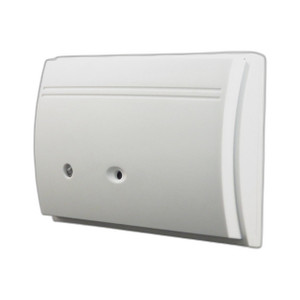
GRI GB-550 Glass Break Sensor Open Loop
The GRI GB-550 is an open loop glass break detection sensor engineered for security integrators managing perimeter protection across commercial and residential installations. Unlike closed-loop sensors that require loop supervision and end-of-line resistor termination, the GB-550 operates in open loop configuration—meaning it integrates directly into existing alarm and access control architectures without dedicated monitoring infrastructure. This approach simplifies deployment in retrofit scenarios and multi-zone security systems where traditional closed-loop sensors introduce unnecessary wiring complexity or cost.
Key Features
- Acoustic Detection Technology: The GB-550 senses the acoustic signature of breaking glass—specifically the frequency and intensity profile that distinguishes actual glass fracture from environmental noise or vibration. This significantly reduces false alarms compared to shock-based sensors, a real concern in high-traffic areas or buildings near machinery.
- Open Loop Architecture: Eliminates loop-closure wiring and end-of-line resistor management. You wire the sensor directly to a supervised or unsupervised input zone on your control panel, reducing commissioning time and troubleshooting overhead during system expansion or maintenance.
- Standard Panel Compatibility: Works with 12VDC and 24VDC alarm control systems without proprietary gateways, modules, or integration boards. This vendor-agnostic approach means you can deploy the GB-550 alongside door/window contacts, motion sensors, and other standard input devices on the same panel.
- Straightforward Installation: Standalone mounting capability allows you to position the GB-550 within 10–15 feet of the protected glass surface. No complex loop wiring, no impedance calculations—just power, a pair of terminals, and alarm output.
- Flexible Zone Configuration: Deploy multiple GB-550 units in parallel across separate zones, or use a single sensor for an entry point. Open loop design naturally suits applications where zone expansion is anticipated or where mixed sensor types are already in use.
- Perimeter and Entry Point Protection: Commonly deployed on retail storefronts, office windows, warehouse access doors, and residential entry points. The acoustic sensing approach works reliably on tempered glass, laminated glass, and standard float glass.
Integration and Compatibility
The GB-550 integrates with standard access control systems and alarm panels that support 12VDC or 24VDC supervised/unsupervised input zones. When specifying the sensor, verify your panel's input module voltage and alarm threshold settings; some control panels allow sensitivity adjustment at the input module level, which you should test during commissioning using the panel's force-arm procedure. Document the zone assignment and input voltage in your system record—open loop zones sometimes require different event logging than loop-supervised sensors.
For retrofit projects or system expansions, the open loop design pairs well with existing alarm control panels and reduces the engineering overhead typical of closed-loop sensor deployments. Many integrators prefer the GB-550 (often searched as GB 550) in mixed-sensor environments where you're already managing multiple input types on a single panel and where simplicity during commissioning and future maintenance is a priority.
Deployment Considerations
Mount the GB-550 within 10–15 feet of the protected glass surface for reliable acoustic coupling; verify the exact mounting distance in your application space during site surveys. The acoustic sensing method naturally suits environments where glass is the primary break-in vector—retail frontage, office perimeter windows, and warehouse entry glazing. In areas with high ambient noise (near HVAC equipment, machinery, or high-traffic zones), conduct a sensitivity test during commissioning to confirm the sensor reliably detects glass breakage without nuisance alarms.
Frequently Asked Questions
Q: What's the difference between open loop and closed loop glass break sensors?
A: Open loop sensors like the GB-550 wire directly to a panel input without requiring loop supervision or end-of-line resistors. Closed-loop sensors are part of a supervised loop where the panel continuously monitors circuit integrity. Open loop is simpler to install and expand; closed loop provides loop-fault detection, which some high-security applications require.
Q: Can I use the GB-550 with any control panel?
A: The GB-550 works with standard 12VDC or 24VDC alarm control panels that have unsupervised or supervised input zones. Before purchase, confirm your panel's input module voltage and alarm threshold voltage. Some panels allow zone-level sensitivity adjustment; others do not.
Q: How far from the glass should I mount the GB-550?
A: Mount the sensor within 10–15 feet of the protected glass surface for reliable acoustic coupling. Exact distance depends on your application space and ambient noise levels; conduct a test during commissioning using the panel's force-arm procedure.
Q: Will the GB-550 false-alarm from vibration or loud noise?
A: The acoustic detection method senses the specific frequency and intensity signature of breaking glass, which significantly reduces false alarms from vibration, machinery noise, or loud environmental sound. However, test sensitivity during commissioning in your actual environment to confirm acceptable performance.
Q: Can I expand my system by adding more GB-550 sensors?
A: Yes. The open loop design allows you to deploy multiple GB-550 units in parallel on separate zones. Each sensor wires independently to its own input zone on your control panel, making system expansion straightforward.
Q: What's the typical power draw of the GB-550?
A: The GB-550 draws minimal power from your 12VDC or 24VDC supply. Exact wattage is not specified in the standard documentation, but the low power requirement means it will not strain most control panel power supplies or dedicated 12/24VDC supplies.
Ted PerryPerspective based on aggregated IP Security Depot and affiliated engineering team experience.
I've evaluated the GRI GB-550 for several retrofit security projects where clients needed glass break detection without the infrastructure cost of closed-loop systems. The open loop design is straightforward to implement, especially in mixed-sensor environments where you're already managing multiple input types on a single panel. The acoustic detection approach cuts nuisance alarms compared to vibration-based sensors—a real advantage in retail and office settings where foot traffic and machinery can trigger false events.
Technical Highlights:
- Acoustic Detection Signature: The GB-550 senses the frequency and intensity profile of breaking glass, not just shock or vibration. This specificity means fewer false alarms in high-traffic or mechanically noisy environments—a meaningful operational benefit when you're managing dozens of sensors across a multi-site deployment.
- Open Loop Wiring: No loop supervision, no end-of-line resistors, no loop closure calculations. Wire the sensor directly to a supervised or unsupervised input zone. This simplifies commissioning and reduces troubleshooting time during system maintenance or zone expansion.
- Standard Panel Integration: Works with 12VDC and 24VDC alarm systems without proprietary modules or gateways. You can mix the GB-550 with door/window contacts, motion sensors, and other standard input devices on the same control panel—no vendor lock-in.
Deployment Considerations:
- Mount the GB-550 within 10–15 feet of the protected glass surface for reliable acoustic coupling. Verify the exact mounting distance in your application space during site surveys—distance, glass type, and ambient noise all affect detection reliability.
- Test sensitivity during commissioning using the panel's force-arm procedure. Some control panels allow threshold adjustment at the input module level; confirm your panel's capabilities before installation.
- Document zone assignment and input voltage in your system record. Open loop zones sometimes require different event logging or supervision configuration than loop-supervised sensors—this matters for audit trails and system reporting.
- Acoustic detection works well on tempered, laminated, and standard float glass, but performance degrades in extremely noisy environments (HVAC plenums, machinery rooms). Conduct a sensitivity test in your actual deployment space if noise levels are high.
The GB-550 is the right choice for retrofit perimeter protection, multi-zone retail and office installations, and any scenario where simplicity during commissioning and cost-effective zone expansion matter more than loop-fault monitoring. If your application requires loop supervision to detect cut wires or sensor tampering, consider a closed-loop glass break sensor instead.