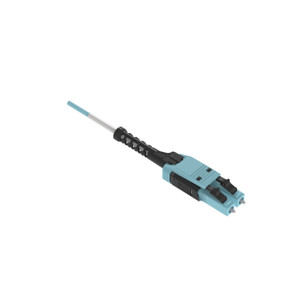
Hubbell DFHPCLCLCF4MM OM4 Duplex LC-LC Plenum Fiber Patch Cord
Overview
The Hubbell DFHPCLCLCF4MM is a 4-meter duplex OM4 multimode fiber patch cord terminated with LC connectors on both ends and jacketed in a plenum-rated (CMP) aqua sheath. If you are pulling cables through air-handling ceiling spaces or plenum return plenums, the CMP jacket is not optional — it is a building code requirement in most jurisdictions, and this cord is built to meet it without requiring conduit in those spaces.
OM4 50/125µm multimode fiber supports 10 Gigabit Ethernet to 550 meters and 40/100 Gigabit to 150 meters over laser-optimized glass, making the DFHPCLCLCF4MM a practical choice for high-density patch panels, spine-to-leaf switch interconnects, and structured cabling backbones where you are running 10GbE or beyond on a multimode plant. The aqua jacket color follows the TIA-598 OM4 color convention, which simplifies port identification and cable management in dense MDA and IDF environments where color discipline matters.
LC connectors are the dominant choice in enterprise and data center deployments today — SFP+, QSFP28 breakout, and virtually every current-generation 10G/25G/40G/100G transceiver uses LC duplex or MPO, so this cord plugs directly into active gear without adapter sleeves or pigtail splices. The compact LC ferrule also lets you pack more ports per panel than SC connectors, which is relevant in high-density switch aggregation rows.
Key Features
- OM4 Multimode Glass: Laser-optimized 50/125µm OM4 fiber supports 10GbE to 550m and 40/100GbE to 150m — headroom for current 10G deployments with a runway to 100G without a fiber plant rip-and-replace.
- Plenum (CMP) Jacket Rating: The CMP-rated outer jacket meets NFPA 90A flame and smoke requirements for installation in air-handling spaces. This eliminates the need for conduit in plenum ceilings and satisfies most AHJ inspections without additional fire-stop measures on the cable itself.
- Duplex LC-LC Termination: Both ends terminate in LC connectors — the industry standard for SFP+, SFP28, and QSFP28 breakout transceiver interfaces. No adapter sleeves needed at the switch or patch panel port.
- 4-Meter Length: A 4-meter run covers patch panel to top-of-rack switch in a standard 600–800mm-deep cabinet with slack for dressing, or cross-connects between adjacent racks without the excess loop bulk of a 5-meter cord.
- Aqua Jacket Color (TIA-598 Compliant): Aqua is the TIA-598 designation for OM3/OM4 multimode fiber. Using color-correct cords keeps your labeling scheme honest in mixed-fiber environments where OM1 (orange), OS2 (yellow), and OM4 (aqua) run side by side.
- Duplex Configuration: The duplex design carries transmit and receive on separate strands in a single jacket pull — standard for all LC-based bidirectional transceiver interfaces and simplifies installation versus managing two simplex cords per link.
- Commercial-Grade Construction: Hubbell's structured Hubbell cabling accessories are built to commercial installation standards, appropriate for enterprise IDF/MDF environments and fiber optic cable runs where consistent insertion loss across hundreds of connections matters.
Integration and Compatibility
The DFHPCLCLCF4MM integrates directly with any LC duplex SFP+ (10GbE), SFP28 (25GbE), or QSFP28 breakout (100GbE) transceiver, as well as LC-terminated patch panels and fiber distribution units. It is compatible with OM4-rated transceivers from major switching vendors including Cisco, Juniper, Arista, HPE, and Ubiquiti when the transceiver's specified minimum modal bandwidth matches the OM4 plant. Pair with an LC fiber patch panel at the MDA or IDF for a clean, traceable cross-connect. If your deployment includes a mix of OM3 and OM4 segments, OM4 cords are backward compatible with OM3 transceivers but the link budget should be calculated on the lower OM3 bandwidth specification at the junction. For OS2 single-mode runs, this cord is not appropriate — you would need an OS2-terminated cord with the correct yellow jacket and APC or UPC termination style matched to the active equipment. Review your network switches transceiver specs to confirm multimode compatibility before deploying in any mixed-fiber plant. If you need to plan a complete fiber structured cabling infrastructure, see the fiber optic cable selection guide for modal bandwidth, distance, and transceiver pairing guidance.
Frequently Asked Questions
Q: What does the plenum (CMP) rating on the DFHPCLCLCF4MM mean for installation?
A: CMP (Communications Plenum) is the highest jacket fire rating for horizontal cabling. It means the cable meets NFPA 90A flame spread and smoke density requirements, allowing installation in air-handling ceiling plenums and raised-floor air returns without conduit in most jurisdictions. If your local AHJ requires riser (CMR) or CMG, CMP satisfies those as well — it is the highest classification and is always acceptable where a lower rating is specified.
Q: Is OM4 backward compatible with OM3 transceivers?
A: Yes, OM4 fiber is backward compatible with OM3 transceivers. However, the maximum supported link distance defaults to the OM3 specification at the junction. If your entire plant is OM4, you get the full OM4 distance and bandwidth benefit. Mixing OM3 and OM4 segments means the weakest link governs — calculate your link budget on OM3 parameters at any OM3 segment.
Q: What transceiver interfaces is the DFHPCLCLCF4MM compatible with?
A: The duplex LC termination is compatible with SFP+ (10GbE), SFP28 (25GbE), and QSFP28 breakout (100GbE) transceivers that specify multimode OM3 or OM4 fiber. It is not compatible with single-mode (OS1/OS2) transceivers or interfaces requiring MPO/MTP connectors. Check your transceiver datasheet for the fiber type and connector style before ordering.
Q: Why is 4 meters a common patch cord length for rack environments?
A: A 4-meter cord covers the typical patch-panel-to-top-of-rack distance in a standard 600–800mm deep cabinet plus enough slack to dress the cord through a cable management arm without a tight bend radius. It also spans adjacent racks in a two-post row without the excess loop bulk that a 5-meter cord creates. If your rack depth or cabinet-to-cabinet span differs, measure the routed path — not the straight-line distance — before specifying cord length.
Q: What is the significance of the aqua jacket color on this cord?
A: Aqua is the TIA-598 standard color designation for OM3 and OM4 multimode fiber. Using color-correct cords is a cable management discipline that prevents mis-mating in mixed-fiber environments — if you see a yellow cord plugged into an OM4 panel, you know immediately there is a mismatch. In high-density environments with hundreds of ports, color coding is one of the few passive error-prevention tools available during moves, adds, and changes.
Q: Can this cord be used in a security camera or NVR fiber uplink application?
A: Yes, where an NVR, network switch, or IP camera aggregation switch provides an SFP+ fiber uplink and the run is within OM4 distance limits (up to 550m for 10GbE). This is common in large warehouse, campus, and enterprise security deployments where copper Cat6A distances are exceeded and a fiber backbone connects IDF closets to the core. Confirm the SFP+ transceiver in your switch specifies OM3/OM4 multimode and LC duplex connectivity.
The spec I always check first on a patch cord order is the jacket rating relative to the installation path — and on the DFHPCLCLCF4MM, the CMP plenum rating is the load-bearing detail. If this cord is going through a drop ceiling that serves as the HVAC return air plenum, CMP is what keeps the inspector from making you pull it all back out. The 4-meter length and duplex LC-LC termination are straightforward for any standard rack cross-connect, but the CMP jacket is the spec that actually governs where you can legally install it.
Technical Highlights:
- CMP Plenum Jacket: Satisfies NFPA 90A flame spread and smoke density requirements — the highest horizontal cabling jacket classification, accepted wherever CMR or lower is specified by the AHJ.
- OM4 Multimode Glass: Laser-optimized 50/125µm fiber rated for 10GbE to 550m and 40/100GbE to 150m, giving current 10G deployments a real upgrade path without fiber plant replacement.
- Duplex LC Connectors: Direct-mate to SFP+, SFP28, and QSFP28 breakout interfaces — no adapter sleeves, no pigtail splices, no additional insertion loss budget consumed at the connection point.
Deployment Considerations:
- Measure the routed cable path — not the straight-line rack-to-rack distance — before committing to 4 meters. A cord that is 200mm short forces a field splice or a full replacement pull, both of which introduce insertion loss or labor cost that a longer cord would have avoided.
- OM4 and OM3 are color-coded identically (aqua per TIA-598), so in a mixed OM3/OM4 plant, label both ends with the fiber grade — color alone will not distinguish them at the port level, and mixing them mid-link drops your effective bandwidth to the OM3 ceiling.
This cord is the right specification for enterprise IDF-to-MDA cross-connects and security system aggregation switch uplinks in air-handling ceiling environments where CMP compliance is required and 10G or higher bandwidth is on the roadmap.