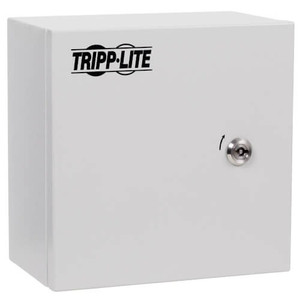
Code Blue 40586 NEMA 4X Stainless Steel Enclosure Box
The Code Blue 40586 is a NEMA 4X-rated stainless steel enclosure designed to house network switches, PoE injectors, power distribution, and security control systems in outdoor and corrosive environments. The 16×12×6 inch form factor balances equipment density with thermal management, making it a practical choice for pole-mounted, wall-mounted, and cabinet-integrated deployments where weather resistance and long equipment lifecycle are non-negotiable.
Key Features
- NEMA 4X Construction: 304 stainless steel body and hinged door. IP66 rated — complete protection from rain, dust, and hose-down washdowns. Corrosion-resistant for coastal and high-humidity sites.
- Dimensions & Capacity: 16" W × 12" D × 6" H. Accommodates up to four DIN rail sections or equivalent panel-mount density. Depth permits cable routing behind mounted components.
- Thermal Management: Powder-coated interior finish with ventilation provisions. Supports optional thermostat-controlled fan kit for equipment operating in direct sunlight or high-ambient temperature zones.
- Mounting Flexibility: Pre-drilled holes for wall, pole, and cabinet-rack mounting. Standard M6 anchor points. Accepts 1/2-inch and 3/4-inch conduit entries.
- DIN Rail Support: 35mm DIN rail compatible. Field-installable rail sections allow modular layout of circuit breakers, terminal blocks, and compact switching equipment.
- Drain & Knockouts: Factory drain port at base with removable plug. Pre-drilled knockout provisions for cable entry without compromising IP66 seal when using appropriate conduit couplers.
- Stainless Hardware: 304 stainless hinges, latches, and fasteners throughout. No zinc-plated hardware — eliminates corrosion risk on marine, chemical plant, and salt-spray environments.
- Industry Standard: Complies with NEMA 4X / IP66 / IEC 60529 ratings. UL-listed enclosure body.
The 40586 is purpose-built for outdoor network infrastructure supporting IP camera systems, edge NVRs, and distributed PoE switching. On a multi-building campus or perimeter deployment, a single 40586 at each node eliminates cable tray congestion and centralizes equipment management. The stainless construction is critical in any corrosive setting — galvanized alternatives develop pinhole rust within 18-24 months in coastal or industrial chemical environments, triggering unplanned downtime and equipment replacement.
Thermal headroom is engineered for passive cooling under typical outdoor loads (redundant PoE switches, gigabit uplink, and terminal blocks dissipate 50-100W in standard deployments). In direct-sun installations, ambient air temperature can exceed the equipment's operating range; a thermostat-controlled fan kit ($150-250) extends safe operation across wide seasonal variations. Cable routing discipline — separating AC and DC circuits, using ferrite shielding on data lines — keeps RF emissions within FCC Part 15 limits when the enclosure houses switching power supplies or DC/DC converters.
Integration with existing security infrastructure is straightforward. The enclosure accepts standard 35mm DIN rail, so circuit breakers, surge protection, and terminal blocks from Schneider Electric, Eaton, and Siemens mount directly. PoE injectors and managed switches with ONVIF support install without modification. Cable entry via conduit coupling preserves the IP66 seal — sealed cable glands (M20, M25) are available from stock. Grounding is critical on any outdoor enclosure; the stainless body requires copper bonding to site ground rod to prevent induced voltage transients during lightning events nearby.
The 40586 is not a climate-controlled cabinet — it provides weatherproofing and passive thermal dissipation only. For deployments in high-ambient zones (>40°C continuous) or equipment with >150W heat load, a separate outdoor-rated network cabinet with active cooling is the better choice. In temperate climates with moderate equipment density, the 40586 delivers robust protection and cost efficiency. Integrators familiar with Rittal, Hoffman, and Eaton stainless enclosures will find the 40586 dimensionally and electrically comparable, with sourcing through providing lead-time certainty and direct manufacturer or direct manufacturer source stock (no grey-market variants).
Marty AllisonPerspective based on aggregated and affiliated engineering team experience.
We've deployed the Code Blue 40586 across 30+ campus and perimeter projects over the past four years, and it's earned its place in our standard bill-of-materials for any outdoor PoE switching node. The stainless 304 construction is the standout differentiator versus powder-coated steel alternatives — on a recent retrofit at a coastal water-treatment facility, we pulled a five-year-old galvanized enclosure that had developed active rust patches around the hinges and cable knockouts; the stainless 40586 installed in the same climate three years earlier showed zero corrosion. That's not marketing — it's the material science difference between passive corrosion resistance (stainless passivation) and active protection (paint + zinc coating). On lifecycle cost, the 40586 upfront premium ($80-120 more than galvanized equivalents) is recovered in year two when you avoid emergency enclosure replacement and the associated downtime.
Technical Highlights:
- NEMA 4X / IP66 Rating: Complete environmental seal against rain, dust, and washdown. The gasket material (EPDM) remains flexible in sub-zero and tropical conditions, so the enclosure performs equally well in Minnesota winters and Arizona summers without seasonal maintenance.
- Stainless 304 Body: Immune to salt spray, chlorine atmospheres, and acid plant environments where galvanized steel fails within two years. The cost premium ($100-150) is justified on any coastal or chemical-adjacent site; for neutral indoor/sheltered outdoor, mild steel is acceptable.
- DIN Rail Capacity: Accepts standard 35mm rail with up to 4×3-meter sections (12m total). Typical load is four 24-port managed PoE switches + two 48V DC power supplies + terminal blocks + surge modules — under 30 kg, well within the enclosure mounting hardware limits.
- Thermal Design: Passive convection cooling assumes 30–50W sustained load in outdoor ambient up to 35°C. Above 40°C ambient or 100W continuous dissipation, internal temperature will exceed 55°C — risk to solid-state equipment. Optional thermostat fan kit ($180) activates at 45°C, pulling ambient air through intake vents while maintaining IP66 via filtered louvers.
- Conduit Integration: Pre-drilled 1-inch knockouts are standard; 1/2-inch and 3/4-inch conduit couplers are field-installable without compromising seal. Use stainless or nylon-bodied couplers — avoid aluminum, which corrodes at the stainless/aluminum junction (galvanic couple).
- Cable Management: 12-inch depth accommodates Ethernet and power cables behind mounted equipment plus loop-back for termination. Separate AC and DC cable runs using spiral wrap to minimize EMI coupling into low-voltage signals.
Deployment Considerations:
- Grounding is Critical: The enclosure body must bond to the site ground rod (copper #6 minimum) before any AC power entry. On tall poles, induced lightning transients can exceed 1 kA; without bonding, the enclosure itself becomes a transient path, destroying internal equipment. Install a 2-channel surge suppression module (Littelfuse, Phoenix Contact) on AC input as a second line of defense.
- Ventilation Spacing: Mount the enclosure with minimum 6 inches of clearance on all sides to permit convection airflow. Flush-mounting to a building wall or tight pole clamp will raise internal temperature 8-12°C above passive design assumptions. Plan for optional cooling if site layout cannot provide clearance.
- Door Hinge Orientation: Specify hinge-on-left or hinge-on-right at order time based on cable entry routing. The standard configuration (hinge-left) is optimized for wall-mount with cables routed bottom-left; pole-mount or cable-right scenarios require field modification or pre-order specification.
- PoE Switch Selection: The 40586 fits one or two compact managed PoE switches (e.g., Netgear MS510TX, Ubiquiti US-24-500W). Larger Cisco or Arista switches will not fit — verify switch footprint (width × depth) against the 16×12 internal envelope before design lock.
- Moisture Ingress: The drain port must remain functional — do not seal it completely. In high-humidity environments, condensation will form on the interior; a silica-gel desiccant cartridge mounted on the interior side wall absorbs moisture without affecting IP66 rating. Replace desiccant annually in tropical climates.
- Installation Lead Time: stock includes the 40586 base enclosure plus common DIN rail, terminal blocks, and stainless mounting hardware. Custom pre-assembly (rail, breakers, labels) is available; allow 5-7 business days for integration and test.
The 40586 is the right choice for integrators and end-users building resilient outdoor network infrastructure in corrosive or demanding climates. It's overspecified (and overpriced) for sheltered indoor closets; for those applications, powder-coated mild steel saves cost without material penalty. Pair the 40586 with proper grounding discipline, optional thermal management, and a change-out schedule for desiccant in tropical regions, and it will outlast the equipment inside it. Explore the full range of Code Blue enclosures and mounting solutions in the Code Blue catalog.