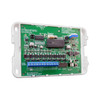
ELK Products ELK-124 TCP/IP Security Accessory
Overview
The ELK-124 is a network-integrated security accessory purpose-built for deployment within ELK Products control system environments. Operating on 8VDC and communicating via TCP/IP, the ELK-124 enables remote integration and flexible placement across commercial and residential security installations where networked device management is required. This accessory bridges ELK control panels with compatible monitoring stations and networked security infrastructure, making it suitable for integrators configuring mixed wired and networked security deployments.
Key Features
- 8VDC Operating Voltage: Low-voltage operation simplifies power supply management — no high-voltage licensing or heavy PSU infrastructure required. Compatible with standard ELK security system power distribution, reducing installation cost and complexity.
- TCP/IP Communication: Network-based connectivity allows the ELK-124 to be deployed remotely from the main control panel. This flexibility eliminates long wire runs and supports distributed sensor or device architectures typical in larger commercial facilities.
- ELK System Integration: Direct compatibility with ELK security control platforms ensures seamless command routing and status reporting. No protocol translation or third-party gateways needed — integration is direct and supported.
- Remote Monitoring Station Support: TCP/IP enables two-way communication with central station and remote monitoring endpoints. Alarms and status updates transmit over network infrastructure, supporting modern cloud-connected security operations.
- Commercial and Residential Deployment: Versatile platform suitable for both light residential retrofits and large commercial installations. Integrators can standardize on ELK-124 across multiple project types without tool or configuration changes.
Integration and Compatibility
The ELK-124 integrates directly with ELK security system control panels and networked monitoring infrastructure. TCP/IP connectivity allows flexible placement — wall-mount or ceiling-mount configurations depending on facility layout. Network deployment supports redundancy and failover pathways typical of enterprise security architectures.
For installers configuring security accessories across multiple ELK deployments, the ELK-124 (often searched as ELK 124) provides a standardized approach to network-based device integration without vendor lock-in to proprietary closed-loop systems.
Deployment Considerations
Verify that your ELK control panel firmware version supports TCP/IP accessory registration. Network bandwidth is minimal but ensure your facility's Ethernet infrastructure reaches the intended installation location. 8VDC power must be sourced from a compatible ELK power supply or secondary 8VDC distribution module — standard 12VDC or 24VDC supplies are not suitable.
Frequently Asked Questions
Q: Does the ELK-124 require a separate power supply?
A: No. The ELK-124 operates on 8VDC sourced from your ELK system's power distribution. Verify that your control panel or power module can supply the required current; consult your ELK system documentation for available auxiliary power capacity.
Q: Can the ELK-124 communicate over Wi-Fi or only wired Ethernet?
A: The ELK-124 communicates via TCP/IP. Standard implementations use wired Ethernet; Wi-Fi capability depends on your facility network infrastructure and ELK control panel support. Confirm with your system integrator whether Wi-Fi bridging is configured.
Q: Is the ELK-124 compatible with third-party monitoring stations?
A: The ELK-124 is designed for ELK system environments and compatible ELK-approved monitoring platforms. Cross-platform compatibility with non-ELK systems is not supported; verify monitoring station compatibility with your ELK dealer.
Q: What is the maximum distance from the control panel to the ELK-124?
A: TCP/IP communication distance depends on your Ethernet infrastructure. Standard CAT5e or CAT6 cabling supports distances up to 300 feet (90 meters); longer runs require network switches or fiber optics. Consult your network design or ELK documentation.
Ted PerryPerspective based on aggregated IP Security Depot and affiliated engineering team experience.
The ELK-124 is a straightforward TCP/IP integration point for ELK control systems where remote placement or networked sensor distribution is a requirement. 8VDC operation keeps power infrastructure simple — you're not dealing with licensed high-voltage wiring — but you must verify that your ELK panel's auxiliary power output has sufficient capacity. The TCP/IP backbone is the real value here: it eliminates the need for long wire runs and opens the door to multi-zone or multi-location deployments where a single control panel serves remote accessory nodes over standard Ethernet.
Technical Highlights:
- 8VDC Low-Voltage Supply: Simplifies power distribution and eliminates high-voltage licensing requirements. Typical auxiliary power budgets on ELK panels range 500–1000 mA; verify your panel's spec before configuring multiple ELK-124 units on the same supply.
- TCP/IP Network Integration: Supports Ethernet-based remote placement, allowing the ELK-124 to reside anywhere on your facility network. No proprietary serial buses or dedicated control lines required — standard IP infrastructure carries command and status traffic.
- ELK System Native Support: Direct integration with ELK control panels eliminates protocol translation overhead and vendor-specific gateway complexity. Configuration is handled within the ELK panel's native menu or via ELK configuration software.
Deployment Considerations:
- Confirm your ELK control panel firmware supports TCP/IP accessory registration. Older ELK systems may require a firmware update before the ELK-124 will initialize properly.
- Network segmentation and firewall rules: if your facility uses VLAN isolation or strict east-west filtering, ensure TCP/IP traffic between the control panel and ELK-124 is whitelisted. Monitoring station communication will also transit the same network — verify that security policies don't block event transmission.
- 8VDC power budget is finite. If you're deploying multiple ELK-124 units or other 8VDC accessories, calculate total draw and confirm your power supply can sustain the load. Brownout conditions on auxiliary power can cause intermittent network registration failures.
The ELK-124 is the right choice for integrators standardizing on ELK platforms across commercial deployments where network-based remote sensors or distributed alarm zones are expected. It's not a gateway or protocol translator — it's a native ELK accessory with Ethernet legs, so it belongs in environments where ELK control is already the core architecture.