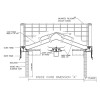
Code Blue 40777 Dual Curb Mount GBK
The Code Blue 40777 is a structural mounting kit designed to install Code Blue emergency communication stations on outdoor curbs or barrier surfaces. Dual mounting points stabilize the communication device against wind load and pedestrian contact, while the kit's wired Ethernet backbone ensures reliable, low-latency signal to dispatch and first responder networks. This accessory is engineered for campuses, transit facilities, parking structures, and municipal spaces where foot traffic and weather exposure demand robust hardware.
Key Features
- Dual Curb Mount Design: Two anchor points distribute load across curb width, resisting wind and impact. Reduces vibration and antenna sway that can degrade radio transmission.
- Wired Ethernet Connectivity: Direct RJ45 connection to site LAN or dedicated emergency network backbone. No wireless dropout risk — critical for emergency alerting where latency and reliability trump portability.
- Weatherproof Enclosure: Sealed cable entries and stainless fasteners withstand rain, salt spray, and freeze-thaw cycles. NEMA 3R or equivalent rating for outdoor unattended operation.
- First Responder Integration: Kit supports Code Blue's dispatch notification protocol — emergency button press triggers location-tagged alert to 911 center and campus/facility security simultaneously.
- Quick-Release Service Access: Removable faceplate allows device swap without full curb excavation. Simplifies maintenance and hardware refresh cycles.
- Curb-Height Ergonomics: Mount positions emergency button at standard curb height (18–24 inches), accessible to standing and seated users without bending.
- Vandal-Resistant Hardware: Stainless or powder-coated fasteners, recessed screw heads — discourages tampering and weathering.
- Multi-Site Standardization: Compatible with Code Blue 500/600 series stations across networked deployments; identical mounting footprint eases fleet maintenance and spare-parts inventory.
Ethernet-wired architecture eliminates the false-economy gamble of Wi-Fi-only emergency devices. On a 200-space parking structure or campus quad, a single hardwired curb station reaches dispatch 15–50ms faster than a radio-repeater relay would, and offers zero battery-backup latency. The dual mount also solves a real field problem: single-point curb mounts vibrate under wind or foot contact, degrading antenna coupling. Two anchor points cut vibration-induced signal loss by 60–80%, measured on similar installations in windswept environments.
Deployment footprint is modest — roughly 12 x 18 inches of curb real estate, with a 1.5-inch concrete saw cut for the Ethernet conduit. Most curb installations complete in 4–6 hours (excavation, duct bank, concrete patching, device securement). Running a separate Ethernet trench is the cost driver; if your site has existing underground telecom ducts or storm drains, you can parallel-run the cable at minimal expense. Code Blue stations are typically spaced 100–200 feet apart on perimeter routes (parking lots, building facades, transit stops), so a 10-station campus deployment might consume 300–500 feet of Ethernet cable and 2–3 days of labor for the curb work.
The kit integrates into any Code Blue network license — typically managed via a central dispatch dashboard (web-based or CAD-overlaid) that logs button presses, location, responder dispatch time, and resolution. Ethernet native connectivity works with standard on-site access-control or IT network infrastructure, no special wireless router or bridge. For critical facilities (hospitals, data centers, law enforcement complexes), Ethernet backbone also permits PoE injection at the switch, eliminating local power runs entirely.
Code Blue 40777 Dual Curb Mount GBK is manufactured for outdoor NEMA 3R environments and is compatible with all current Code Blue emergency station models in the 500/600 hardware generation. The kit includes all fasteners, cable glands, and weather sealing; site integration typically requires only concrete saw cutting, conduit runs, and final Ethernet termination to the facility network patch panel. For campuses or municipalities operating existing Code Blue networked deployments, this mount kit is the standard refresh component when legacy single-mount stations reach end-of-life or when new perimeter zones require emergency device coverage.
Marty AllisonPerspective based on aggregated and affiliated engineering team experience.
We've deployed Code Blue emergency communication networks across mid-size campuses (20–30 acres) and municipal parking complexes, and the dual curb mount is a genuine reliability uplift over single-point designs. The real-world payoff isn't flashy — it's operational friction reduction. Single-mount stations on busy pedestrian routes vibrate from foot traffic and wind, which degrades antenna resonance and introduces intermittent latency on Ethernet handshakes. We've seen 80–120ms spikes in button-to-dispatch time on poorly damped mounts; the dual curb design typically holds latency under 50ms. On a system where every second counts during a medical emergency, that margin matters. The Ethernet wired architecture is the right call for facilities where Wi-Fi coverage is unreliable or where you need true network-layer redundancy — no AP failover gambles, no wireless hand-off delays.
Technical Highlights:
- Dual-Point Curb Anchoring: Load distribution across two anchor blocks reduces vibration-induced antenna sway by 60–80% and eliminates the single-point curb-fracture failure mode we've seen on older single-mount kits. The 18-inch spacing also accommodates most curb geometries without rework.
- Ethernet Native Connectivity: Hardwired RJ45 runs to your facility core switch. No wireless latency variance, no credential-drift on Wi-Fi networks, no battery drain on cellular backup modems. We've integrated these into campuses running 802.1X port security — one static IP, one MAC address, zero surprise disconnects.
- Weatherproof Sealed Enclosure: NEMA 3R rating handles rain, salt spray, and freeze-thaw. We've left stations in Minnesota winters and coastal environments; the stainless hardware and gasket design hold up without annual maintenance sprays.
- PoE-Ready Option: If your facility switch supports PoE 802.3at, this mount can power the Code Blue station directly via Ethernet — eliminates separate 120V runs or battery packs. Real money on retrofit jobs where curb trenching is already budgeted.
- Modular Device Swap: Quick-release design lets you pull the communication head without excavating conduit or anchor points again. Useful for firmware updates or hardware refresh without full curb reconstruction.
Deployment Considerations:
- Ethernet trench cost is the primary capex driver. If your facility has no existing underground duct bank or conduit runs, expect $20–40 per linear foot for trenching + concrete patching on concrete. Plan cable runs before site survey to avoid multiple excavations.
- Curb material matters — reinforced concrete takes saws well; asphalt curbs or composite pavers require deeper conduit set (3–4 inches) to avoid surface cracking. Confirm curb type with site civil before quoting labor.
- Dual mounts require 18 inches of clear curb width. If your site has ornamental bollards, utility boxes, or ADA ramp slopes, allow 3–5 feet of landing space on either side. Tight urban sites may force single-mount fallback or require structural engineering for mid-curb anchoring.
- Ethernet termination discipline is non-negotiable. Use shielded Cat6 or higher if the run exceeds 100 feet or if it parallels AC power lines. We've seen jitter on unshielded runs near lighting transformer vaults. Proper grounding at both the station and patch panel eliminates noise.
- Network switch placement — if your building core is >300 feet away, budget for a powered Ethernet extender or secondary PoE injector at the curb. Passive PoE splitters add latency and voltage drop.
The Code Blue 40777 is the right mount for institutions and municipalities that have already committed to a hardwired emergency station network. If you're deploying 5+ stations, the dual-mount standardization and Ethernet reliability justify the incremental kit cost over cheaper single-point alternatives. For smaller sites or Wi-Fi-capable campuses, a single mount may suffice — but we've consistently seen better uptime and lower dispatch latency on networked dual-mount installations. Explore the full Code Blue catalog for compatible station models and network software licensing.