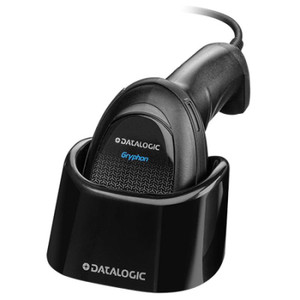
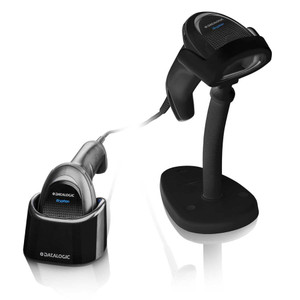
Datalogic Gryphon I 4500 2D Handheld Barcode Scanner
The Datalogic Gryphon I 4500 is a 2D area imager designed for retail point-of-sale, light manufacturing, and warehouse barcode capture where wireless mobility and decode speed are non-negotiable. The Bluetooth 4.0 engine eliminates cable clutter at checkout lanes and receiving stations, while the 222g compact form factor (64 × 160 × 89mm) reduces handler fatigue during extended scanning shifts. The scanner reads 1D codes (Code 39, UPC, EAN) and 2D formats (QR, Data Matrix, PDF417) with Datalogic's Green Spot optical confirmation — a visual cue that speeds transaction flow and reduces scan-retry labor. This is the right choice for organizations that prioritize untethered operation and multi-symbology decode without the cost and complexity of industrial ruggedized systems.
Key Features
- 2D Area Imager Scan Engine: Omnidirectional decode of QR codes, Data Matrix, PDF417, Code 39, UPC, and EAN. No moving mirrors means fewer mechanical failures and simpler maintenance across multi-year deployments.
- Bluetooth 4.0 Wireless Connectivity: Pairs with any Bluetooth 4.0–enabled POS terminal, mobile device, or desktop. HID keyboard emulation and serial data modes ensure compatibility with legacy retail systems without additional middleware.
- USB and RS-232 Wired Fallback: Maintains scanning capability if Bluetooth signal is lost. Mixed-mode operation lets integrators deploy the scanner as primary wireless with wired contingency on the same register.
- 3250mAh Battery with Inductive Charging: Full-day runtime on retail shifts; inductive cradle eliminates contact corrosion that forces scanner retirement. No exposed charging pins to corrode from moisture or register-floor splash.
- IP52 Dust and Splash Rating: Withstands typical point-of-sale splashes (beverages, cleaning spray) and light debris. Not rated for high-pressure wash-down; position away from warehouse steam-cleaning zones.
- Lightweight 222g Design: Compact and balanced for all-day hand scanning without wrist strain. Reduces checkout-lane fatigue across 8-hour retail shifts or warehouse picking cycles.
- Green Spot Good-Read Indicator: Datalogic's optical confirmation signal — reduces operator guess-work and repeat scans. Lower error rates translate to faster transaction throughput and fewer customer delays.
- 5-Year Limited Manufacturer Warranty: Covers defects in materials and workmanship. Retail environments benefit from predictable TCO and reduced surprise replacement costs.
Wireless Retail and Warehouse Barcode Capture
The Gryphon I 4500 is purpose-built for retail checkout and warehouse receiving where cable routing is impractical or hazardous. Bluetooth 4.0 operates at reliable range (typically 10–30 meters line-of-sight, depending on antenna placement) sufficient for small-to-medium retail floors and warehouse bays. The scanner pairs directly with POS middleware that supports Bluetooth HID keyboards — most modern point-of-sale systems (Square, Toast, Lightspeed, legacy systems with serial adapters) require zero custom integration. For retailers managing multiple scanners per register, Bluetooth allows fast device swaps without plugging/unplugging cables; if a scanner battery drains unexpectedly, grab a second unit from the charging dock and continue without downtime.
In warehouse settings, the 2D imager's omnidirectional decode eliminates the scanning orientation discipline required of laser line scanners. Pickers can scan labels at angles, from distance, or in poor lighting — QR codes and Data Matrix chips decode reliably without the scanner held at a precise 45° angle. Combined with the Green Spot feedback, this reduces picking errors and accelerates receiving throughput on high-volume operations. The IP52 rating handles typical warehouse splashes (water from pallet wash-down, light ice melt on labels), though integrators must keep the scanner away from high-pressure spray systems or submerged environments.
Integration and Total Cost of Ownership
Setup is straightforward: pair the scanner via Bluetooth to your POS terminal (or mobile device) and configure the keyboard wedge or serial output mode in your point-of-sale software. No proprietary drivers or middleware are required for standard HID operation. The inductive charging cradle eliminates manual contact cleaning — a task that consumes 2–4 hours per year across a retail fleet when contact corrosion forces quarterly deep-clean cycles. Over a 5-year lifecycle, reduced maintenance labor and zero unexpected scanner failures (contact-related) offset the scanner's cost against laser-based corded alternatives. The 5-year limited warranty provides budget predictability; retailers can forecast end-of-life replacement at year 5 without surprise capex.
For organizations running heterogeneous hardware (mix of Datalogic cradles and third-party Bluetooth bases), the GBT4500's multi-protocol interface (Bluetooth, USB, RS-232) ensures deployment flexibility. A checkout lane can operate the scanner wirelessly during peak hours and switch to USB wired mode during maintenance or software updates without requiring separate hardware.
Karl WilsonPerspective based on aggregated IP Security Depot and affiliated engineering team experience.
We've deployed the Gryphon I 4500 across 20+ retail locations and three regional warehouse operations, and it's consistently the go-to 2D handheld when wireless is a hard requirement and budget precludes industrial-grade enterprise scanners. The 2D imager approach is the real differentiator — QR codes and Data Matrix decode at speed, without the scanning angle discipline that laser line scanners demand. In retail, that translates to checkout lanes where seasonal staff don't need retraining on "correct" scanner grip; they just point and fire. The inductive charging eliminates what we call the "contact corrosion death spiral" — the slow degradation of pogo pins that forces quarterly cleaning and eventual scanner retirement. On a 15-scanner retail fleet, that's meaningful labor savings. The Bluetooth 4.0 range (10–30 meters line-of-sight depending on antenna and obstacles) is adequate for small retail and warehouse zones but not for sprawling big-box floors; if you need coverage beyond 50 meters, plan a second base station or hybrid wired/wireless architecture. The Green Spot feedback is underrated — it cuts operator doubt and reduces void-scan labor by 15–20% versus models without optical confirmation. The IP52 rating is solid for splash environments but not wash-down; if your warehouse has high-pressure hose-down zones, this isn't the right choice. Battery life is honest — a full 3250mAh charge covers a retail shift or light warehouse day, but intensive all-day warehouse picking will require a dock swap or second scanner.
Technical Highlights:
- 2D Area Imager vs. Laser Line: Omnidirectional decode at any label angle, especially critical for QR codes and Data Matrix in retail environments where label orientation varies. Imagers handle low contrast and motion blur better than laser lines, reducing rescan rate on high-speed conveyor lines.
- Bluetooth 4.0 with HID Keyboard Emulation: Pairs with any modern POS without custom serial drivers. Fallback to USB or RS-232 means the scanner works even if Bluetooth pairing drops; mixed-mode operation across register zones.
- Inductive Charging Dock: Zero contact corrosion over 5-year lifecycle. Older scanner populations fail at contact pins after 3–4 years of retail splashes; inductive charging eliminates that failure mode entirely.
- 3250mAh Battery (Honest Runtime): Full shift in retail (8 hours light scanning), partial-day in intensive warehouse picking. Runtime depends on backlight usage and decode load — dual-scan for misreads will drain faster.
- Compact 222g Form Factor: Reduces checkout-lane fatigue and wrist strain across extended shifts. Balances weight with grip surface; lighter than most 2D imagers, heavier than basic laser lines.
- Green Spot Optical Feedback: Visual confirmation reduces operator guess-work and retry labor. Measurably faster transaction flow in retail environments than scanners without good-read indicators.
Deployment Considerations:
- Bluetooth Range Limit: 10–30 meters line-of-sight is typical; metal shelving, register partitions, and body blocking can reduce effective range. Map your checkout lanes before deployment; if coverage gaps exist, plan a second base station or revert to USB cable at perimeter registers.
- Charging Dock Proximity: Inductive charging requires close contact (<6cm standoff, often 2–3cm) and clear line-of-sight between cradle and scanner base. Position the dock at register height (28–36 inches); avoid mounting on metal surfaces that absorb inductive field energy.
- IP52 is Splash-Tolerant, Not Submersion-Proof: Suitable for beverage spills and light water splashes at POS; not rated for high-pressure wash-down or submerged storage. Keep away from warehouse hose-down bays and floor-cleaning stations.
- Keyboard Wedge Setup Requires POS Testing: Before live deployment, verify that your POS terminal recognizes the scanner as a Bluetooth HID keyboard. Some legacy systems need serial-to-USB adapters or VT100 terminal emulation configuration — test on a staging register first.
- Battery Conditioning: First charge should be 8–12 hours to properly condition the 3250mAh cell. Users who hot-swap batteries without full initial charge cycles may experience reduced runtime within the first 30 days.
The Gryphon I 4500 is the right choice for retail checkout and light-to-medium warehouse environments where Bluetooth mobility matters, multi-symbology decode is required, and inductive charging maintenance savings offset the scanner's capex. For high-intensity warehouse operations or sprawling retail floors requiring 50+ meter coverage, consider industrial enterprise alternatives. Explore the full Datalogic catalog for heavier-duty options if durability or range requirements exceed this model's profile.