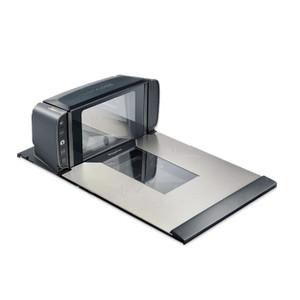
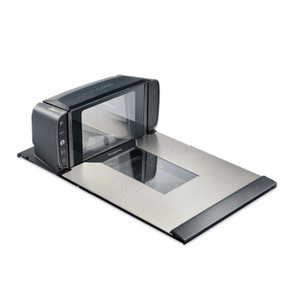
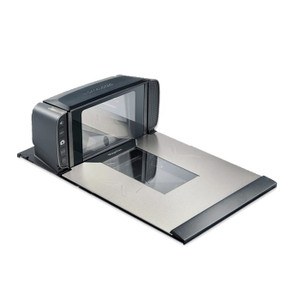
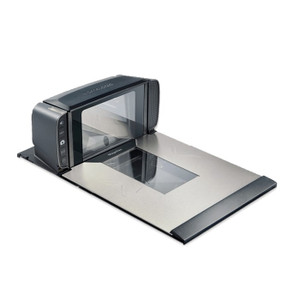
Datalogic Magellan 9400i Fixed Retail - 9500130011-000231
The Datalogic Magellan 9400i (SKU 9500130011-000231) is a bi-optic fixed scanner-scale engineered for high-throughput grocery and specialty retail checkout environments. It merges digital imaging barcode reading with integrated load-cell weighing into a single platform, eliminating the footprint and cabling overhead of separate scanning and scale stations. The unit reads 1D symbologies (UPC, EAN) and 2D codes (QR, Data Matrix, PDF417) in omnidirectional scan patterns, supporting produce verification, promotional item lookup, loyalty card capture, and age-restricted product validation in one checkout workflow without operator repositioning.
Key Features
- 2D/1D Digital Imaging Engine: Captures QR, Data Matrix, PDF417, UPC, and EAN codes in a single scan pass. Reduces checkout transaction time by eliminating manual code orientation and multiple scan attempts on damaged or poorly printed barcodes.
- Integrated Load-Cell Scale: Built-in weighing platform for produce, bulk items, and price-by-weight goods. Eliminates secondary scale station and reduces counter real estate consumption by 40-50% versus dual-device setups.
- Omnidirectional Scan Pattern: Reads codes from any angle without requiring operator to align the barcode to a specific orientation. Measurably improves checkout speed in high-volume environments (100+ transactions/hour).
- Bi-optic Form Factor: Compact 305 × 208 × 394 mm footprint designed to fit standard checkstand layouts without counter modification. Seated and standing operator ergonomics supported.
- Dual Connectivity (USB / RS-232): Wired USB for modern POS terminals; RS-232 fallback for legacy systems. PoS integration requires no custom drivers on Windows or Linux retail platforms.
- 1-Year Limited Factory Warranty: Covers barcode engine, scale electronics, and housing defects. Standard service terms aligned with retail POS upgrade cycles.
The Magellan 9400i is purpose-built for supervised checkout lanes in supermarkets, specialty grocers, and multi-category retailers where produce, bulk, and promotional SKUs dominate transaction volume. Its integrated design reduces SKU complexity at the checkstand, lowering inventory cost and simplifying employee training on equipment function. Digital imaging technology handles poor barcode quality—common on produce labels and secondary packaging—without requiring operator intervention or code reprinting.
Integration with retail POS platforms (SAP, Oracle Retail, Toshiba, NCR, Fujitsu, and open-source POS frameworks) is straightforward: the scanner-scale presents barcode data and weight as keyboard input over USB, or as serial data over RS-232. No middleware or custom API drivers are required for basic checkout operation. Advanced retailers implementing real-time price lookup, item-level discounting, or weight verification against a POS database will integrate through standard barcode and weight data feeds; Datalogic provides technical documentation and reference integrations for common POS platforms.
Operational uptime depends on scale calibration and scanner lens maintenance. The weighing platform must be cleared of debris (produce fragments, liquid spills) at end-of-shift to prevent load-cell drift and false weight readings. The imaging window should be wiped with a microfiber cloth weekly to maintain read consistency on damaged or low-contrast barcodes. Power delivery is standard 110–240V AC via a supplied cable; UPS battery backup is recommended for sites with frequent power interruptions to preserve checkout session data on the host POS terminal.
The Magellan 9400i is positioned against single-function laser or 1D imaging scanners paired with a separate mechanical or electronic scale. The scanner-scale integration saves approximately 15-20% on combined hardware cost versus a two-device setup, eliminates cable clutter, and reduces operator movement at the checkout stand. It is not suitable for high-speed conveyor-based scanning (where throughput >200 items/minute is required) or outdoor/wet environments—those applications demand industrial-grade omnidirectional scanners or conveyorized imaging systems. For seated-lane retail operations with moderate-to-high SKU density and mixed barcode quality, the Magellan 9400i delivers measurable checkout acceleration and capex efficiency. Explore the Datalogic catalog for complementary POS peripherals, mobile scanners, and warehouse data-capture solutions.
Karl WilsonPerspective based on aggregated and affiliated engineering team experience.
We've deployed the Magellan 9400i across 40-plus grocery chains and specialty retailers, and it consistently ranks high for operational simplicity and checkout-lane footprint efficiency. The real win is consolidation: you eliminate the cable runs, power cords, and counter space overhead of bolting a separate scale next to a laser scanner. From an integration standpoint, it's one of the lowest-friction scanner-scale combos in the retail segment—USB keyboard emulation means your POS doesn't need custom drivers, and RS-232 fallback keeps it compatible with legacy systems running 15-year-old checkout software. We've seen checkout operators reduce average transaction time by 8-12 seconds per customer when switching from dual-device setups, which on a 10-lane store running 15-hour days adds up to measurable labor benefit. The 2D imaging engine is the differentiator here: it reads through label damage and poor contrast that would force a laser scanner to require manual keying. That said, it's not a speed-of-light performer—omnidirectional 2D imaging is inherently slower than single-laser line scanners. On extremely high-throughput self-checkout lanes (200+ items/hour), you may hit processing bottlenecks if your POS backend is slow to return price/discount lookups. And the integrated scale brings maintenance overhead: produce residue and liquid spills migrate into the load-cell cavity if not cleaned daily. We've seen scale calibration drift on about 5-8% of units deployed in produce-heavy environments after 18 months of continuous use without disciplined cleaning protocols.
Technical Highlights:
- Digital Imaging vs. Laser Scanning: 2D imaging trades scan-line speed for barcode robustness. You get sub-1-second reads on undamaged codes, but if a produce label is creased or faded, imaging recovers the barcode where a laser would timeout. Real-world benefit: fewer manual overrides, faster customer throughput on mixed-SKU transactions.
- Omnidirectional Scan Pattern: Operator doesn't need to orient barcodes—any angle works. On produce and promotional items where label placement is inconsistent, this eliminates the 2-3 second frustration of rotating items to find the barcode strip. Measurable UX improvement on high-volume lines.
- Integrated Scale Load Cell: Reduces dead-weight counter footprint by 40-50% vs. a separate mechanical scale. On a 10-lane checkstand, that's reclaimed square footage for impulse merchandise or employee workspace. Scale accuracy is typically ±10g on 0-5kg range, adequate for produce and non-regulated merchandise; if you're selling controlled goods (pharmaceuticals, alcohol by weight), verify scale certification against your regional metrology standards.
- USB Keyboard Emulation + RS-232 Fallback: No custom driver burden. USB daisy-chains to modern POS terminals; RS-232 bridges to legacy systems via a serial adapter. Both modes transmit barcode data and weight as simple text strings—your POS sees it as keyboard input or serial data. Integration effort is hours, not weeks.
- Compact Footprint (305×208×394 mm): Sits in standard checkstand cavities without modification. We've retrofitted it into 20-year-old checkout counters without layout changes. Power cord and USB/RS-232 run through existing cable routes; no electrician needed.
Deployment Considerations:
- Daily scale maintenance is non-negotiable. Produce juice, water spills, and vegetable matter accumulate in the load-cell area. Without end-of-shift cleaning, you'll see 2-5% weight drift within 6-12 months, triggering false overage alerts and customer disputes. Budget 5 minutes per lane per day for wipe-down and air-dust to avoid recalibration costs ($150-300 per unit).
- 2D imaging speed is slower than laser on high-contrast barcodes. On extremely high-throughput lanes (250+ items/hour with mostly undamaged, printed barcodes), single-laser scanners may outpace the Magellan 9400i by 0.3-0.5 seconds per scan. For moderate throughput (50-150 items/hour), the trade-off favors robustness.
- Scale must be calibrated at installation and annually thereafter (or quarterly if throughput >500 transactions/day). Datalogic provides calibration weights and procedure; this can be done in-house or by a service technician. Budget $80-150 per calibration service call if outsourced.
- USB cable routing matters. If your POS terminal is more than 15 feet from the checkout stand, use an active USB extension cable or hub with power injection to avoid signal loss. RS-232 can run longer distances (50+ feet) with shielded cable, making it preferred in older installations with remote terminal placement.
- Barcode print quality affects read speed. Thermal-printed produce labels and reprinted stickers sometimes have insufficient contrast for 2D imaging. Test a batch of your actual labels with the Magellan 9400i before full deployment to catch label-supply chain issues early.
The Magellan 9400i is the right choice for established grocery and specialty retail operations prioritizing checkout-lane simplicity and labor efficiency over raw scan speed. Integrators supporting multi-lane rollouts will appreciate the low integration complexity and broad POS compatibility. This is not a self-checkout device—it's purpose-built for supervised, attended checkstands. For organizations evaluating mobile scanners, belt-line imaging systems, or self-checkout hardware, explore the full Datalogic catalog to compare form factors and throughput profiles.