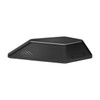
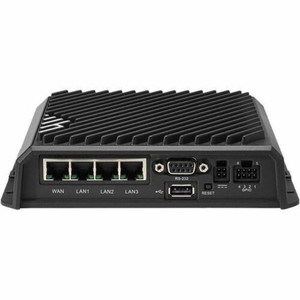
Cradlepoint TAA-TCA3-2105-5GB-GA 4-Port Router with 5G Cellular
Overview
The Cradlepoint TAA-TCA3-2105-5GB-GA R2100 Series is a compact desktop router designed for remote and semi-permanent network deployments where dual-mode connectivity—cellular and Wi-Fi—is non-negotiable. This TAA-compliant unit combines 2.5 Gigabit Ethernet backhaul, integrated 5G/4G/3G cellular modem, and Wi-Fi 6 (802.11a/b/g/ac) in a footprint small enough for field vehicles, temporary command posts, or hardened warehouse edge locations. It's purpose-built for integrators deploying failover links, mobile workforce connectivity, or out-of-band management to remote security equipment.
Key Features
- Four Gigabit Ethernet Ports with 2.5GbE uplink: The TAA-TCA3-2105-5GB-GA provides four Ethernet ports capable of 2.5 Gigabit throughput, eliminating traditional 1GbE bottlenecks on the backhaul. This matters when you're aggregating traffic from multiple IP cameras, access control readers, or warehouse scanners over a single uplink—2.5GbE cuts latency and congestion compared to 1GbE. Desktop form factor mounts on a shelf or pole without requiring rack space.
- Integrated 5G/4G/3G Cellular Modem: Built-in WWAN module supports 5G, 4G LTE, and 3G fallback, eliminating the need for an external USB modem or cellular gateway. Useful for primary connectivity in areas with spotty fiber, or as a redundant failover link when your primary ISP drops. No separate enclosure to manage or power.
- Wi-Fi 6 with Backward Compatibility: 802.11a/b/g/ac support means legacy mobile devices and IoT sensors can associate without compatibility headaches. Wi-Fi 6 efficiency reduces airtime congestion in dense deployment scenarios—important if you're running multiple wireless access points in a large warehouse or distribution center.
- NetCloud Management Integration: Cloud-based administration via Cradlepoint's NetCloud platform provides zero-touch provisioning, remote reboot capability, and centralized monitoring across dozens of remote sites. Real-world benefit: push a configuration update to 50 field routers without on-site technician visits. Device health telemetry feeds directly into your NOC dashboard.
- TAA Compliance: Trade Agreements Act (TAA) certification means this unit qualifies for federal government purchasing (GSA Schedule, CMMC, etc.) and avoids country-of-origin restrictions. Critical if your end customer is public sector, DoD contractor, or federal agency.
- Compact Desktop Deployment: Unlike rack-mount enterprise routers, the TAA-TCA3-2105-5GB-GA fits in a vehicle, a shipping container, or a small outdoor enclosure. No 110-240V AC requirement complexity—power via PoE or 12VDC adapter. Ideal for temporary site activation or rapid redeployment.
Integration & Compatibility
The TAA-TCA3-2105-5GB-GA pairs with standard Ethernet infrastructure and supports both cellular and Wi-Fi uplink simultaneously, enabling automatic failover. It integrates with network routing and switching equipment via standard RJ-45 connections and manages connectivity for IP cameras, NVRs, access control panels, and mobile devices on the same network. NetCloud orchestration means minimal on-site configuration—most provisioning happens from the cloud. Compatible with ONVIF-compliant cameras and standard Ethernet-powered devices, making it a straightforward addition to existing security integrations.
When to Choose a Different Model
If you need rack-mount consolidation for a primary data center, consider higher-density routing platforms in the Cradlepoint enterprise line. If cellular connectivity is optional and you only need redundant wired failover, a passive Ethernet switch with separate WAN diversity may cost less. For extremely high-throughput backhaul (10GbE+), this model's 2.5GbE ceiling becomes a constraint—step up to industrial-grade routing hardware. If you have no cellular coverage in your area, the built-in modem offers no advantage; a simpler dual-Ethernet failover device may suffice.
Frequently Asked Questions
Q: Is the TAA-TCA3-2105-5GB-GA TAA-compliant for federal procurement?
A: Yes. This model is explicitly TAA-certified, meeting Trade Agreements Act requirements for government contracts, GSA schedules, and CMMC-regulated environments.
Q: Can the TAA-TCA3-2105-5GB-GA handle automatic failover between cellular and Wi-Fi?
A: Yes. The router supports both cellular and Wi-Fi simultaneously and can be configured for automatic failover via NetCloud management, routing traffic to whichever uplink is available.
Q: What's the power requirement for the TAA-TCA3-2105-5GB-GA?
A: The unit supports PoE or 12VDC adapter input, eliminating dependency on 110-240V AC mains. Actual wattage will be specified in the device datasheet—confirm with your distributor if peak power budget is critical.
Q: Does the TAA-TCA3-2105-5GB-GA work with existing IP cameras and security equipment?
A: Yes. Its four Gigabit Ethernet ports connect standard ONVIF-compliant IP cameras, NVRs, access readers, and PoE-powered devices. No special integration software is required beyond NetCloud for remote management.
Q: What's the maximum throughput on the 2.5GbE uplink?
A: The TAA-TCA3-2105-5GB-GA supports 2.5 Gigabit Ethernet on the backhaul port, a practical middle ground between legacy 1GbE and enterprise 10GbE—sufficient for aggregated multi-camera or multi-reader traffic without excessive latency.
Q: Is the TAA-TCA3-2105-5GB-GA suitable for outdoor or harsh-environment mounting?
A: The base unit is a desktop device; outdoor deployment requires an IP-rated enclosure. Check with your integrator on rated environmental conditions and recommended mounting hardware.
Ted PerryPerspective based on aggregated IPSD and affiliated engineering team experience.
I evaluate the TAA-TCA3-2105-5GB-GA primarily as a failover and remote-access enabler, not a primary backbone router. The 2.5GbE port is genuinely useful—it sidesteps the 1GbE ceiling that chokes aggregated multi-camera streams. More important: the integrated 5G/4G/3G modem plus NetCloud orchestration means you can commission a remote site, push config updates, and monitor uplink health without sending a truck. That's where the ROI lives for integrators managing distributed deployments.
Technical Highlights:
- 2.5 Gigabit Ethernet backhaul: Cuts latency on aggregated camera traffic compared to 1GbE; practical for 4–8 concurrent IP camera streams or mixed camera + reader traffic without flow congestion. Not 10GbE, but adequate for field and semi-permanent sites.
- Integrated 5G/4G/3G with no external modem: Eliminates the "USB modem hanging off a switch" anti-pattern. Failover to cellular is automatic if configured correctly—no manual intervention. Real win for remote sites with unreliable ISP.
- NetCloud cloud-based management: Zero-touch provisioning and remote reboot mean you avoid site visits for firmware or configuration pushes. Monitoring feeds into a central dashboard; alerts surface uplink failures in real time.
Deployment Considerations:
- Desktop form factor requires a small shelf or pole mount; not suited to panel-mount or DIN-rail installations. Plan enclosure strategy if deploying outdoors or in a vehicle.
- Power input (PoE or 12VDC) means dependency on your local PoE supply or 12VDC adapter—confirm wattage budget and cable routing before installation. Confirm peak draw with the datasheet.
- TAA compliance is a checkbox win for government/federal projects, but adds cost vs. non-compliant equivalents. Only pursue this model if you need that certification.
The TAA-TCA3-2105-5GB-GA excels in distributed remote security deployments (warehouse branches, temporary command posts, mobile surveillance platforms) where a single device must backhaul camera and access control traffic AND maintain out-of-band management connectivity. Avoid it if you need pure fiber backbone performance or rack-mount consolidation in a central NOC.