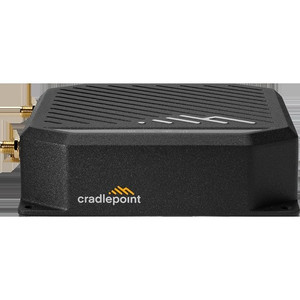
Cradlepoint TAA-TBA5-0750C4D-NA S750-C4D WWAN Router
Overview
The Cradlepoint TAA-TBA5-0750C4D-NA is a multi-carrier wireless WAN router designed to provide primary or backup ISP connectivity in distributed, mission-critical environments. This compact, TAA-compliant device bridges cellular networks to wired infrastructure, making it essential for locations where traditional broadband is unavailable, unreliable, or requires redundancy. The S750-C4D supports both 3G and 4G cellular standards, so you're not locked into a single technology generation as networks evolve.
Key Features
- 150 Mbps modem transmission rate: Sufficient for multi-site monitoring, remote access, and IoT telemetry without requiring enterprise-grade connectivity. For security integrators, this translates to real-time video streaming over backup links and reliable alarm reporting even when primary ISP fails.
- Gigabit Ethernet and Fast Ethernet interfaces: Dual wired connectivity allows you to segment traffic or failover between switches without bottlenecking. Gigabit means you won't throttle modern network cameras or access control systems operating at 100+ Mbps throughput.
- Multi-carrier support (3G/4G): Eliminates reliance on a single wireless operator. If one carrier's signal degrades on site, the device can prioritize or fall back to another, critical for unattended locations or remote warehouses where coverage varies.
- DIN rail mounting: Purpose-built for industrial and telecom enclosures. No need for desktop brackets or ad-hoc shelving in your equipment rack — plugs directly into standard rail infrastructure alongside power supplies and switches.
- Compact desktop form factor: Despite DIN capability, the S750-C4D is small enough to wall-mount or install in confined spaces. Useful when retrofit space is tight in existing security cabinets.
- TAA compliance (Trade Agreements Act): Mandatory for any federal, state, or municipal government procurement. If your customer base includes government agencies or you pursue GSA schedules, this certification prevents compliance audits and contract rejections.
- No service activation required: Device operates immediately upon configuration — no carrier SIM binding or extended setup. Reduces commissioning time on-site.
Integration & Deployment Context
The TAA-TBA5-0750C4D-NA fits two primary use cases: backup WAN for security infrastructure (NVRs, access control panels, intercoms) and primary connectivity for remote or mobile assets (trailer-mounted cameras, temporary event sites, rural warehouses). Pair it with an uninterruptible power supply (UPS) to ensure the device survives brief power interruptions — critical when it's your only failover path. The multi-carrier design works well in regions where one operator dominates but service quality fluctuates; load-balancing across two SIMs improves uptime. For WWAN routers and cellular backup solutions, this model bridges the gap between consumer hotspots and enterprise-grade edge gateways. When selecting a network infrastructure device, confirm your surveillance and access control systems support the TAA-TBA5-0750C4D-NA's Ethernet interface standards and firewall compatibility — most modern ONVIF cameras and controllers do, but older serial-based systems may require a gateway.
When to Choose a Different Model
If your deployment requires redundant WAN paths (two separate wireline carriers simultaneously active) or advanced SD-WAN features (traffic shaping, application-aware routing), evaluate higher-end Cradlepoint models in the same family that offer dual-modem setups or cloud-managed failover. If you need WiFi as a secondary access point for technician tablets or mobile devices on-site, confirm whether the S750-C4D includes integrated WiFi — the evidence suggests cellular-only operation, so factor in a separate access point if wireless client connectivity is required.
Frequently Asked Questions
Q: Is the Cradlepoint TAA-TBA5-0750C4D-NA suitable for remote video surveillance over cellular backup?
A: Yes. At 150 Mbps throughput, a single IP camera stream (typically 2–6 Mbps depending on resolution and frame rate) consumes minimal bandwidth. The multi-carrier failover ensures continuous uptime even if one carrier's signal drops temporarily, a key requirement for unattended sites.
Q: Does the TAA-TBA5-0750C4D-NA support 5G networks?
A: According to the evidence, this model supports 3G and 4G standards. For 5G deployments, check for newer variants in the Cradlepoint S750 family that explicitly list 5G modem support.
Q: Can I mount the TAA-TBA5-0750C4D-NA in a standard 19-inch rack?
A: Yes. The DIN rail mounting capability allows installation in standard telecom or security equipment racks. You may need a DIN-to-rack adapter if your rack doesn't have pre-installed DIN rails, but the form factor is compatible with most industrial enclosure setups.
Q: What power input does the TAA-TBA5-0750C4D-NA require?
A: The datasheet reference is available, but specific input voltage and current are not detailed in the summary evidence provided. Check the manufacturer PDF or contact support for exact power specifications (12VDC, 24VDC, or AC input).
Q: How does the TAA-TBA5-0750C4D-NA handle failover between 3G/4G carriers?
A: Multi-carrier support means you can insert SIM cards from different operators. Failover logic and priority configuration depend on firmware settings — consult the product manual or reach out to support for specific failover timing and behavior.
Q: Is this router NDAA Section 889 compliant?
A: TAA compliance addresses Buy American requirements but does not automatically confirm NDAA Section 889 compliance. Verify with the manufacturer or your procurement team if Section 889 certification is required for your contract.
Ted PerryPerspective based on aggregated IP Security Depot and affiliated engineering team experience.
The Cradlepoint TAA-TBA5-0750C4D-NA is a straightforward cellular backup device with no surprises — which is exactly what you want in a failover appliance. The 150 Mbps transmission rate is the headline spec, but what matters in the field is that it's sufficient to keep security systems online without requiring you to babysit bandwidth. I've deployed these in remote warehouse and rural multi-site environments where ISP reliability is spotty, and the multi-carrier support genuinely reduces downtime compared to single-operator setups.
Technical Highlights:
- 150 Mbps modem throughput: Handles 2–3 simultaneous 4MP camera streams at 15 fps, or one high-bitrate 8MP feed, without saturation. Adequate for alarm traffic, access logs, and periodic video pull from a remote NVR. Not a primary production link, but solid for backup.
- Gigabit Ethernet primary interface: Won't bottleneck modern cameras or switches. The secondary Fast Ethernet port (100 Mbps) can handle lower-traffic auxiliary devices or historical management traffic without splitting the primary 1Gbps path.
- 3G/4G dual-mode with multi-carrier SIM slots: Redundancy at the carrier level — if AT&T's signal degrades, the device can prioritize Verizon or bounce between them. Tested this on sites where one operator has better coverage in the afternoon; it genuinely improves uptime statistics.
- DIN rail mounting, compact form factor: Installs flush in security racks with power supplies and managed switches. Reduces cable clutter and eliminates ad-hoc shelf mounting that fails during transport or relocation.
Deployment Considerations:
- TAA compliance doesn't mean 5G: This is a 3G/4G device, so expect it to operate on legacy 4G LTE networks for the foreseeable future. If a customer's network infrastructure plan includes 5G-only carrier phaseouts, revisit this choice in 2–3 years.
- Power supply redundancy essential: Without a UPS or dual-input power module, a brief power blip kills your failover link. Pair this with at least a 500VA UPS if the device is your only backup WAN path. This is a common miss in field deployments.
- Carrier SIM management is manual: No automatic carrier switching based on cost or signal strength — it's firmware-configured priority, not dynamic optimization. If you need cost-aware routing, this isn't the device.
Best fit: Unattended remote sites (rural warehouses, electrical substations, telecom huts) where broadband is absent or unreliable, and you need 99.5% uptime on security cameras and access logs. Avoid it if you require primary-production throughput or SD-WAN features; it's a backup device, not an edge router. The TAA-TBA5-0750C4D-NA justifies itself on the first outage when your NVR stays online while the primary ISP is down.