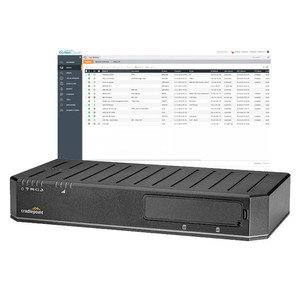
Cradlepoint TAA-BFA5-0300C7C-GN Managed Gigabit SFP Module
Overview
The Cradlepoint TAA-BFA5-0300C7C-GN is a managed SFP (Small Form-factor Pluggable) module designed to extend gigabit Ethernet connectivity in branch and fixed-site network deployments. This is not a general-purpose optics module — it's engineered for integration into branch infrastructure where centralized management and compliance are non-negotiable. TAA compliance means it meets Buy American Act requirements, a critical requirement for federal and many state procurement cycles. The five-year warranty backs production deployments without surprise replacement costs.
Key Features
- Managed Architecture: Unlike passive SFP transceivers, the TAA-BFA5-0300C7C-GN supports centralized configuration and monitoring. Your network management platform gains visibility into module status and performance metrics — meaning you catch port failures or degradation before field staff do.
- Gigabit Ethernet Speed: Operates at 1 Gbps, the standard for modern branch aggregation and backbone links. Sufficient for typical branch traffic loads; if you're running multi-gigabit spine links, you'll need higher-speed optics.
- Industrial Operating Temperature Range: Operates reliably across extended temperature ranges suitable for non-climate-controlled warehouses, outdoor cabinets, and remote sites. This matters when your network closet sits in an uninsulated building or outside environment — temperature swings won't degrade performance or shorten module life.
- TAA Compliance: Meets Trade Agreements Act requirements, essential for federal, state, and many municipal buyers. If your procurement process requires TAA language, this module satisfies that gate.
- Five-Year Warranty: Longer than typical transceiver warranties. In production branch networks, this eliminates end-of-life surprises and simplifies capital planning for fixed-site deployments.
- SFP Form Factor: Plugs directly into existing SFP cage slots on compatible switches. No chassis modifications or additional hardware needed — install and manage from your existing port assignments.
Integration & Compatibility
The TAA-BFA5-0300C7C-GN integrates into any switch or network device with available SFP slots and support for managed transceivers. Confirm your switch firmware supports transceiver monitoring and management before ordering — not all models expose transceiver sensors, which limits the value of the managed feature. Pair with compatible switches supporting standard SFP optics and SNMP-based transceiver telemetry for full visibility.
When to Choose a Different Approach
If you need higher speeds (10 Gbps or 25 Gbps), consider higher-speed SFP variants in the same product family. For passive optics in non-managed environments, standard transceivers are sufficient and cost less. If your procurement doesn't require TAA compliance, generic SFP modules may offer better pricing.
Frequently Asked Questions
Q: Is the TAA-BFA5-0300C7C-GN suitable for outdoor fiber runs?
A: The module itself handles industrial temperatures; however, optics performance depends on your fiber plant. Verify your fiber spans, environmental conditions, and link budget before deploying. Consult your switch vendor's compatibility matrix and request a pre-sales fiber assessment for long-distance outdoor runs.
Q: What's the warranty coverage on the TAA-BFA5-0300C7C-GN?
A: Five-year manufacturer warranty against defects. Covers hardware failure; does not cover fiber damage, misalignment, or environmental damage outside the stated operating range.
Q: Does the TAA-BFA5-0300C7C-GN require special management platform integration?
A: The managed architecture supports SNMP-based transceiver monitoring. Your switch and management platform must expose SFP transceiver diagnostics (DDM/DOM — Digital Diagnostics Monitoring). Standard switches support this; verify your NMS or switch GUI can query transceiver status before deploying.
Q: Can I use the TAA-BFA5-0300C7C-GN in a temperature-variable outdoor cabinet?
A: Yes. Industrial-grade operating temperature range supports non-climate-controlled installations. Confirm the specific temperature limits in your product datasheet against your site's minimum and maximum conditions.
Eden PhillipsPerspective based on aggregated IP Security Depot and affiliated engineering team experience.
The TAA-BFA5-0300C7C-GN is a deliberate choice for integrators managing federal or compliant procurement gates. Managed SFP transceivers are less common than passive optics, and the TAA designation adds friction to some supply chains — but it eliminates compliance questions downstream. If your customer's procurement requires domestic-source certification, this module closes that loop without redesign.
Technical Highlights:
- Managed Transceiver Architecture: Exposes module temperature, power, and link status via SNMP DDM (Digital Diagnostics Monitoring). Early warning on failed or degrading links before users report outages — saves troubleshooting time on multi-site branches.
- Gigabit SFP Form Factor: 1 Gbps over standard single-mode or multi-mode fiber. Plug-and-play into any SFP-capable port; no cage rework, no SFP+ chassis upgrades unless you're scaling to higher speeds.
- Industrial Temperature Tolerance: Rated for extended temperature swings typical of uninsulated cabinets and remote shelters. Eliminates thermal derating concerns on non-climate-controlled deployments.
Deployment Considerations:
- Verify your switch or aggregation device supports managed transceiver monitoring. Some older or budget-line switches ignore DDM output — if your platform can't read module diagnostics, you're paying for a feature you won't use.
- TAA compliance adds lead time in some channels. Budget 4–6 weeks if sourcing through GSA or major federal integrators; standard commercial channels may deliver faster but without the compliance paperwork trail.
Position the TAA-BFA5-0300C7C-GN for federal, state, or municipal branch aggregation where compliance is a hard requirement and you need telemetry-enabled optics. For pure commercial speed-and-distance, standard managed SFP transceivers may cost less. For unmanaged branches, passive optics are simpler and cheaper — but you sacrifice visibility.