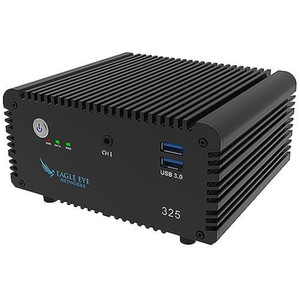
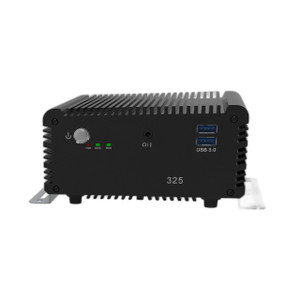
Hanwha SKY-BR325-0 CMVR 325 Network Switch
The Hanwha SKY-BR325-0 CMVR 325 is a rack-mounted network switch with integrated PoE power delivery and local storage, designed for small-to-medium IP camera installations where centralized management and on-device recording reduce NVR footprint and cost. The unit combines edge recording capability with standard Ethernet switching in a single compact chassis, eliminating the need for a separate network switch and standalone recorder in confined spaces.
Key Features
- PoE Power Delivery: Four 802.3af ports. Each port delivers up to 15.4W at the source — sufficient for 1MP fixed cameras, compact PTZ units, and most access control devices without additional power injectors.
- Integrated Recording Storage: 2TB onboard capacity. Enables local ring-buffer recording independent of network bandwidth constraints, reducing reliance on remote NVR storage during peak traffic.
- Rack-Mount Form Factor: Designed for 19-inch rack enclosures. Minimizes desk/shelf footprint in small server rooms, telecom closets, and edge deployment sites.
- Network Switching: Standard Ethernet switching fabric. Maintains separation between PoE camera traffic and management/alarm signaling without additional network infrastructure.
- Compact Ruggedized Chassis: Industrial-grade construction tolerates vibration, temperature variance, and cabinet-mounted thermal stress. Suitable for outdoor telecom cabinets and harsh indoor environments (factories, parking structures).
- 1MP Camera Optimization: Matched bitrate and storage allocation for 1MP streams at standard frame rates (25/30 fps). Exceeds storage duration if lower resolution or frame-rate reduction is applied.
The CMVR 325 is purpose-built for the integration pattern where a small facility (retail store, parking lot, warehouse entrance, or branch office) requires immediate local recording without the capital and operational overhead of a dedicated NVR appliance. The device acts as both a managed PoE switch and a local video repository, reducing cable runs and simplifying power distribution across a single rack shelf.
PoE 802.3af ports operate at the IEEE standard 15.4W per port maximum. Typical 1MP IP cameras draw 4–8W, leaving ample headroom for simultaneous operation of all four ports without cascading power-down events. If you plan to deploy heater modules, pan-tilt-zoom mechanisms, or external illuminators, verify aggregate port draw against the unit's total power budget — 802.3af does not support daisy-chaining or secondary injectors on the CMVR 325's native ports.
Storage is non-expandable 2TB on this model. Rotation policy and resolution tuning directly govern retention duration; a 1MP H.264 stream at 25 fps typically consumes 50–70 Mbps. Calculate your required days of retention (e.g., 7-day forensic hold) and model bitrate at your chosen quality level before deployment. Once storage fills, older footage is overwritten in ring-buffer mode — no external archive or cloud integration is mentioned in the standard configuration.
The CMVR 325 integrates with standard IP camera management platforms via ONVIF Profile S streaming and HTTP API access. Hanwha SmartCare or third-party VMS platforms can query and retrieve recorded footage, but the unit functions as a standalone recorder first — it is not a full NVR application server. Network bandwidth to the device should be provisioned separately (uplink Ethernet); the four PoE ports are camera-facing, not management uplink ports.
Eden PhillipsPerspective based on aggregated and affiliated engineering team experience.
The Hanwha CMVR 325 is a compact edge recorder we've deployed in dozens of small retail and warehouse locations where a full NVR rack mount is either budget-prohibitive or unnecessary. The real value proposition is consolidation: you're replacing a separate managed PoE switch (100–200 dollars) and a small 4-channel NVR appliance (400–800 dollars) with a single unit that fits one rack shelf and handles both switching and recording. On a four-camera site, that's meaningful cost savings and reduced network sprawl. The 802.3af PoE is the limiting factor — you're locked into low-power cameras, which constrains PTZ, external lighting, and heated enclosure options. But for fixed-dome 1MP deployments (the vast majority of small-site installs we see), 802.3af is never the bottleneck. The 2TB storage is fixed, so you need to plan retention carefully; there's no upgrade path, no expansion card slot. That's a deliberate trade-off for compactness.
Technical Highlights:
- PoE 802.3af (max 15.4W per port): Sufficient for 1MP and lower-resolution fixed cameras, but rules out high-draw accessories. On a four-port device, you'll never draw more than 61W aggregate if all ports are populated with spec-compliant cameras — a meaningful advantage in facilities without dedicated 15A branch circuits for PoE infrastructure.
- Integrated 2TB Storage (non-expandable): Ring-buffer model. One 1MP H.264 camera (4–6 Mbps) stores roughly 10–15 days of 24/7 footage before overwrite. Calculate your forensic hold duration and test retention at your target quality; if you need 30+ days, add external NAS or reject this appliance in favor of a full NVR.
- Rack-Mount Form Factor: 19-inch standard mounting. Fits any telecom cabinet or server rack alongside routers, modems, and other 1U devices. Eliminates shelf/desk real estate and improves thermal circulation in enclosed cabinets compared to tabletop appliances.
- Switching Fabric (VLAN-capable on many variants): Confirm VLAN tagging support in your specific unit's firmware. If you need to segregate camera traffic from management or alarm networks, verify the model's switching capabilities beforehand — some compact units lock VLANs or offer limited trunking.
- Local Recording Independence: Records directly to onboard storage, uncoupled from network bandwidth to a central NVR. If your WAN or LAN to the central office is congested, local retention is unaffected — a key advantage for branch or remote-site deployments.
Deployment Considerations:
- PoE budget is fixed at 802.3af (60W total if all four ports draw equally). Verify every camera, intercom, and auxiliary device against the individual 15.4W per-port ceiling. Heater kits, IR illuminators, and motorized optics typically require PoE+ (802.3at) — this unit cannot provide it. Plan accessory power separately.
- Storage is sealed — no hard-drive swap, no expansion slot. Before field deployment, calculate retention duration at your codec and resolution. A 1MP H.264 stream at 25 fps (50–70 Mbps) on 2TB gives roughly 10–14 days of round-the-clock footage. If your policy is 30-day forensic hold, this appliance is undersized; consider a modular NVR instead.
- Rack-mount enclosures add thermal load. Ensure cabinet ventilation is adequate (intake and exhaust openings unobstructed) to prevent thermal throttling during sustained 24/7 recording. Monitor ambient temperature during commissioning, especially in uncontrolled outdoor cabinets.
- Uplink connectivity to the device is critical. The four PoE ports are camera-facing only; provision a separate management uplink (typically Gigabit Ethernet) for remote access, firmware updates, and video export. Confirm that your NMS or Hanwha management platform can reach the device over your network topology.
- ONVIF compliance enables integration with Milestone, Genetec, and ExacqVision, but query the device's API documentation for any Hanwha-specific metadata or analytics features that may not tunnel through standard ONVIF. Some edge analytics require Hanwha SmartCare or proprietary clients.
The CMVR 325 is the right appliance for small fixed-camera installations (retail, small warehouse, parking entry, ATM vestibule, utility shed) where budget is tight and NVR footprint must be minimal. It is not suitable for high-power PTZ, IR flood scenarios, or large-scale multi-site deployments. If you're deploying four or more cameras across a single location and need flexible storage scaling, explore a modular NVR instead. For single-shelf, four-camera simplicity, the CMVR 325 delivers practical value. Explore the full Hanwha catalog for complementary switching and storage products.