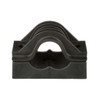
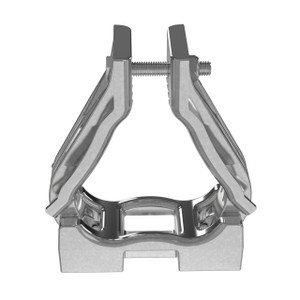
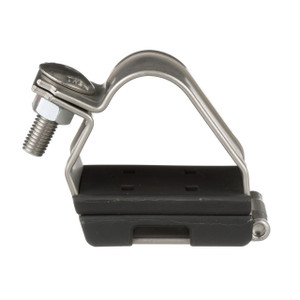
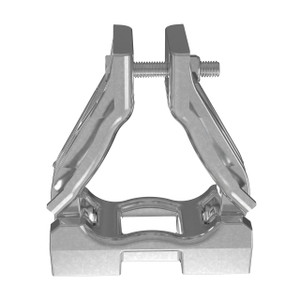
Panduit CCPLTR3745-X Polymer Trefoil Cable Cleat
The Panduit CCPLTR3745-X addresses the critical challenge of restraining trefoil-configured power cables during short circuit faults in commercial and industrial environments. Certified to IEC 61914:2015 and tested to 136kA peak fault current, this glass-filled nylon cleat prevents catastrophic cable whip in data centers, renewable energy installations, and industrial power distribution systems where three-phase cables are run in trefoil formation. Designed for cables 37-45mm in diameter, the cleat mounts directly to cable tray rungs via user-supplied M10 hardware and ships in a 10-pack for large installations.
Key Features
- IEC 61914:2015 certified for short circuit fault protection up to 136kA peak current
- Trefoil-specific design accommodates three-phase cable bundles 37-45mm (1.46-1.77") in diameter
- Glass-filled nylon construction withstands medium to high fault conditions in non-corrosive environments
- Rounded internal edges prevent cable jacket abrasion during installation and fault events
- Direct-mount design fits cable tray rungs via M10 bolt fixing holes (hardware user-supplied)
- 10-pack quantity supports multi-span installations in a single order
Short circuit faults generate electromagnetic forces that can tear unsecured cables from their routes, destroying adjacent equipment and creating arc flash hazards. The CCPLTR3745-X mitigates this risk through a purpose-engineered trefoil clamp that locks around three cables arranged in triangular formation—the standard configuration for balanced three-phase power. The glass-filled nylon formulation provides mechanical strength comparable to metallic cleats while eliminating galvanic corrosion concerns in mixed-metal environments. IEC 61914:2015 certification confirms the cleat has passed dynamic short circuit testing at 136kA peak, simulating real-world fault conditions where cable movement must be restricted to prevent secondary failures. The rounded internal geometry distributes clamping force evenly across cable jackets, preventing stress concentration that could compromise insulation integrity during thermal cycling or fault-induced vibration.
Installers mounting CCPLTR3745-X cleats to ladder-style cable tray will appreciate the direct-fix design: the cleat's mounting holes align with standard tray rung spacing and accept M10 bolts, eliminating the need for separate backing plates or saddle brackets. This simplifies Bill of Materials planning and accelerates installation in environments where cable routes span dozens of meters. The 37-45mm cable diameter range covers common medium-voltage power cables (including 185mm² to 300mm² conductors) used in substations, UPS battery strings, and generator tie-ins. When specifying cleats for a new build or retrofit, match this model to cable OD measurements taken at the insulation—not the conductor—and confirm your cable tray rungs provide sufficient clearance for the 117mm overall cleat height. Each 10-pack reduces packaging waste and freight cost compared to individually packed units, a practical advantage on projects installing cleats every 0.5-1.0 meters per IEC guidelines.
Panduit's CCPLTR3745-X trefoil cable cleat meets the fault-current withstand requirements of IEC 61914:2015, the globally recognized standard for cable cleats in power installations. For integrators building data centers to Uptime Institute Tier III/IV specifications or renewable energy sites subject to utility interconnection review, this certification provides the third-party validation inspectors expect during AHJ review. The polymer construction eliminates the need for insulating bushings required with steel cleats in some installations, simplifying compliance with NEC Article 300.5(J) mechanical protection rules. When combined with proper cleat spacing and torque-controlled bolt installation per Panduit guidelines, the CCPLTR3745-X provides cost-effective short circuit protection without the weight and corrosion liability of zinc-plated steel alternatives.