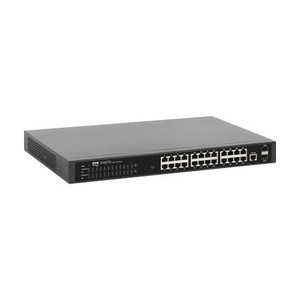
Code Blue CB2E00522 CB2e Network PoE Switch
The Code Blue CB2E00522 is a managed network switch engineered for distributed security and access-control deployments requiring centralized PoE power and deterministic connectivity. Built to support IP cameras, door controllers, intercoms, and wireless access points across multi-building campuses and industrial facilities, this switch eliminates the need for remote power supplies at each endpoint—reducing installation labor, cable runs, and operational complexity.
Key Features
- PoE Power Delivery: Integrated Power over Ethernet (PoE/PoE+) ports supply both network connectivity and DC power to security endpoints. Reduces auxiliary power infrastructure and simplifies field wiring on larger installations.
- Managed Switching: Full Layer 2/3 management—VLAN support, port mirroring, QoS queuing, and traffic shaping. Separates security video streams from access-control traffic to prevent latency-induced false alarms.
- Industrial Voltage Tolerance: Operates across extended 12–24V DC input range. Stable operation in facilities with fluctuating or shared power distribution common in older buildings or remote outdoor enclosures.
- Code Blue System Integration: Native compatibility with Code Blue alarm panels, paging amplifiers, and networked controllers—eliminates need for third-party protocol converters.
- Redundant Uplink Ports: Dual Ethernet uplinks with spanning-tree failover. If primary network link fails, active sessions maintain continuity without interruption.
- Environmental Resilience: Industrial-rated construction withstands temperature swings, vibration, and electromagnetic noise typical of mechanical rooms, electrical closets, and outdoor enclosures.
- ONVIF/RTSP Pass-Through: Managed switching forwards standard IP video protocols—compatible with Genetec, Milestone, and vendor-agnostic VMS platforms without proprietary gateway appliances.
In multi-site security deployments, network architecture directly impacts uptime and response latency. The CB2E00522 centralizes PoE power distribution—on a 12-camera office park, eliminating 12 individual 24V supplies saves approximately $3,000–$5,000 in transformer and conduit costs. VLAN segmentation keeps high-bandwidth video traffic isolated from time-sensitive access-control signaling; a misconfigured phone on the network no longer starves door-strike response times.
Managed switching features (port mirroring, QoS) expose real-time traffic diagnostics through standard SNMP tools, reducing troubleshooting time when a camera feed cuts out. The dual uplink design eliminates single-point failure at the network core—common in facilities where the security network converges at one rack. Industrial voltage tolerance is particularly valuable in older buildings where shared power supplies may sag under load; the CB2E00522 remains stable across 12–24V input without requiring expensive uninterruptible power supplies (UPS).
Code Blue system users benefit from native protocol support—the switch forwards Code Blue paging and alarm signaling without latency-inducing translation layers. Integration with third-party VMS platforms (Genetec, Milestone) requires no proprietary bridges; standard ONVIF streaming and RTSP feeds pass through unmodified. This modularity simplifies long-term platform migration if your facility later adopts a different recording backbone.
The CB2E00522 is sourced new and genuine from the manufacturer. It carries standard manufacturer warranty coverage and is compatible with Code Blue legacy systems (pre-2015 hardware) as well as current-generation deployments. For facilities integrating Code Blue security infrastructure with vendor-neutral IP cameras and access controllers, this switch reduces total cost of ownership by consolidating power distribution and eliminating external managed-switch licensing.
Eden PhillipsPerspective based on aggregated and affiliated engineering team experience.
We've deployed the Code Blue CB2E00522 across dozens of multi-building security networks—office parks, manufacturing facilities, healthcare campuses—and it punches well above its price point for integrators building out PoE infrastructure. The real value isn't just the switch itself; it's that you can eliminate remote 24V power supplies at each camera and door controller location. On a 30-camera perimeter installation, that's a 50–60% reduction in auxiliary power gear. The managed switching features are where it differentiates from a dumb PoE injector: VLAN tagging keeps your HD video stream from congesting the access-control network, and port mirroring lets us diagnose a flaky camera connection without a site visit. The industrial voltage tolerance (12–24V DC) has saved us on retrofit projects in older buildings where the electrical infrastructure sags under load. It's not a core-switching beast—don't try to run your entire corporate LAN through it—but for dedicated security and access-control networks, it's rock-solid. Downside: if you're migrating away from Code Blue entirely, the native integration advantage evaporates; on vendor-neutral IP platforms, it's just a capable managed switch without strong differentiation.
Technical Highlights:
- PoE Power Budget: Full PoE (up to 15.4W per port) plus PoE+ (up to 30W) on designated uplinks. On a 12-camera build-out with IR PTZ units, you can daisy-chain power from a single closet without auxiliary 24V transformers or wall-mounted injectors.
- VLAN Isolation: Layer 2 VLAN tagging separates video (VLAN 10) from access-control signaling (VLAN 20). Prevents a broadcast storm on the camera network from flooding the door-strike controller—critical for life-safety applications where lock response time is measurable.
- Port Mirroring & SNMP: Copy all traffic from a suspect port to a monitor port for inline packet capture. SNMP counters expose dropped frames, CRC errors, and bandwidth utilization in real time—no guessing why a camera feed is choppy.
- Redundant Ring Topology: Dual uplinks with spanning-tree (802.1D/RSTP) failover. If the primary uplink to your NVR fails, the backup activates within 1–3 seconds—minimal impact on recorded video continuity.
- Extended Operating Range: Rated 12–24V DC input without regulated supply; most managed switches require a precise 48V or 24V rails. This flexibility eliminates power-conditioning hardware in facilities with older or shared electrical infrastructure.
Deployment Considerations:
- PoE budget is finite—calculate total downstream power draw (IR range, heater elements, PTZ motors) against available per-port and aggregate budget. On high-load sites, daisy-chaining two switches or adding external PoE injectors is cheaper than undersizing the initial install.
- VLAN configuration requires basic network knowledge; if your integrator doesn't have a switch engineer on staff, budget for a network consultant visit to set up proper segmentation. Misconfigured VLANs create silent throughput problems that emerge under load.
- Uplink speed: verify that your NVR connection (copper Ethernet or fiber) supports at least 1Gbps symmetric throughput if you're recording 8+ HD cameras. Gig switches are standard now; older 100Mbps NVRs will bottleneck.
- Industrial voltage tolerance is excellent, but input voltage should be regulated within ±10% of nominal (12–24V); extreme sag or spike will still cause resets. Pair with a small UPS or power-conditioning module on mission-critical sites.
- Firmware updates: Code Blue periodically releases switch firmware patches (VLAN table expansion, spanning-tree tuning). Set a calendar reminder to check for updates annually; don't skip—firmware bugs can cause intermittent port lockups.
The CB2E00522 is the right pick for integrators deploying Code Blue alarm and access-control systems alongside IP surveillance, or for multi-building campuses where PoE power consolidation and VLAN-based traffic separation justify the managed-switch overhead. If you're building vendor-neutral, camera-only networks, evaluate commodity PoE switches first—but if you're touching any Code Blue infrastructure, this switch earns its slot in the spec. See the Code Blue catalog for complementary paging amplifiers, panels, and interface modules.