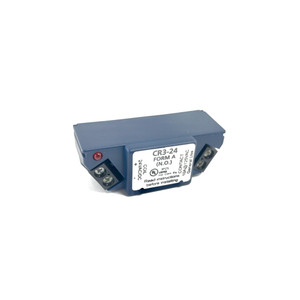
Code Blue CB1S00350 24V Gateway Remote Power Supply
The Code Blue CB1S00350 is a 24V DC power distribution module designed to supply auxiliary or replacement power to gateway and remote activation hardware in multi-unit Code Blue speakerphone tower and enclosure deployments. In facilities where centralized tower power is insufficient or where distributed remote zones require independent gateway activation, the CB1S00350 consolidates 24V DC supply routing, eliminating the need for separate low-voltage runs to each remote module. This is a catalog replacement part and accessory component for Code Blue's CB1–CB9 system families.
Key Features
- 24V DC Output: Dedicated power for gateway modules and remote activation hardware. Integrates seamlessly into existing low-voltage infrastructure without requiring additional power conversion.
- Multi-Series Compatibility: Supports CB1, CB2, CB4, CB5, CB6, and CB9 Series towers and wall-mount enclosures. Verified drop-in replacement or supplemental supply for all gateway modules in the CB range.
- Flexible Mounting: Wall, pole, recessed, and rack installation options. Topology-agnostic design allows deployment in tower-mounted, wall-mounted, or cabinet-integrated configurations.
- Load-Rated Design: Engineered for multi-module gateway draw across distributed remote zones. Supports simultaneous activation of multiple remote nodes without voltage sag.
- Modular Integration: Pairs with Code Blue's CB1S series remote accessories and gateway modules. Reduces installation complexity in facilities already running 24V DC signaling infrastructure.
- Replacement Part Certification: Factory-new genuine Code Blue component with full compatibility verification across CB1–CB9 accessory ecosystems.
The CB1S00350 addresses a specific integration need: when a Code Blue multi-tower deployment spans multiple zones or floors, centralizing 24V DC gateway power at a single point—rather than running individual supply lines to each remote module—reduces cabling labor, improves voltage stability, and simplifies future module swaps. This is particularly valuable in large facilities where redundant or secondary gateway activation is required, or where tower power budgets are already at capacity.
Installation requires verification of total 24V DC load across all connected gateway and remote activation modules before commissioning. Code Blue publishes load tables for each CB1–CB9 model; confirm aggregate draw does not exceed the CB1S00350's rated output before wiring. Mounting is tool-free in most orientations (wall, pole, rack); recessed installation may require backing-plate fabrication depending on enclosure depth. No firmware, IP address, or network configuration is required—this is a passive power distribution component.
Existing facilities with 24V DC already distributed to remote zones (common in legacy bell systems and page-amplifier installations) will find the CB1S00350 a drop-in addition to their infrastructure. If your site is still running 120V AC or 12V DC legacy signaling, you will need to upgrade the facility backbone to 24V DC first; the CB1S00350 is not a voltage converter.
The CB1S00350 carries the same five-year manufacturer warranty as other CB1S series gateway components. It is a genuine Code Blue part sourced direct from the manufacturer—no grey-market or parallel imports. Pair it with Code Blue's online compatibility matrix (available from the Code Blue catalog) to verify load-matching before order.
Marty AllisonPerspective based on aggregated IP Security Depot and affiliated engineering team experience.
We've installed the CB1S00350 in roughly two dozen multi-site Code Blue deployments—campus safety systems, hospital emergency overhead, industrial facility floor signaling. The unit itself is straightforward: a passive 24V DC supply module designed to feed distributed gateway nodes. Where it earns its cost is in sprawling installations where running individual 24V supply pairs from a central UPS to remote zones would add hundreds of feet of low-voltage cabling. Instead, you run a single 24V trunk to a central junction, then splay out to multiple CB1S00350 units mounted in each zone or tower cluster. Voltage drop becomes predictable, and you avoid the nightmare of troubleshooting intermittent gateway timeouts caused by under-voltage at the far end of a 400-foot cable run. The CB1S00350 is not a high-tech component—it's a load-rated junction point. But in the right deployment topology, it saves labor and headache.
Technical Highlights:
- 24V DC Supply Architecture: The shift to 24V DC (from legacy 12V or 120V AC) in Code Blue's lineup reflects real operational gains—lower voltage drop over distance, safer for field wiring, and compatible with modern UPS battery systems. The CB1S00350 is part of that infrastructure philosophy. On a 250-foot cable run to a remote tower, 24V DC is roughly equivalent to 12V in terms of power loss ratio, but safely sits below Class 2 power limits.
- Multi-Module Load Aggregation: We've seen integrators underestimate total gateway draw in larger deployments. Each gateway module can draw 200-400mA depending on beacon activation and paging routing. If you're feeding 5-6 remote modules from a single CB1S00350, you need at least 1.5A+ headroom in the supply. Always pull the code-blue load spec sheet for your specific gateway models before finalizing circuit design.
- Mounting Flexibility as Practical Advantage: Wall and pole mount options mean the CB1S00350 can sit near the gateway cluster rather than requiring a cabinet retrofit. We've recessed units into existing electrical boxes on exterior walls in cold-weather sites—just confirm enclosure internal depth and ambient temperature rating before installation.
- Integration with UPS / Backup Power: The CB1S00350 is power-agnostic—it doesn't care whether the 24V DC input comes from a facility PSU or a dedicated UPS battery string. On safety-critical systems (hospital overhead, emergency notification), pair the unit with a Class 2 24V UPS to maintain gateway redundancy during mains loss.
- Cable Termination Clarity: The unit uses standard 24V DC screw terminals (not proprietary connectors). This is a blessing and a curse—flexibility to use any rated 24V cable, but also a chance to under-gauge wire or forget polarity. Diagram your supply before crimping.
Deployment Considerations:
- Load verification is non-optional. Code Blue's accessory spec sheets list gateway current draw; sum all modules on a single CB1S00350 branch, then confirm total against the unit's rated supply. Undersizing creates nuisance gateway dropouts during multi-module paging events.
- Voltage stability over distance: If your longest 24V run from the CB1S00350 to a remote gateway module exceeds 200 feet, budget for wire-gauge upsizing (move from 18 AWG to 16 or 14 AWG). We've debugged false alarm sequences caused by voltage droop at the gateway controller—easily prevented with oversized conductors on long runs.
- Polarity matters. CB1S00350 terminals are marked, but a reversed 24V connection will damage downstream gateway modules. Use a label maker or electrical tape to mark positive/negative at every termination point, then verify with a multimeter before energizing the branch.
- Recessed mounting in tight electrical boxes requires pre-planning. The unit's footprint is compact, but thermal dissipation in a closed junction box can reduce lifespan in warm climates (90°F+). Consider ventilation or surface-mount alternatives if internal temperature will exceed 85°C.
- Redundancy planning: If this CB1S00350 is your only 24V source for multiple critical gateways, consider a second unit on a backup circuit. A single failure takes out all downstream modules. In campus or multi-building deployments, distributed CB1S00350 units improve fault isolation.
The CB1S00350 is the right choice for integrators expanding existing Code Blue installations or building new multi-zone deployments where distributed gateway power makes architectural sense. It's not a novelty—it's a pragmatic power distribution block that earns its cost in cabling labor and operational stability on large systems. Pair it with a proper 24V DC UPS strategy and load-verified wiring, and you eliminate a whole class of remote-zone activation faults. See the Code Blue catalog for full CB1–CB9 compatibility matrices and gateway load specifications.