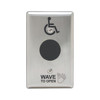
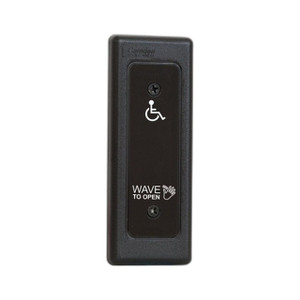
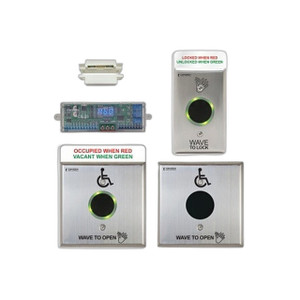
Camden CM-333 Hybrid Battery Powered Touchless Switch
The Camden CM-333 is a battery-powered touchless switch engineered for retrofit applications where AC power installation is impractical or cost-prohibitive. Designed to activate 30VDC electric strikes and magnetic locks via a single Form C relay output, the CM-333 eliminates contact surfaces in high-traffic access points while removing the conduit-run expense and installation complexity of line-powered alternatives. Two alkaline AA batteries deliver an estimated 2-year service life at 100 daily operations—a practical duration for egress doors, stairwell access, and secondary entries where integrators want hands-free control without electrical infrastructure investment. Adjustable sensing range (1–12 inches) and three selectable relay modes (momentary, momentary with alarm, or maintained latching) allow field tuning to match site conditions and access-control workflow.
Key Features
- Hands-Free Activation: IR sensor detects motion within adjustable 1–12 inch range. Eliminates contact-surface hygiene concerns and supports ADA-compliant egress control.
- 30VDC Relay Output: Form C (SPDT) dry contact rated 3 amps @ 30VDC. Drives electric strikes, magnetic locks, and door operators without additional amplification or power conversion.
- Battery Hybrid Design: Two AA alkaline batteries (or optional lithium) power the circuit for ~2 years at typical daily cycles. No AC wiring, no permanent power feed required.
- Three Relay Modes: Momentary (standard push-button behavior), momentary with audible alarm (user feedback), or maintained latching (toggle lock/unlock). Configurable on-site.
- Compact Form Factor: 4 inches wide × 2¾ inches tall × 1⅜ inches projection. Single-gang faceplate standard; narrow enclosure option (CM-34BL/N) fits tight horizontal spaces.
- Integration Ready: Relay contacts accept external dry contact inputs from access-control panels, card readers, intercoms, and request-to-exit (RTE) loops. SPDT configuration supports both fail-safe and non-fail-safe strike configurations.
- Field-Adjustable Sensing: Reduce false triggers in windy entries by tightening detection range at installation. No firmware update or special tools required.
- Stainless Steel Option: Standard black polycarbonate faceplate or corrosion-resistant stainless steel variant for wet/coastal environments.
The CM-333 solves a recurring integration problem: retrofit access control to existing non-powered push-plate installations without running new conduit. Typical deployments include stairwell exits, loading-dock personnel gates, and secondary entries where motion-sensor activation reduces contact-surface liability and improves user experience. At 30VDC, the relay output is inherently safe for low-voltage strike circuits and integrates seamlessly into legacy door-control systems without relay cabinets or external power supplies.
Integration is straightforward because the CM-333 is agnostic about the source of relay activation—whether triggered by its own IR sensor, an external access-control panel, or an intercom system. This flexibility means a single hardware SKU can serve multiple control topologies across a multi-building campus. The dry contact relay is rated for mechanical switching, so paired with a properly sized 30VDC power supply at the strike, operational reliability is consistent across heavy-traffic and low-traffic installations alike.
Battery longevity depends heavily on relay duty cycle. At 100 operations per day with momentary activation (typical door pass-through), two alkaline AAs sustain ~2 years of operation. Higher-cycle deployments (high-traffic lobbies, frequent alarm triggers) may exhaust batteries in 9–12 months; upgrade to lithium AAs in advance if cycling exceeds 300 daily operations or if service intervals are tight. Sensing range adjustment is the most important field commissioning step—loose detection thresholds cause nuisance triggers in weather-exposed entries, while overly tight ranges frustrate users approaching the door.
The CM-333 carries a manufacturer warranty standard across all variants. Installation requires only relay wire termination to the strike or lock; no additional infrastructure, no software licensing, no network dependency. Faceplate options include English and French graphics, and stainless steel finishes meet coastal and food-processing facility corrosion standards. Consult the product datasheet (link below) for detailed relay contact ratings, wiring diagrams, and battery life tables at various duty cycles.
Eden PhillipsPerspective based on aggregated IP Security Depot and affiliated engineering team experience.
We've deployed the CM-333 across dozens of retrofit projects—stairwell exits, back-office doors, and employee parking gates—where running AC power or network cabling to the strike wasn't feasible or cost-effective. The battery-hybrid topology eliminates the infrastructure friction that typically derails retrofit access-control upgrades. Instead of negotiating electrical conduit runs with facility teams, you install a single faceplate and two AA batteries. The 30VDC relay output is the real differentiator here: it drives both electric strikes and magnetic locks without external amplification, and the Form C (SPDT) contact can be wired for fail-safe or non-fail-safe operation depending on your egress-code requirements. On multi-building campuses, that flexibility reduces parts inventory and simplifies maintenance. The adjustable sensing range (1–12 inches) is deceptively important—we've seen high false-trigger rates at weather-exposed entries when installers left the factory default at 12 inches. Tightening range during commissioning cuts nuisance activations to near-zero and preserves battery life.
Technical Highlights:
- Form C Relay @ 30VDC, 3A: Drives standard electric strikes and 12VDC/24VDC/30VDC magnetic locks directly—no intermediate relay cabinet required. SPDT contact allows parallel integration with access-control panel outputs and RTE loops. Mechanical switching reliability is inherent; dry contact means no semiconductor failure modes.
- 2-Year Battery Life at 100 ops/day: Two alkaline AAs are industry-standard; lithium option extends performance in high-cycle installations (300+ ops/day). Battery replacement is a field-swap task—no tools, no downtime beyond the few seconds to swap cells. Plan preventive battery replacement at 18 months on high-traffic doors to avoid surprise lock failures.
- Adjustable IR Sensing (1–12 inches): Out-of-box 12-inch range catches users approaching the door from hallways. Tighten to 2–4 inches if wind-blown debris or HVAC air flows trigger false activations. No field programming required—adjust with the selector knob during commissioning.
- Three Relay Modes: Momentary (standard) activates for 1 second per motion pulse. Momentary with alarm adds audible feedback for accessibility. Maintained latching toggles lock/unlock on each motion event—useful for temporary access or testing. Mode selection is on the faceplate; no hidden jumpers or firmware.
- No AC Power Dependency: Complete autonomy from building electrical infrastructure. Ideal for spaces where conduit installation would require HVAC rework, asbestos surveys, or extended construction windows. Reduces total project timeline by weeks on retrofit jobs.
Deployment Considerations:
- Battery life is duty-cycle sensitive. We've observed 18–24 month spans on light-traffic stairwells (50–80 ops/day) and 9–12 month spans on high-throughput lobbies (300+ ops/day). Use the battery-life table in the datasheet to model your specific site and plan preventive replacement accordingly.
- Sensing range must be commissioned during installation. Test the 12-inch default by waving your hand at the faceplate from various distances; if false triggers occur, dial back to 4–6 inches. Wind and debris at exterior doors often require tighter thresholds than interior spaces.
- Relay contact load is 3 amps maximum @ 30VDC. Verify your strike or lock nameplate current draw; oversized solenoids may require an intermediate 24VDC/30VDC relay or a higher-capacity external relay. Don't exceed the relay rating—contact burnout shortens product life.
- Fail-safe vs. non-fail-safe configuration depends on your wiring and strike type. SPDT contact provides both N.O. and N.C. paths—wire appropriately for your egress-code jurisdiction and strike logic. Consult the wiring diagram in the datasheet for your specific strike model.
- Stainless steel faceplate is essential for coastal, food-processing, or high-humidity environments. Standard polycarbonate corrodes in salt spray within 1–2 years; stainless variants (CM-34SS) cost marginally more and eliminate corrosion callbacks.
The CM-333 is the right fit for retrofit projects where AC power runs aren't available, egress code requires fail-safe logic, and 2-year battery service intervals are acceptable. Budget integrators love this product because there's no learning curve—install, commission range, and walk away. Facility teams appreciate battery autonomy; electrical departments appreciate the elimination of conduit negotiation. If your project involves stairwell exits, loading-dock gates, or temporary access on multi-tenant buildings, the CM-333 should be your baseline retrofit switch. Visit the Camden catalog for additional door-control hardware and integration options.