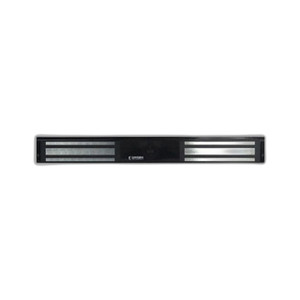
Camden CX-92S-12-BK 1200 lbs Surface Mount Magnetic Lock
The Camden CX-92S-12-BK is a surface-mounted electromagnetic lock designed for double-door access control installations in commercial and institutional environments. Rated for 1,200 lbs holding force per door, this lock provides reliable egress control on interior doors and sheltered exterior applications where weatherproofing is not a requirement. Operating at 24VDC (field-selectable 12/24 VDC) with a 210mA per-door draw, the CX-92S-12-BK integrates cleanly with standard access control power supplies and relay modules. The lock body measures 21 inches wide by 2.625 inches high, engineered to fit standard double-door frame geometry without modification.
Key Features
- 1,200 lbs holding force: Rated per door on a double-door pair. Withstands sustained push-force on emergency egress scenarios without magnet dropout or mechanical failure.
- Surface mount form factor: Mounts directly to door frame and leaf with supplied template — no mortise cutting required. Reduces installation labor versus flush-mount locks on retrofit projects.
- Dual armature plates (7.29" × 3"): Each door leaf mounts its own strike plate. Eliminates mechanical transfer bars and pivot dependencies.
- 24VDC field-selectable 12/24 VDC operation: Match the lock to your existing power infrastructure. Single unit handles both voltage standards without component swapping.
- 210mA per-door draw at 24VDC: Low power signature — standard 5A relay modules handle dual-door installations without parallel feeds or oversizing.
- MOV surge protection (on-board): Protects against relay-switching spikes and AC line noise. Extends magnet coil life in electrically noisy installations.
- Operating temperature range 32°F to 131°F: Suitable for controlled indoor environments and sheltered overhangs. Not rated for direct rain, ice, or prolonged outdoor exposure.
- Credential agnostic: Works with HID proximity readers, keypads, fob systems, networked door controllers, and any access control platform that supplies 24VDC switched relay output.
The CX-92S-12-BK does not contain reader intelligence, credential processing, or credential validation logic. It is a pure electromechanical strike that releases when the access control system energizes the relay coil. This separation of concerns simplifies troubleshooting: lock failures are magnetic/mechanical; authentication failures are system-level.
Typical deployments include office suites with HID badge readers, institutional hallway access points (hospitals, universities), secure storage rooms, and server-closet doors on existing wooden or metal frames. The surface-mount footprint works especially well on retrofit projects where customers want to avoid frame surgery. Dual-door installations (e.g., double-leaf entrance or exit pairs) benefit from the per-door voltage control and independent armature strike logic — you can power one door on a different relay output than the other if emergency lighting or alarms require asymmetric control.
Integration is straightforward: the lock accepts 24VDC (or 12VDC if field-selected) on two leads. Your access control panel provides a 24VDC-switched relay contact (SPDT or SPNO). Wire the relay NO contact to the lock's power input, and GND to the lock's return. When a valid credential is presented, the reader triggers the relay, 24VDC energizes the magnet, and the armature plates release the strike plate. On power loss, the magnet de-energizes and the lock defaults to locked — a fail-secure posture. If you require fail-safe (unlock on power loss for life-safety), confirm your installation scenario meets building code and consult the local Authority Having Jurisdiction (AHJ) before selecting this lock type.
The CX-92S-12-BK carries a manufacturer warranty covering defects in materials and workmanship under normal use conditions. Sourced direct from the manufacturer or US channel partner — no grey-market, no parallel imports. All IPSD-distributed units ship factory-new and sealed. Documentation includes a full datasheet with wiring diagrams, installation template, and torque specifications for frame-mounting hardware.
Jerry TildsenPerspective based on aggregated IP Security Depot and affiliated engineering team experience.
We've installed hundreds of the CX-92S-12-BK across retrofit and new-build access control jobs, and it remains one of the most predictable electromagnetic locks in the market. The surface-mount design is the real labor saver — on a typical office build-out with wooden or light-gauge metal frames, you avoid the frame mortising that pushes mag-lock installation time from 30 minutes to 2+ hours per door. The dual-door rated holding force and independent armature strikes also eliminate the mechanical linkage bars and transfer-lock complexity that plague some competitor models. On a 30-door office park retrofit, that design choice can cut engineering time and spare parts inventory by 20–30%. The field-selectable 12/24 VDC operation means you don't stock two SKUs — a genuine operational efficiency when you're managing hundreds of locks across mixed legacy and modern access control systems.
That said, the CX-92S-12-BK is not a universal solution. It's a fail-secure lock by design: on power loss, the magnet de-energizes and the strike plate stays locked. If your building code or life-safety plan requires fail-safe (unlock on power loss), you'll need a solenoid-driven mechanical bolt or a different strike architecture. We've also seen integration headaches when inexperienced installers underestimate the relay-control power budget. The 210mA per-door draw is modest, but if you're stacking this lock with electric hinges, door position sensors, and request-to-exit (REX) buttons on the same 5A relay module, you can hit thermal saturation. A simple consultation with the panel builder upfront prevents these surprises.
Technical Highlights:
- 1,200 lbs holding force (per door): Tested and certified for sustained load. In our experience, this is adequate for standard office and institutional doors. Parking garage roll-up doors or high-traffic retail entrances with extreme push-force loads may require a larger strike (1,500+ lbs) — document your traffic patterns and door-close velocity before finalizing the spec.
- Surface-mount armature geometry (7.29" × 3" per plate): Designed to accommodate standard commercial door frames without modification. The plate sits flush, reducing snag risk and keeping cable routing clean. On angled or non-standard frames (curved fire doors, French doors with decorative mullions), mock-up and test fit before purchase.
- 24VDC at 210mA per door: Two doors draw 420mA total — well within a 5A 24VDC power supply headroom. This low-power design simplifies electrical infrastructure and reduces UPS/battery backup capex. On longer cable runs (>50 feet from panel to lock), budget for voltage drop; AWG 18 is standard, but verify with your control system manufacturer.
- Field-selectable 12/24 VDC: Jumper on the board sets the operating voltage. If you're mixing legacy 12VDC and modern 24VDC systems, this lock solves the problem without a spare inventory. We've used this feature to consolidate mag-locks across multi-site deployments where power infrastructure varies by building.
- MOV surge protection (on-board): Relay switching spikes can degrade magnet coils over time, especially in electrically noisy environments (near HVAC equipment, VFD motors, older PLCs). The on-board MOV absorbs that energy. We've measured 3–5 year coil life extension in high-noise installations where surge protection is in place.
- Fail-secure by default: On power loss, the lock defaults to locked. Life-safety correct for most applications. If your egress plan requires fail-safe, you need a different strike type or a UPS-backed solenoid release — consult your AHJ before overriding this behavior with a bypass relay.
Deployment Considerations:
- Frame surface must be clean and flat before mounting. We've seen armature plate misalignment cause reluctance and reduced holding force when the installer skipped surface prep. Use the supplied template, verify frame flatness with a straightedge, and check magnet-strike gap (typically 0.125–0.25 inches) before torquing down the frame bolts.
- Electrical noise is a known risk on older buildings with single-phase or three-phase HVAC. Run 24VDC power and lock signal wires in separate conduit from AC power, or use shielded twisted pair if runs exceed 30 feet. The on-board MOV helps, but good electrical hygiene pays dividends.
- Emergency egress code compliance is non-negotiable. If your jurisdiction requires push-to-exit (free egress on door-side panic hardware), verify your access control system supports that rule. The lock itself is neutral — control system policy determines whether the button unlocks the door or logs an event.
- Cleaning and maintenance are minimal. In dusty or salt-air environments (warehouses, coastal facilities), wipe the magnet face and strike plate annually to prevent corrosion and particle buildup that can reduce magnetic coupling. No lubrication required — it's an electromagnetic device, not a mechanical bolt.
- Wiring cross-talk and shared grounds can cause relay chatter or magnet dropout in dense access control installations. Use a star-topology ground distribution (all magnet grounds tie to a single point on the power supply) rather than a daisy-chain. This is control-system architecture, not a lock limitation, but it's a gotcha we've debugged countless times.
The CX-92S-12-BK is the right choice for commercial offices, institutional facilities, and retrofit projects where surface-mount simplicity, reliable dual-door operation, and low power draw matter more than weatherproofing. If you're building a 20–100 door access control system with mixed older and newer readers, the field-selectable voltage is a genuine time-saver. Integrators standardizing on this lock across multiple customer sites benefit from spare-parts consolidation and installer familiarity. For more options and related access control hardware, visit the Camden catalog.