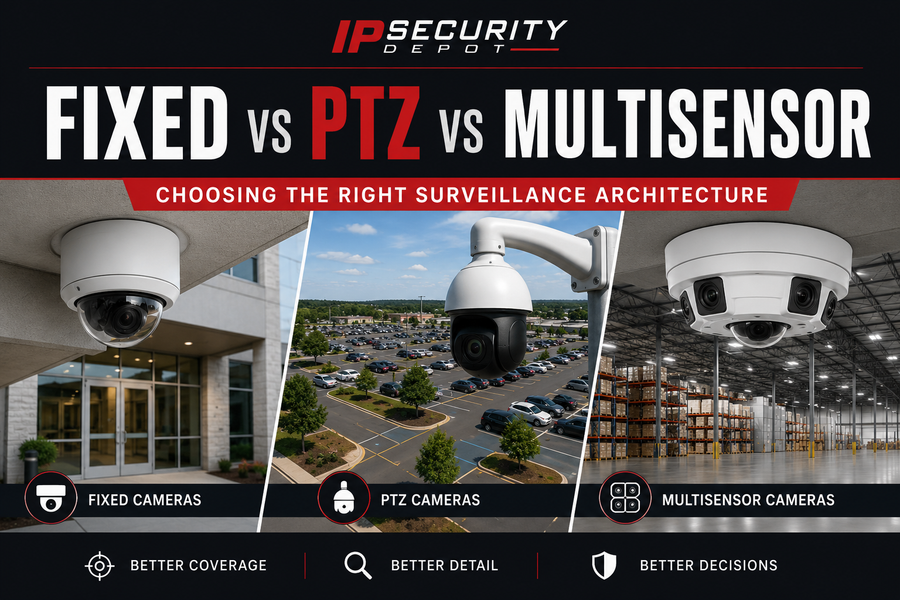
Choosing between a fixed camera, PTZ camera, or multisensor camera is one of the most important decisions in surveillance design. Each camera architecture solves a different problem. Understanding the tradeoffs between coverage, detail, and operational awareness can help prevent blind spots, reduce unnecessary costs, and improve the quality of the evidence your system captures.
This guide explains where each camera type fits, where each one falls short, and why the strongest surveillance systems typically combine multiple camera architectures rather than relying on a single solution.
Quick answer: Use fixed cameras for predictable evidence points, PTZ cameras for active long-distance investigation, and multisensor cameras for continuous wide-area coverage. The strongest surveillance systems often use all three.
Coverage vs Detail: The Tradeoff That Drives Camera Selection
Every surveillance camera design balances two competing goals: how much area the camera covers and how much usable detail it captures.
- More coverage generally means fewer pixels on target.
- More detail generally means a narrower field of view.
A wider field of view covers more ground, but it spreads pixels across a larger scene. As the scene gets wider, the amount of detail available on a target decreases.
This is why a camera may detect movement hundreds of feet away while still being unable to identify a person. Understanding this tradeoff is one of the most important concepts in surveillance design.
What Is DORI?
DORI (Detection, Observation, Recognition, Identification) is a framework defined in IEC 62676-4 that helps determine whether a camera can deliver usable footage at a specific distance.
| DORI Level | Pixel Density | Typical Outcome |
|---|---|---|
| Detection | 25 px/m | Detect that something is present |
| Observation | 62.5 px/m | Observe activity |
| Recognition | 125 px/m | Recognize a known subject |
| Identification | 250 px/m | Identify an unknown subject under suitable conditions |
Design takeaway: Wide coverage does not automatically mean useful detail. Pixel density determines whether footage supports detection, recognition, or identification.
Fixed Cameras
A fixed camera continuously records a single field of view. It does not move, pan, tilt, or optically zoom after installation.
This simplicity is its greatest strength. The camera records the entire scene continuously, whether anyone is actively watching or not.
Best Applications for Fixed Cameras
- Building entrances
- Loading docks
- Vestibules
- Receiving doors
- Access-controlled openings
- Checkout lanes
- Warehouse choke points
Advantages
- Continuous evidence capture
- No moving parts
- Lower acquisition cost
- Consistent coverage
- Simple maintenance requirements
Limitations
- Cannot investigate distant activity
- No optical zoom after installation
- May require multiple cameras to cover large spaces
PTZ Cameras
PTZ stands for Pan, Tilt, and Zoom. PTZ cameras are designed to move and use optical zoom to investigate activity at distance.
Unlike fixed cameras, PTZs can concentrate pixels on a target rather than spreading them across an entire scene.
Best Applications for PTZ Cameras
- Parking lots
- Perimeters
- Industrial yards
- Campuses
- Ports and transportation facilities
- Large outdoor spaces
Advantages
- Optical zoom for long-distance detail
- Wide-area situational awareness
- Ability to investigate events
- Effective for active monitoring environments
Limitations
A PTZ only records the area currently within its field of view. If the camera is investigating one location, activity elsewhere may not be visible or recorded.
This is why experienced surveillance designers rarely use PTZ cameras as the sole source of evidence at critical entrances or chokepoints.
Common mistake: Using a PTZ as the only camera protecting a critical entrance. If the camera is pointed elsewhere when the event occurs, the evidence may never be captured.
Multisensor Cameras
Multisensor cameras combine multiple fixed imagers within a single housing. Depending on the model, they can provide 180-degree, 270-degree, or 360-degree coverage without moving parts.
For many wide-area applications, multisensor cameras provide a compelling middle ground between fixed cameras and PTZs.
Best Applications for Multisensor Cameras
- Warehouses
- Distribution centers
- Parking lots
- Manufacturing facilities
- Campus environments
- Large open interior spaces
Advantages
- Wide-area coverage
- Continuous recording
- No PTZ blind spots
- No moving mechanical assemblies
- Reduced infrastructure compared to multiple separate cameras
Limitations
- Higher cost than many fixed cameras
- Less optical zoom than PTZ cameras
- Requires thoughtful design to maximize pixel density
Fixed vs PTZ vs Multisensor Comparison
| Feature | Fixed | PTZ | Multisensor |
|---|---|---|---|
| Records entire view continuously | Yes | No | Yes |
| Long-distance detail | Limited | Excellent | Moderate |
| Wide-area coverage | Moderate | Strong | Strong |
| Moving parts | No | Yes | No |
The Best Designs Use More Than One Camera Type
The strongest surveillance systems rarely rely on a single camera architecture.
Instead, they layer fixed cameras for evidence, PTZ cameras for investigation, and multisensor cameras for continuous wide-area coverage.
The objective is not to buy the most advanced camera. The objective is to match the camera to the operational requirement.
Next step: Compare camera architectures, evaluate DORI requirements, and build a surveillance design that matches your environment rather than forcing a single camera to solve every problem.