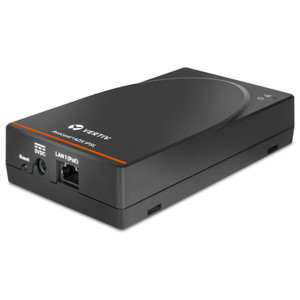
Vertiv ADX-IPSL104-400 4-Port IP Serial Console Server
Overview
The Vertiv ADX-IPSL104-400 is a compact 4-port IP serial console server designed to give network and infrastructure teams remote out-of-band access to serial-managed devices — routers, switches, PDUs, firewalls, and similar equipment — without requiring a technician on-site. If your data center or remote equipment room relies on serial console access for configuration and recovery tasks, the ADX-IPSL104-400 slots into that workflow as a dedicated, network-reachable serial gateway. It connects to your LAN via a single RJ-45 Ethernet port, making it straightforward to provision into existing IP infrastructure. The unit ships in black and is Plug and Play — no driver installation ceremony before first use.
This device sits within the broader Vertiv Avocent ADX product line, which targets structured out-of-band management for enterprise and edge compute environments. If you're evaluating IP serial console servers at this port count, the ADX-IPSL104-400 is worth comparing directly against higher-port-density options in the same family before committing to a deployment architecture.
Key Features
- 4 Serial Console Ports: Manages four independently addressable serial-attached devices over IP — enough for a small equipment cluster, a top-of-rack switch stack, or a remote branch office gear closet where serial management is the fallback when the primary network path fails.
- Single RJ-45 Ethernet LAN Port: The unit joins your management VLAN through one standard Ethernet connection, keeping the footprint minimal and the cabling straightforward. No secondary NIC to configure, no bonding complexity at this tier.
- USB Type-A Console Ports: Console connections are USB Type-A, which matters if you're managing devices that expose their serial interface over USB rather than legacy RS-232 DB9. This sidesteps the need for separate USB-to-serial adapters on those endpoints.
- 2x USB 2.0 Type-A Hub Ports: Two integrated USB 2.0 hub ports extend local USB connectivity without a separate hub. Useful for attaching authentication tokens, local storage, or peripheral devices that need to ride along with the management session.
- Plug and Play — No Driver Configuration: Out of the box, the ADX-IPSL104-400 is recognized by the host system without manual driver installation. This matters during recovery scenarios when you need immediate access and don't have time to troubleshoot driver stacks.
- PoE LED Indicator: A dedicated PoE status LED gives you an at-a-glance power confirmation without opening a management interface — useful during rack installation to confirm the unit is receiving power before you proceed with port configuration.
- DC-In Jack Available: Beyond PoE, a DC-in jack provides a secondary or alternative power path. Environments that can't deliver PoE from their switch infrastructure can power the unit directly — no forced dependency on PoE-capable switching.
- Compact Physical Form Factor: At a package footprint of 145 mm deep × 84 mm wide × 35.5 mm tall and a packaged weight of 181 g, this unit is genuinely small. It can shelf-mount, DIN-rail mount (verify bracket compatibility), or tuck into a 1U shelf without consuming meaningful rack space.
Integration and Compatibility
The ADX-IPSL104-400 (often searched as ADX IPSL104 400) is part of Vertiv's Avocent ADX ecosystem, which is engineered for integration with Vertiv's centralized management software. For multi-site deployments managing more than four serial endpoints, the ADX platform scales by adding additional units managed through a common interface rather than requiring a forklift upgrade to a higher-density chassis. Consult the out-of-band management category for complementary devices, including higher-port-count serial servers and KVM-over-IP switches that may share the same management plane in larger environments.
The single RJ-45 port means this unit connects to one network segment. If your management network and production network are physically separated — a recommended architecture for serial console infrastructure — plan accordingly: the ADX-IPSL104-400 lives on the management VLAN and does not bridge across segments natively. Review your KVM and console switching infrastructure requirements before selecting this unit if your environment needs combined KVM and serial access from a single device.
Frequently Asked Questions
Q: How many serial devices can the ADX-IPSL104-400 manage simultaneously?
A: The ADX-IPSL104-400 supports four serial console ports, so it can connect to and manage up to four serial-attached devices concurrently over IP.
Q: Does the ADX-IPSL104-400 require PoE, or can it run on a direct DC power supply?
A: It supports both. The unit includes a DC-in jack for direct power, so it does not require a PoE-capable switch. The PoE LED indicator confirms power status when PoE is in use.
Q: What type of USB ports does the ADX-IPSL104-400 use for console connections?
A: Console ports are USB Type-A. The unit also includes two USB 2.0 Type-A hub ports for attaching peripheral devices.
Q: Is the ADX-IPSL104-400 Plug and Play?
A: Yes. The ADX-IPSL104-400 is rated Plug and Play, meaning it can be recognized by the host system without manual driver installation — an important factor in recovery and rapid-deployment scenarios.
Q: What is the physical size of the ADX-IPSL104-400?
A: Packaged dimensions are 145 mm deep × 84 mm wide × 35.5 mm tall with a packaged weight of 181 g. It is a compact unit suitable for shelf, bracket, or small-space rack deployment.
Q: Does the ADX-IPSL104-400 have a built-in display?
A: No. The ADX-IPSL104-400 does not include a built-in display. Management is performed remotely via IP, which is the standard operational model for IP serial console servers.
The ADX-IPSL104-400 is a purpose-built 4-port IP serial console server from Vertiv's Avocent ADX line, and the spec I keep coming back to in field deployments is the dual power path: a DC-in jack alongside PoE support. In branch office and edge rack scenarios where you may not control whether the upstream switch delivers PoE reliably, that DC fallback is not a nice-to-have — it's the difference between having an accessible serial console during a network recovery event and not having one.
Technical Highlights:
- 4 Serial Console Ports: Covers a standard small-site equipment footprint — a router, a managed switch, a firewall, and a PDU — in one unit without over-provisioning.
- USB Type-A Console Interface: Eliminates the USB-to-RS232 adapter layer for devices that already expose serial over USB, reducing one point of failure in the out-of-band chain.
- 2x USB 2.0 Hub Ports: Local USB expansion built in — attach an authentication token or local storage without a separate hub occupying additional shelf space.
Deployment Considerations:
- The unit uses a single RJ-45 LAN port. In segmented management architectures, plan VLAN assignments before deployment — this device does not bridge network segments natively.
- No built-in display means all status monitoring beyond the PoE LED is IP-dependent. Confirm your out-of-band management path is functional before the primary network fails, not after.
This unit fits well in a structured edge or branch deployment where you need serial console access to four devices, power flexibility matters, and rack space is constrained — a small retail back-office equipment room or a distributed enterprise WAN node are the scenarios where the ADX-IPSL104-400's combination of compact size and dual-power support earns its place.