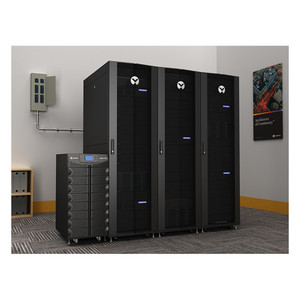
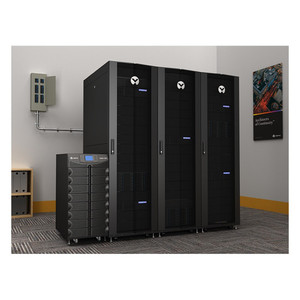
Vertiv AS4A0NCUGNNXLKB Lithium-Ion UPS 5KVA Scalable to 20KVA N+1
Overview
The Vertiv AS4A0NCUGNNXLKB is a lithium-ion UPS platform that starts at 5KVA and scales to 20KVA in an N+1 redundant configuration — a meaningful architectural choice for data centers, edge deployments, and security infrastructure rooms where both growth headroom and uptime are non-negotiable. Unlike traditional VRLA-based systems, the AS4A0NCUGNNXLKB is built on LiFePO₄ chemistry, delivering a service life of up to 10 years and a substantially lower total cost of ownership over that span. If you're sizing power protection for a rack environment that will expand over time, this scalable architecture means you're not ripping and replacing the UPS every three to four years as load increases.
Browse the full Vertiv power protection catalog for companion infrastructure components that pair with this platform, or explore the broader UPS and power protection category if you're still comparing form factors and architectures.
Key Features
- LiFePO₄ Lithium-Ion Chemistry: Thermal runaway is the principal safety concern with lithium battery systems. LiFePO₄ chemistry is the most thermally stable lithium variant — it doesn't enter thermal runaway under the same conditions that affect NMC or NCA cells. For a system installed in a security operations room or a wiring closet with limited airflow, that stability matters more than raw energy density.
- Up to 10-Year Battery Service Life: VRLA batteries in comparable UPS deployments typically require replacement every 3–5 years. A 10-year service life on the AS4A0NCUGNNXLKB cuts replacement labor, disposal costs, and unplanned downtime windows roughly in half over a decade — that's the core argument for lithium in total cost of ownership calculations on long-lived infrastructure.
- Scalable from 5KVA to 20KVA, N+1: Starting at 5KVA with a path to 20KVA N+1 means you can right-size the initial purchase against current load and add capacity as the environment grows. N+1 redundancy provides one full backup module — if the active unit fails or goes into maintenance, power transfer happens without a break in output. Critical for any environment running 24/7 surveillance recording, access control systems, or network switching.
- Recharge Time Under 4.5 Hours: After a full discharge event — say, an extended grid outage — the system returns to full capacity in under 4.5 hours. Compared to VRLA systems that can take 8–12 hours to reach 90% capacity, a faster recharge window reduces the time the installation is running at reduced protection. For sites that experience repeated short outages, this matters.
- Advanced BMS with Cell-Level Monitoring: The onboard Battery Management System monitors at the individual cell level, not just the string level. Cell-level visibility catches imbalances and early degradation before they cascade into a string failure. This translates to more accurate state-of-health reporting, better runtime estimates, and fewer surprise failures during an actual outage.
- ~46 lbs Per Battery String: At roughly 46 pounds per battery string, the lithium configuration is substantially lighter than equivalent VRLA capacity. For installations in raised-floor data rooms with weight limits per tile, or in wall-mounted equipment rooms where floor loading is a constraint, weight matters at installation and during any future battery service.
- Better Performance at Higher Temperatures: VRLA batteries derate significantly above 25°C — every 10°C increase above that threshold roughly halves the expected battery life. LiFePO₄ chemistry tolerates higher ambient temperatures with less capacity penalty. For edge deployments in unconditioned spaces, telecom cabinets, or outdoor enclosures with limited cooling, this is a real operational advantage.
- Minimal Maintenance Requirements: No watering, no regular equalization charges, no semi-annual capacity tests that take the system offline. The BMS handles routine cell balancing automatically. For distributed deployments across multiple sites where on-site technician visits are expensive, reduced maintenance cadence lowers operational overhead meaningfully.
- 5-Year Manufacturer Warranty (UPS + Batteries): The 5-year warranty covers both the UPS electronics and the battery strings — an important distinction, since many UPS warranties cover the electronics at a longer term but limit battery coverage to 1–2 years. A unified 5-year warranty on both components simplifies support contracts and reduces the administrative overhead of tracking separate coverage windows.
Integration and Compatibility
The scalable N+1 architecture is designed for rack-integrated environments where network switching, NVRs, access control panels, and security servers share the same power infrastructure. When sizing this system for a multi-camera recording environment, factor the combined load of your NVRs, PoE switches, and any edge analytics appliances — the 5KVA starting point covers most small-to-mid-scale security infrastructure rooms, and the 20KVA ceiling accommodates significant expansion. For guidance on how to architect power protection into a broader surveillance network design, see the security system planning guide. The lightweight battery strings (~46 lbs each) also simplify integration into existing rack environments where floor loading or rack weight ratings are a constraint.
Frequently Asked Questions
Q: What is the battery service life on the AS4A0NCUGNNXLKB?
A: Vertiv rates the LiFePO₄ battery strings in the AS4A0NCUGNNXLKB at up to 10 years of service life — roughly twice what you'd expect from comparable VRLA-based UPS systems. This is one of the primary total cost of ownership arguments for this platform.
Q: What is the warranty on the AS4A0NCUGNNXLKB?
A: The AS4A0NCUGNNXLKB carries a 5-year manufacturer warranty covering both the UPS electronics and the battery strings. Coverage on the batteries under the same term as the electronics is notable — many competitive products limit battery warranty to 1–2 years separately.
Q: How long does the AS4A0NCUGNNXLKB take to recharge after a full discharge?
A: Recharge time is under 4.5 hours to full capacity. This is significantly faster than most VRLA UPS systems, which typically require 8–12 hours to return to 90% capacity after a deep discharge event.
Q: Is LiFePO₄ chemistry safe for use in enclosed equipment rooms?
A: LiFePO₄ (lithium iron phosphate) is the most thermally stable of the commercial lithium battery chemistries. It does not exhibit the same thermal runaway characteristics as NMC or NCA cells, making it a practical choice for enclosed server rooms, wiring closets, and edge deployments with limited ventilation.
Q: How heavy is each battery string in the AS4A0NCUGNNXLKB?
A: Each battery string weighs approximately 46 pounds — substantially lighter than equivalent VRLA capacity. This affects both initial rack integration and any future battery service or replacement work.
Q: Can the AS4A0NCUGNNXLKB scale up over time as power requirements grow?
A: Yes. The platform starts at 5KVA and scales to 20KVA in an N+1 redundant configuration. You can size the initial deployment to current load and add capacity incrementally, avoiding the need to replace the entire system when power requirements increase.
The spec I keep coming back to on the AS4A0NCUGNNXLKB is the 10-year battery service life. In most commercial security and data infrastructure deployments I've worked through, the UPS battery replacement cycle is the single most disruptive scheduled maintenance event — it requires load transfer, bypass mode, and in many cases a site visit. Cutting that cycle from every 3–4 years to once per decade changes the operational math significantly for any multi-site deployment.
Technical Highlights:
- LiFePO₄ Thermal Stability: Unlike NMC lithium cells, LiFePO₄ doesn't cascade into thermal runaway under overcharge or high-temp conditions — directly relevant for installations in telecom cabinets, edge enclosures, or any room where ambient cooling is inconsistent.
- Cell-Level BMS Monitoring: Most lower-tier UPS systems report at the string level, which means a single weak cell can mask itself until it causes a string failure during an actual outage. Cell-level monitoring on this platform catches imbalance early and gives accurate state-of-health data to your monitoring stack.
- Sub-4.5-Hour Recharge: For sites in areas with frequent short outages — utility instability, grid switching events — faster recharge means the system is back at full protection faster. A VRLA system at 8–12 hours to 90% is genuinely exposed during that window if another event occurs.
Deployment Considerations:
- At ~46 lbs per battery string, rack weight budgeting is easier than with VRLA equivalents, but confirm your rack's rated capacity before stacking multiple strings in a fully scaled 20KVA N+1 configuration — aggregate weight adds up across a full build-out.
- The 'better performance at higher temperatures' spec is an advantage, but it's not a license to ignore thermal management. The BMS will protect cells from extreme heat, but runtime will still derate at sustained high ambient temperatures — check Vertiv's derating curves for your specific environment before finalizing runtime calculations.
This platform is the right call for security operations centers, large-scale NVR deployments, or any distributed infrastructure program where lifecycle cost over 10 years is being modeled against capital budget — the unified 5-year warranty and reduced battery replacement cadence make the TCO argument concrete, not theoretical.